Saint Homobonus of Cremona
Died November 13, 1197
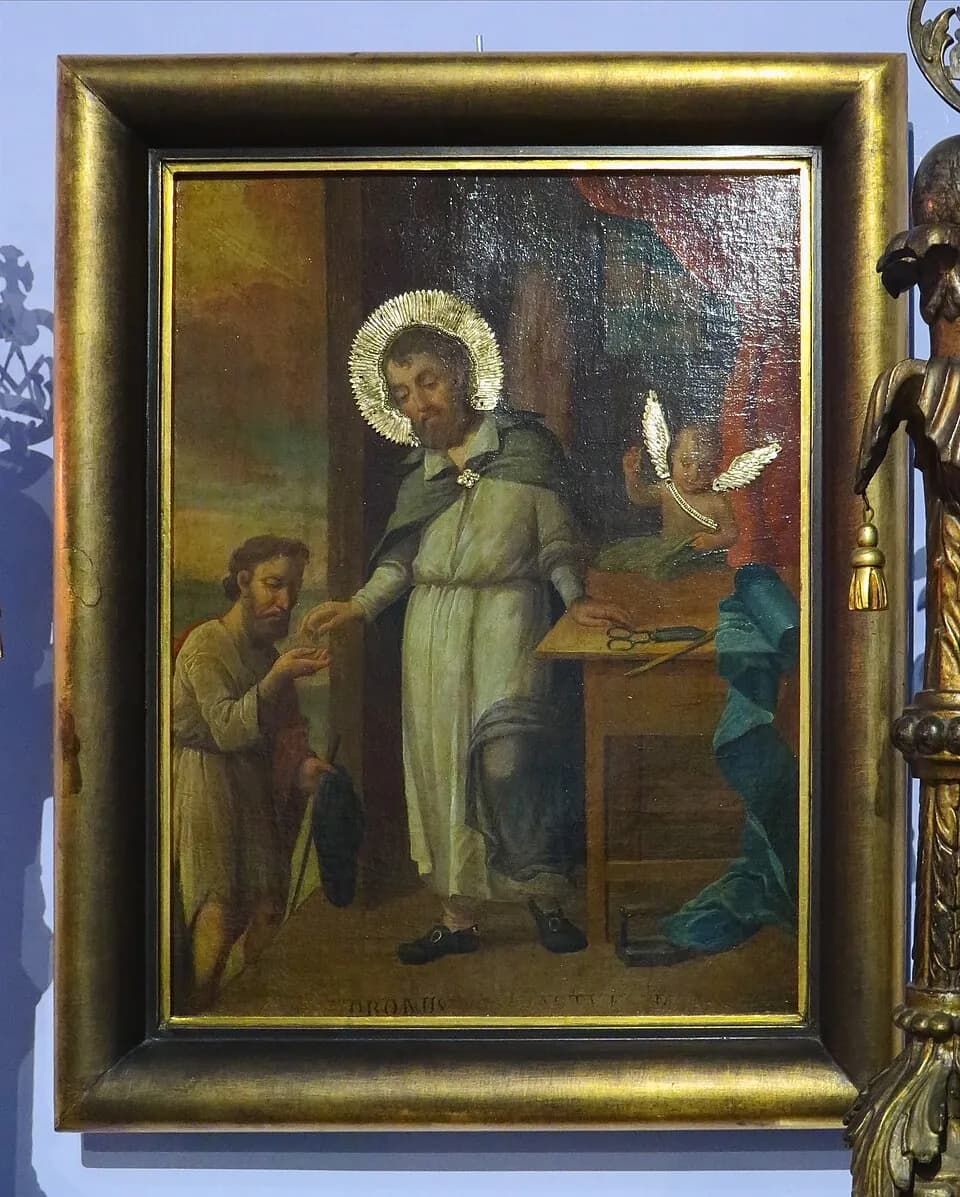
- Patron saint of
- Businesspeople, tailors and shoemakers, per Denver Catholic 4; businesspeople, tailors and clothworkers, and shoemakers, per the National Catholic Register 5; the city of Cremona 15
Saint Homobonus was a cloth merchant of Cremona, in northern Italy, who died at Mass in his parish church on November 13, 1197, and was declared a saint by Pope Innocent III fourteen months later. 135 John Paul II called him "the first and only layman of the faithful, not to belong either to the nobility or to a royal or princely family, to be canonized during the Middle Ages." 1 His name means "good man," the poor of his city called him their father, and he is the patron saint of Cremona and of businesspeople and tailors, with a feast on November 13. 1245
A merchant, or a tailor
His family name was Tucenghi. 15 Vatican News says his father was a tailor who, at the baptism, gave the boy a name meaning "good man," and that Homobonus took up the same trade and worked at it carefully and honestly. 2 The National Catholic Register also makes him a tailor, and says he inherited a large estate from a father who was both a tailor and a merchant. 5
John Paul II, writing to the Bishop of Cremona in 1997, describes him differently: "a cloth merchant in Cremona," and "a businessman engaged in the cloth trade and, while involved in the market dynamics of Italian and European cities, conferred spiritual dignity on his work." 1 Denver Catholic reports that the cathedral where he is buried calls him a fabric merchant. 4 The two descriptions are not far apart in a town where cloth was cut and sold by the same families, but the sources do not settle it, and this page gives both.
Vatican News adds that he understood work as a continuation of God's own work described in Genesis, and so as a way of supporting his family and helping the poor. 2 Nothing in the sources gives the year he was born.
Father of the poor
"Testimonies of the time unanimously define Homobonus 'pater pauperum', father of the poor," John Paul II writes. 1 The letter dates the change in him to "his radical conversion to the Gospel," though it gives no year or occasion for it. 1 From then on, he "made his home a place of welcome. He personally attended to the burial of the abandoned dead. He opened his heart and his purse to every category of needy person." 1 The Register says he paid for the funerals of people who had been abandoned or had no money to be buried. 5
Vatican News describes him visiting the poor himself, taking an interest in abandoned boys and seeing to their schooling, and going into households where quarrels were common to try to bring them to reason and peace. 2 John Paul II puts the same work on a larger scale: "He did his utmost to settle the controversies which broke out between factions and families in the city." 1 Denver Catholic, again citing the cathedral, calls him a reconciler in the troubles of the city's communal life. 4
He went to Mass every day and prayed before the crucifix. 125 John Paul II adds that he defended "the integrity of the Catholic faith faced with heretical infiltrations," and that in the parish he was "dedicated to catechesis, profoundly linked to the ministry of the priest." 1
Opposition at home, in church and at work
The pope's letter does not make his life sound easy. He "had to face and overcome obstacles from his family circle, because his wife did not share his choices, from the parish, which looked with suspicion at his austerity, and from his work environment, because of the competition and bad faith of some who tried to cheat the honest merchant." 1 The same letter still calls him "an exemplary spouse and father." 1
The Register tells the domestic side differently. In its account Homobonus and his wife lived simply together, choosing modest housing and clothes, so that most of their income could go to people in poverty. 5 The two sources do not agree about his wife, and neither names her. Both readings are given here.
His death at Mass
He died on November 13, 1197, at Mass in the church of Saint Giles, his parish in Cremona. 12 The sources describe the moment three ways. John Paul II says he died "contemplating the Crucifix, while attending Mass ... as was his daily custom." 1 Vatican News says he died during the singing of the Gloria; the people around him thought he was absorbed in prayer, and realized he was dead only when he did not stand for the Gospel. 2 The Register says he was lying prostrate with his arms stretched out in the form of a cross. 5
A layman canonized
Bishop Sicardo of Cremona, whom the 1908 Catholic Encyclopedia remembers as the author of a chronicle, took the cause to Rome. 26 John Paul II says he came as a pilgrim with the parish priest, Osberto, and a group of citizens, and that Innocent III acted "after having evaluated the numerous testimonies, some written, of the miracles attributed to the intercession of Homobonus." 1 The canonization is dated January 12, 1199, in both the pope's letter and the 1910 Catholic Encyclopedia, which lists Homobonus first among the saints Innocent canonized. 13 John Paul II calls that "little more than a year" after the death; the Register says fourteen months; Vatican News says just two years later. 125
In the bull of canonization, Quia pietas, Innocent described him, in John Paul II's English, as "Father of the poor", "consoler of the afflicted", "assiduous in constant prayer", "man of peace and peacemaker" and "a man good in name and deed." 1 Vatican News calls the canonization a rarity, since he was a married layman in trade with no royal descent. 2 John Paul II, citing the historian André Vauchez, goes further: Homobonus is "the first and only layman of the faithful, not to belong either to the nobility or to a royal or princely family, to be canonized during the Middle Ages." 1
The same letter warns against making too much of it: "We cannot attribute the character of a 'promotion of the lay status', in the modern sense of this concept, to the canonization of Homobonus, which matured in the context and procedures of the Middle Ages." 1 What John Paul II draws from it instead is a call to holiness "that is not reserved for some, but proposed to everyone without distinction." 1
Cremona and the "heavenly merchant"
In 1592 the cathedral of Cremona was dedicated to him together with Saint Mary of the Assumption, and in 1643 the city council chose him as patron of the city, amid, in the words the letter quotes, "the immense joy" and the "tears of devotion" of the people. 1 "A layman saint," the pope writes, "elected as patron of the laity themselves." 1 His body lies in the cathedral crypt. 45
John Paul II notes that devotion to him spread to many Italian dioceses and beyond Italy, that people still come to his remains, especially on his feast, and that they call him the "heavenly merchant." 1 For the eighth centenary, the Diocese of Cremona kept a "Year of St Homobonus" from November 13, 1997, to January 12, 1999, the anniversaries of his death and of his canonization. 1
What is Saint Homobonus the patron saint of?
Saint Homobonus is the patron saint of Cremona, chosen by its city council in 1643. 1 Denver Catholic calls him the patron saint of businesspeople, tailors and shoemakers. 4 The National Catholic Register gives businesspeople, tailors and clothworkers, and shoemakers, and also names Cremona. 5 John Paul II's letter does not use the word patron for any trade, though it records that Cremona's people call him the "heavenly merchant." 1
Saint Homobonus's feast day
Praying with Saint Homobonus
His holiness was recognized in the place where he earned his living. The sources show a man who sold cloth, or cut it, in a city where, as John Paul II puts it, "money and market trends" were at the heart of life, and who stayed in that trade after his conversion. 1 He did not leave the market to become a monk. He gave from what it brought in, and was cheated by some of the people he dealt with. 12
The pope's letter is frank about the cost. His wife did not share his choices, his own parish was suspicious of how austerely he lived, and competitors tried to take advantage of his honesty. 1 Another source remembers the marriage differently, and the page leaves that disagreement standing. 5 What the letter records is that the opposition came from the people closest to him and did not stop him.
Much of what he did is plain and physical: opening his house, paying for the burial of people nobody else would bury, visiting the poor himself, going into quarreling households. 125 Alongside it ran daily Mass and long prayer before the crucifix, and he died in the middle of the first. 12
John Paul II read him as a sign that holiness is "proposed to everyone without distinction," while warning against reading a modern idea of the laity back into a medieval canonization. 1 Both halves of that are worth keeping in view. He belongs to the twelfth century and to Cremona, and a reader praying with him today is looking at the life of a married man in trade, not at a program.
Saint Homobonus of Cremona, pray for us.
Sources
- 1.John Paul II, Letter to Giulio Nicolini, Bishop of Cremona, for the eighth centenary of the death of St Homobonus, June 24, 1997.
- 2."San Omobono," Santo del giorno, 13 novembre, Vatican News (Italian).
- 3.Michael Ott, "Pope Innocent III," The Catholic Encyclopedia, Vol. 8 (New York: Robert Appleton Company, 1910).
- 4.Paul Winkler, "St. Homobonus, patron of business leaders, pray for us!," Denver Catholic (Archdiocese of Denver), November 15, 2024.
- 5.Kathy Schiffer, "St. Homobonus: Patron Saint of Honest Work and Generous Living," National Catholic Register, January 30, 2026.
- 6.Umberto Benigni, "Cremona," The Catholic Encyclopedia, Vol. 4 (New York: Robert Appleton Company, 1908).
Saints to turn to next
Others in this collection who are turned to for some of the same things.
- Saint Isidore the Farmerc. 1070 - May 15, 1130Work and vocationPoverty and simplicityMarriage and family
- Saint CajetanOctober 1480 - August 7, 1547Work and vocationPoverty and simplicity
- Saint JosephFirst centuryWork and vocationMarriage and family
- Saint Zita of LuccaEarly 13th century - April 27, 1271, 1272 or 1278Work and vocationPoverty and simplicity