Saint Hilarion
c. 291 - c. 371
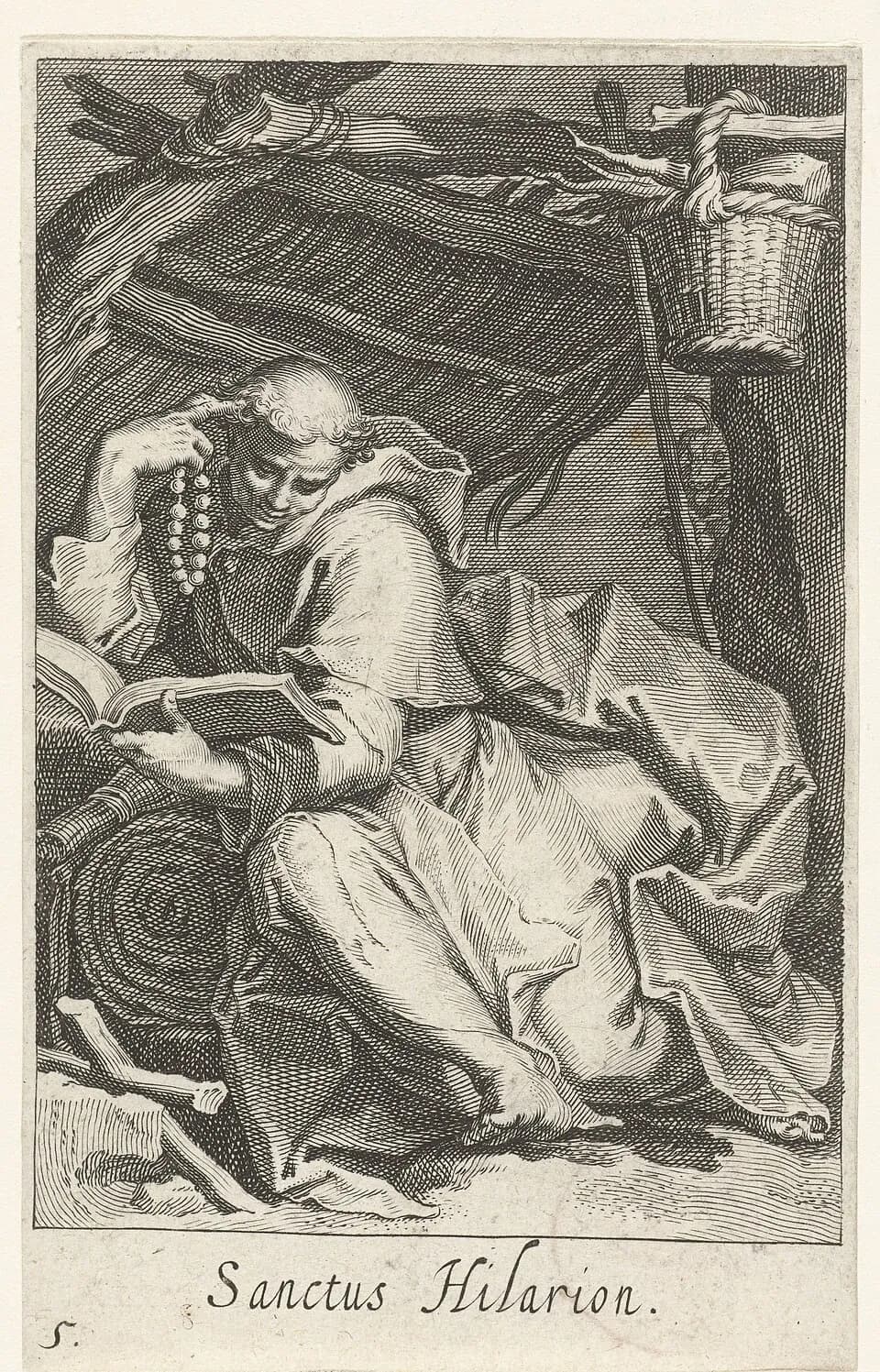
- Known as
- "Founder of anchoritic life in Palestine" 2
Saint Hilarion was a fourth-century hermit from a village near Gaza who learned the solitary life from Saint Anthony in Egypt and, at about fifteen, carried it home to Palestine, where no one had lived that way before. 12 Nearly everything known of him comes from the Life that Saint Jerome wrote in 390: fifty years of fasting and basket-weaving on the coast south of Gaza, then a long flight across the Mediterranean from the crowds his miracles kept drawing. 13 He died on Cyprus about 371, and his feast is October 21. 24
A student in Alexandria
He was born about 291 at Tabatha, a village some five miles south of Gaza. 12 His parents were pagans, "and therefore, as the saying is, the rose blossomed on the thorn," Jerome writes. 1 They sent him to Alexandria to study under a grammarian, and there he became a Christian. 12
All Egypt was then talking about Saint Anthony the Abbot. Hilarion went out to the desert to see him and stayed about two months. 1 The sick and the troubled came to Anthony in crowds, and Hilarion thought it strange to bear in the desert the crowds of the cities. 15 He decided to start where Anthony had started: "Antony is reaping the reward of victory like a hero who has proved his bravery. I have not entered on the soldier's career." 1
He went home and found his parents dead. He gave part of his inheritance to his brothers and part to the poor and kept nothing. 15 He was about fifteen; katolsk.no, the website of the Catholic Church in Norway, puts the year at about 306. 13
Between the sea and the marsh
The place he chose was a wilderness seven miles from Majuma, the port of Gaza, with the sea on one side and marshland on the other. 1 He wore a shirt of sackcloth, a cloak of skins that Anthony had given him and a coarse blanket, and ate fifteen dried figs a day, after sunset. 1 He hoed the ground and wove baskets from rushes to earn his keep. 12
For four years he sheltered in a hut of reeds and sedge. Then he built a cell that was still standing when Jerome wrote, five feet high, lower than he was tall, and only a little longer. "One might suppose it a tomb rather than a house." 1 He cut his hair once a year, at Easter, and never washed his sackcloth, saying "it was going too far to look for cleanliness in goats' hair-cloth." 1
When he was eighteen a band of robbers hunted for him all night, found him at daybreak, and asked what he would do if robbers came. "He that has nothing does not fear robbers," he said. Told that he might be killed, he agreed that he might, and said he was prepared to die. 1
The crowds arrive
He lived this way for twenty-two years, known across Palestine only by reputation, before anyone dared to approach him. 1 Then two cures made his name, a childless woman who bore a son and three boys dying of fever in Gaza, and people came from Syria and Egypt. Many stayed as monks. 1 "For as yet there were no monasteries in Palestine," Jerome writes, "nor had anyone known a monk in Syria before the saintly Hilarion." 1 The encyclopedia dates the gathering of disciples to 329 and calls him the "Founder of anchoritic life in Palestine." 2
Italicus, a Christian of Gaza, kept racehorses that ran against those of a magistrate devoted to the god Marnas, and asked for help against the other side's magician. Hilarion smiled and asked why he did not give the price of the horses to the poor, then sent him off with a cup of water to sprinkle over the stable. Italicus won, and the crowd shouted "Marnas is conquered by Christ." 1 The church historian Sozomen adds a story from his own family: his grandfather's household and that of a man named Alaphion were the first Christians in Bethelia, a town near Gaza, and it was said that Hilarion converted them by driving a demon out of Alaphion. 6
Running from his own name
By his sixty-third year he was at the head of a large monastery, with the wilderness around it full of the sick and those who brought them, and he wept over it daily. "I have returned again to the world and have received my reward in my lifetime," he told one of the brethren. 1 Two years later he tried to slip away on a donkey. Ten thousand people turned out to stop him, Jerome says, and he got free only by refusing food and drink for seven days. 13
He went first to Anthony's mountain in Egypt, where he lay down on the dead man's bed and kissed it. 1 Katolsk.no has him set out after Anthony died in 356; the encyclopedia puts the return to Egypt about 360. 23 When Julian became emperor the city of Gaza petitioned for Hilarion's death, his monastery was destroyed, and he hid for a year in an oasis of the Libyan desert. 12
From there he sailed for Sicily, where he bundled firewood each day to sell for bread. 16 A healing gave him away. His disciple Hesychius, who had searched three years for him, found him and took him on to Epidaurus in Dalmatia. 12 Katolsk.no prints the name as Epidamnos and identifies it with Ragusa, today's Dubrovnik. 3 When an earthquake drove the sea over its bounds, the townspeople set him on the shore; he traced three crosses in the sand and held out his hands, and the water sank back. 16
A garden on Cyprus
Cyprus was the last stop. He settled two miles outside Paphos and was discovered within three weeks. 1 After two years Hesychius found him a place twelve miles from the sea, high in the mountains, reached almost on hands and knees: a garden with running water and fruit trees, beside a ruined temple that people said was haunted. He lived there five years. 1
He died there in his eightieth year, about 371. 12 His will was a note in his own hand leaving Hesychius everything he owned: a copy of the Gospels, a sackcloth tunic, a cowl and a cloak. 1 He asked to be buried at once, in the garden, in the clothes he had on. Jerome gives his last words: "Go forth, what do you fear? Go forth, my soul, why do you hesitate? You have served Christ nearly seventy years, and do you fear death?" 1
About ten months later Hesychius stole the body and carried it home to Majuma. 125 Jerome reports a dispute still running in his day between Palestine and Cyprus, "the one contending that they have the body, the other the spirit of Hilarion." 1 Sozomen says the people of Palestine kept a public festival for him every year, and that "even now many afflicted and possessed people are healed at his tomb." 5
How far to trust Jerome
Jerome wrote at Bethlehem in 390, about twenty years after Hilarion died, and his English translators warn that the Life contains "much that is legendary" alongside "some statements which attach it to genuine history." 12 Katolsk.no says some details are unreliable but that the book rests on what Saint Epiphanius of Salamis, who knew Hilarion, had written. 3 Scholars who tried to make Hilarion a fiction did not persuade the encyclopedia, which holds that "there can be no doubt as to the historical fact of his life and the truth of its chief features." 2
What is Saint Hilarion the patron saint of?
No source used for this profile names Saint Hilarion the patron saint of any place, trade or need. The encyclopedia, the Roman Martyrology and katolsk.no all describe him as the man who brought the hermit's life to Palestine, and none attaches a patronage to him. 234 In his lifetime people came to him for healing and for deliverance from evil spirits, and Sozomen says they were still coming to his tomb when he wrote, but nobody in these sources calls that a patronage. 15
Saint Hilarion's feast day
Saint Hilarion's feast day is October 21. The Catholic Encyclopedia says "His feast falls on 21 October," katolsk.no gives the same day as his memorial, and the Roman Martyrology enters him on October 21 on the island of Cyprus, as an abbot who followed in the footsteps of Saint Anthony. 234 None of them says it was the day he died, and Jerome gives no date for the death at all. 1
Praying with Saint Hilarion
Jerome says plainly what impressed him most. "Some may wonder at the miracles he worked, or his incredible fasting, knowledge, and humility. Nothing so astonishes me as his power to tread under foot honour and glory." 1 Hilarion spent the first half of his life becoming a man whom thousands wanted to see and the second half trying not to be seen. 1
He never managed it. Each hiding place failed the same way: someone was sick or tormented, he had pity, and word got out. 1 On Cyprus, in a place almost nobody could reach, he found a paralyzed man at his garden gate, wept, and healed him, and the crowds came up the mountain. 1
His poverty was exact. He gave away his inheritance as a boy and left behind a book and the clothes he died in. 1 When a rich man he had healed begged him at least to pass his gifts on to the poor, Hilarion told him to do it himself: "Why should I who have forsaken my own seek another man's?" 1
And at the very end he was afraid. The last words Jerome gives him are an argument with his own soul, telling it to go and asking why it hesitates after nearly seventy years of serving Christ. 1 Jerome wrote the Life to praise him, and he left that in. 1
Saint Hilarion, pray for us.
Sources
- 1.St. Jerome, "The Life of St. Hilarion," trans. W. H. Fremantle, G. Lewis and W. G. Martley, Nicene and Post-Nicene Fathers, Second Series, Vol. 6 (Buffalo: Christian Literature Publishing Co., 1893), with the translators' introductory note. New Advent.
- 2.Johann Peter Kirsch, "St. Hilarion," The Catholic Encyclopedia, Vol. 7 (New York: Robert Appleton Company, 1910).
- 3.Per Einar Odden, "Den hellige Hilarion av Gaza (~291 - ~371)," Den katolske kirke (the Catholic Church in Norway), last updated March 11, 1998 (in Norwegian).
- 4.Roman Martyrology, entry for October 21, "Sant'Ilarione, abate," as printed in "Santo del giorno," Conferenza Episcopale Italiana (in Italian).
- 5.Sozomen, Ecclesiastical History, Book III, chapter 14, trans. Chester D. Hartranft, Nicene and Post-Nicene Fathers, Second Series, Vol. 2 (Buffalo: Christian Literature Publishing Co., 1890). New Advent.
- 6.Sozomen, Ecclesiastical History, Book V, chapters 10 and 15, trans. Chester D. Hartranft, Nicene and Post-Nicene Fathers, Second Series, Vol. 2 (Buffalo: Christian Literature Publishing Co., 1890). New Advent.
Saints to turn to next
Others in this collection who are turned to for some of the same things.
- Saint Agnes of Bohemiac. 1200-1205 - March 1281 or 1282Poverty and simplicityPrayer
- Saint Aidan of Lindisfarnec. 590 - August 31, 651Poverty and simplicityPrayer
- Saint Alexius of RomeFifth century, by traditionPoverty and simplicityPrayer
- Saint André BessetteAugust 9, 1845 - January 6, 1937PrayerPoverty and simplicity