Saint Heribert of Cologne
c. 970 - March 16, 1021
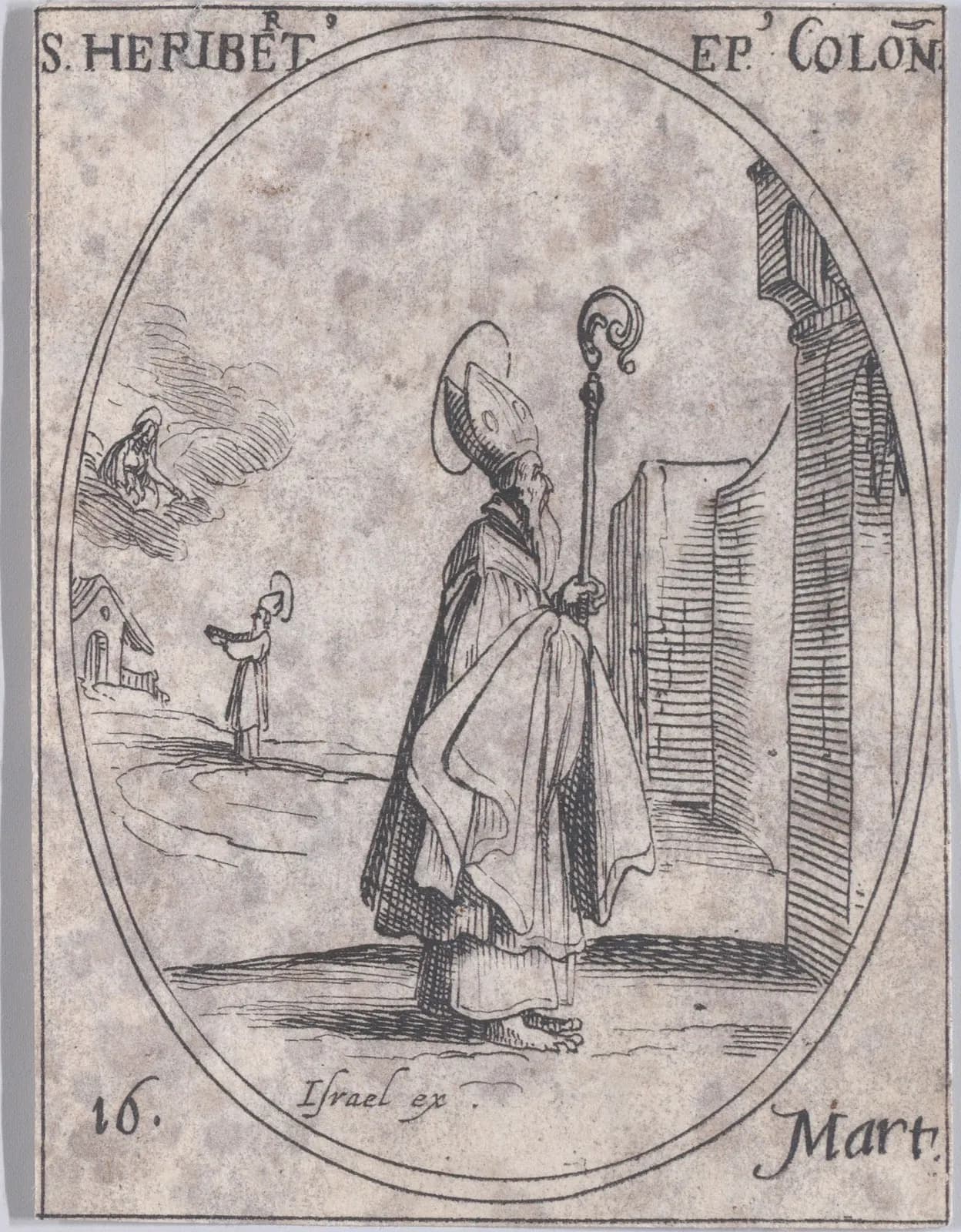
Saint Heribert was the chancellor of the young emperor Otto III and, from 999, archbishop of Cologne. 13 He brought the dead emperor home from Italy across hostile country, was held prisoner for a time by Otto's successor, and spent the rest of his life serving that same king while giving away nearly everything his see brought in. 12 He died in 1021 and lies in the abbey of Deutz, which he founded on the far bank of the Rhine. 12
Worms, Gorze and the imperial court
Heribert was born at Worms about 970. 12 Michael Ott, in the 1910 Catholic Encyclopedia, calls his father Duke Hugo of Worms; the Norwegian bishops' saints database (katolsk.no) and CatholicCulture.org call him a count. 124 He was taught at the cathedral school of Worms and spent time at the monastery of Gorze in Lorraine, which katolsk.no says he was sent to while still a boy. 12 Back in Worms he became provost of the cathedral, and katolsk.no says he was barely twenty when he did. 12
In 994 the young king Otto III made him chancellor for Italy, and four years later chancellor for Germany as well. 1 Ott dates his ordination as a priest to the same year as the first appointment; katolsk.no puts it a year later, in 995. 12 As chancellor, Ott writes, he was "the most influential adviser of Otto III," and he went with the king to Rome. 1 Franz Kampers, writing on Otto in the same encyclopedia, describes a ruler convinced "of the spiritual character of his imperial dignity," who made his friend Gerbert pope as Sylvester II in 999. 6 katolsk.no adds that Heribert was present when Otto had the tomb of Charlemagne at Aachen opened. 2
Archbishop of Cologne
He was still in Italy when Cologne chose him as its archbishop. 1 Ott gives the election as 999; katolsk.no says he was elected in 998 and confirmed by pope and emperor in 999. 12 The Roman Martyrology, as the Italian bishops print it, says he was elected against his will. 3 On July 9, 999, at Benevento, Sylvester II gave him investiture and the pallium, according to Ott, who has him consecrated in Cologne on Christmas Day. 1 katolsk.no has the pope consecrate him at Benevento that July, and says he was enthroned in Cologne on Christmas Eve. 2
katolsk.no tells how he arrived. In the middle of winter he took off his shoes and walked into the city barefoot, and from then on he wore a hair shirt under an archbishop's splendid vestments. 2 He kept his post as imperial chancellor, which drew him deep into the politics of his day, but katolsk.no says this did not make him neglect his diocese. 2 The Martyrology remembers him as a bishop who never stopped enlightening clergy and people by the example of his virtues, the same virtues he urged on them in his preaching. 3
The emperor's body and the new king
Otto III died in Italy, at Paterno, in January 1002, with Heribert at his deathbed. 16 Ott gives the date as January 23, Kampers as January 24. 16 Kampers says that "only by recourse to arms" could the body be brought back to Aachen. 6 katolsk.no describes hard fighting on the way, with Heribert relying on the imperial guard to carry home both the dead emperor and the regalia of the empire. 2
Duke Henry of Bavaria, who meant to succeed Otto, was waiting for him. 2 katolsk.no says Henry wanted the Holy Lance, one of the imperial insignia and now kept in Vienna, and that Heribert enraged him by refusing to hand over the regalia until a new king had been properly chosen. 2 Ott says Heribert at first opposed Henry's candidacy and was held captive by him for some time. 1
Once Henry was elected king on June 7, 1002, Heribert recognized him. 1 katolsk.no says he stepped down as chancellor after Otto's burial and Henry's election. 2 Ott describes years of loyal service all the same: Heribert went with Henry to Rome in 1004, mediated between him and the House of Luxemburg, and helped him in many other ways. 1 Joseph Lins, writing on Cologne, also notes that he aided Henry on that Roman expedition. 5 Even so, Ott writes, he never won the king's full confidence until 1021, "when the king saw his mistake and humbly begged pardon on the archbishop." 1 This king is himself venerated as Saint Henry II. 2 katolsk.no says only that the emperor came at last to recognize the archbishop's wisdom and integrity. 2
Deutz, the poor and the rain
Lins counts Heribert among the "vigorous archbishops" under whom Cologne recovered from the raids of the Northmen, and says he was very active in promoting the welfare of his diocese. 5 He founded and richly endowed the Benedictine monastery and church of Deutz, says Ott; katolsk.no says he founded it together with Otto III. 12 Deutz is now part of Cologne, on the right bank of the Rhine. 2
katolsk.no says that, at a time when many churchmen in the service of the state neglected their spiritual duties, Heribert was a devoted shepherd. 2 The archbishopric made him a rich man, but apart from what he strictly needed, his whole income went to the Church and to the poor. 2 Ott writes that "he was already honoured as a saint during his lifetime." 1 Miracles were told of him, and the best known is a downpour that ended a severe drought. 2 CatholicCulture puts it simply: "He is thus invoked for rains." 4
His death and canonization
In the winter of 1021, still weak, he set out on a long journey and got only as far as Neuss, where he fell gravely ill again. 2 He was carried back to Cologne as fast as possible, and katolsk.no says he asked to be taken into the cathedral, where he prayed for his diocese and for the poor. 2 He died at Cologne on March 16, 1021, and was buried at Deutz. 12
The record of his canonization is tangled. 124 Ott says Pope Gregory VII canonized him between 1073 and 1075, and CatholicCulture gives the year as 1074. 14 katolsk.no says no declaration survives, that it is generally reckoned to have happened between 1046 and 1048, and that the formal bull ascribed to Gregory VII is now regarded as a forgery from the seventeenth century. 2 The monks of Deutz kept his cult alive. 2 His relics were enshrined in 1147, and on August 30, 1180, they were laid in the gold shrine that still rests on four marble columns in the apse of the Heribert church at Deutz. 2
What is Saint Heribert the patron saint of?
katolsk.no names Saint Heribert patron of Deutz and invokes him for rain, and CatholicCulture likewise says he is invoked for rains, because of the drought his prayer is said to have ended. 24 katolsk.no adds that he is shown in art as an archbishop bringing rain by his intercession, and sometimes with the emperor Henry II kneeling before him. 2
Saint Heribert's feast day
Praying with Saint Heribert
Heribert spent his life close to power. He was a chancellor at about twenty-four and an archbishop before he was thirty, and he moved among emperors, popes and armies. 12 The sources do not present this as something he escaped. They present it as the place where he was holy. 23
Under the vestments he wore a hair shirt, and the revenues of one of the richest sees in the empire went to the Church and the poor. 2 He entered his own cathedral city barefoot in winter. 2 None of that made the politics simpler, and katolsk.no is plain that it brought him prison and long years of the king's mistrust. 2
He kept serving the man who had held him captive, and Ott records that it was the king who finally asked pardon. 1 At the end, with his strength gone, he asked to be carried into the cathedral and prayed there for the people in his care, and especially for the poor. 2
Saint Heribert of Cologne, pray for us.
Sources
- 1.Michael Ott, "St. Heribert," The Catholic Encyclopedia, Vol. 7 (New York: Robert Appleton Company, 1910).
- 2."Den hellige Heribert av Köln (~970-1021)," Den katolske kirke (katolsk.no), Catholic Diocese of Oslo (in Norwegian).
- 3.Roman Martyrology, entry for March 16, "Sant'Eriberto, vescovo," as printed in "Santo del giorno," Conferenza Episcopale Italiana (in Italian).
- 4."Saint Heribert," Liturgical Year, March 16, CatholicCulture.org (Trinity Communications).
- 5.Joseph Lins, "Cologne," The Catholic Encyclopedia, Vol. 4 (New York: Robert Appleton Company, 1908).
- 6.Franz Kampers, "Otto III," The Catholic Encyclopedia, Vol. 11 (New York: Robert Appleton Company, 1911).
Saints to turn to next
Others in this collection who are turned to for some of the same things.
- Saint André BessetteAugust 9, 1845 - January 6, 1937PrayerWork and vocationPoverty and simplicity
- Saint Benedict the Moor1524 or 1526 - April 4, 1589Work and vocationPoverty and simplicityPrayer
- Saint Crispin of ViterboNovember 13, 1668 - May 19, 1750Work and vocationPoverty and simplicityPrayer
- Saint Didacus of Alcalác. 1400 - November 12, 1463Work and vocationPoverty and simplicityPrayer