Saint Henry II
972 or 973 - July 13, 1024
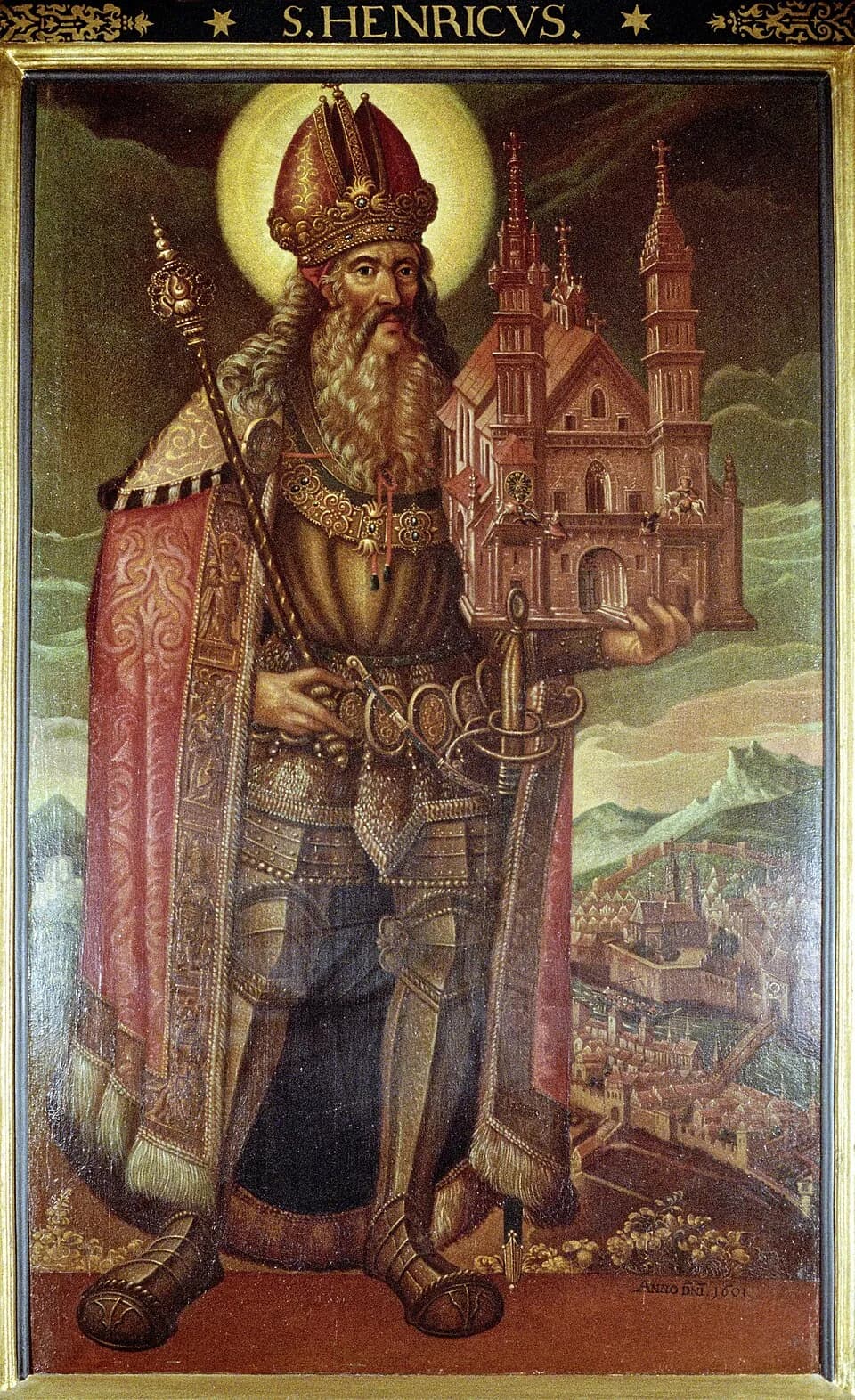
- Patron saint of
- Childless people, sterility, disabled people, Benedictine Oblates, kings, dukes, Basel and people rejected by religious orders, as Catholic Culture lists them 5; rulers, according to Vatican News 3; with his wife, the Diocese of Bamberg, in Benedict XVI's words 6
- Born
- 972 according to the Catholic Encyclopedia; May 6, 972 according to Franciscan Media; Bamberg, 973, according to Vatican News 124
- Died
- July 13, 1024, in his palace of Grona, at Göttingen 1
Saint Henry II was the last of the Ottonian dynasty, King of Germany from 1002 and Holy Roman Emperor from 1014. 23 He founded the diocese of Bamberg, fought on nearly every frontier of his empire, and was buried in its cathedral beside his wife, Saint Cunegunde, with whom he had no children. 1245 His feast is July 13, the day he died. 134
A duke's son meant for the Church
Henry was the son of Duke Henry of Bavaria, known as the Quarrelsome, and of the Burgundian princess Gisela. 1 The 1910 Catholic Encyclopedia gives his birth year as 972, and Franciscan Media dates it to May 6 of that year; Vatican News has him born in Bamberg in 973. 124 Franz Kampers, who wrote the encyclopedia's article, says he was destined for the priesthood in his youth and so came to know the Church's affairs early. 1 Vatican News fills in the teachers: the canons of Hildesheim first, then Saint Wolfgang, Bishop of Regensburg. 2
He succeeded his father as duke, and in 1002 he followed his cousin Otto III as King of Germany. 2 Kampers credits the German Church with putting him on the throne, as the advocate of German unity and of inherited succession. 1 In 1004 he crossed the Alps, Arduin of Ivrea gave way before him, and the Archbishop of Milan crowned him King of Italy. 1 On a second Roman expedition he was crowned emperor on February 14, 1014, by Pope Benedict VIII. 12
A practical man at war
Franciscan Media describes him as "a practical man of affairs" who crushed rebellions and feuds and fought along every frontier, always aiming at "a stable peace in Europe." 4 Kampers calls him "an eminently sober man" who never attempted anything but the possible, and adds that he crossed the empire sick with fever to keep the peace, and that "the masses especially he wished to help." 1
The record is not tidy. His wars against Duke Boleslaw of Poland had little success, and Vatican News notes that he allied himself with pagan Slavic tribes against Boleslaw, "a decision for which he was criticized." 12 His own brothers-in-law, the Counts of Luxembourg, were "the heart and soul of the disaffection" in Lorraine, and Kampers says the royal authority "suffered greatly" in the northwest even though Henry would not bend the empire to a family interest. 1 On his third journey to Rome, in 1021, he set out to end Greek supremacy in the south and did not fully succeed. 1 Franciscan Media's verdict is that from our standpoint "he may have been too quick to do battle and too ready to use power to accomplish reforms." 4
Bamberg
The diocese of Bamberg was his own creation. Kampers calls it "entirely his own scheme," carried through in 1007 over the energetic opposition of the Bishop of Würzburg. 1 Its first purpose, he writes, was to germanize the Wends who had settled along the Upper Main and the Regnitz, and its lasting importance lay in its schools. 1 Much of the land around Bamberg belonged to the king, so he could endow it richly. 1 The older account in Abbot Guéranger's Liturgical Year says he founded it "out of his family possessions" and made it tributary to Saint Peter and the Pope, and Catholic Culture's summary credits the foundation to Henry and Cunegunde together. 5
When Bamberg kept the thousandth anniversary of its cathedral in 2012, Benedict XVI wrote to the archdiocese and asked its people to pause before "the extraordinary funerary monument of St Henry and St Kunigunda," carved by Riemenschneider. 6 He called the couple "Christians, to us exemplary," who received from Baptism, Confirmation and Matrimony "the mandate and mission to serve the Kingdom of God in the world," and named them "the holy patron saints of the diocese." 6
An emperor and the reform of the Church
The sources read his dealings with the Church differently. Vatican News stresses his support for the reform that began at Cluny, whose abbot, Saint Odilo, was one of his counselors. 2 Henry helped fight simony, promoted clerical celibacy, and in 1022 presided with Benedict VIII over the Council of Pavia, which issued canons against clerical concubinage. 2 Vatican News also credits him with wanting the Creed recited at Sunday Mass. 2
Kampers is cooler. He says Henry promoted the Church largely to make it a better support for royal power, disposed of bishoprics "autocratically," and treated bishops as "nothing but officials of the empire," though "this political dependency did not injure the internal life of the German Church." 1 He also records that Henry was drawn more and more to the reform party, and at the end of his life sided wholly with Rome against Archbishop Aribo of Mainz, whose synod at Seligenstadt in 1023 had forbidden appeals to Rome without a bishop's consent. 1 Franciscan Media holds both views together: he named loyal men as bishops, as eleventh-century rulers did, but "avoided the pitfalls of this practice and actually fostered the reform of ecclesiastical and monastic life." 4
Henry, Cunegunde, and the vow of chastity
Henry and Cunegunde had no children, and a tradition grew up that they had chosen not to, living together under a mutual vow of chastity. Guéranger's account, as Catholic Culture prints it, states it as fact: Henry "set the rare example of preserving virginity in the married state, and at his death restored his wife, St. Cunigund, a virgin to her family." 5
The other sources are more careful. Vatican News says the couple's childlessness "has given rise to the belief that the spouses had taken a mutual vow of chastity, although some historians dispute this." 2 Kampers is blunt: "the highly varied theme of his virgin marriage to Cunegond has certainly no basis in fact." 1 What Vatican News does treat as certain is that, "contrary to a common medieval practice," Henry did not put away his childless wife, and that this "contributed in no small part to his reputation for sanctity." 2
Legends of a holy emperor
Guéranger's narrative carries other stories that the encyclopedia would class with the later legends. In it Henry falls gravely ill at Monte Cassino and is cured by Saint Benedict "by a wonderful miracle"; he undertakes nothing without prayer, and at times sees "the angel of the Lord, or the holy martyrs, his patrons, fighting for him at the head of his army." 5 It also says that after Henry gave his sister in marriage to King Stephen of Hungary, Stephen was baptized "and thus the whole nation was brought to the faith of Christ." 5 Kampers warns that the later legends "ascribed ascetic traits to this ruler, some of which certainly cannot withstand serious criticism." 1 They are given here as Guéranger told them.
Death and canonization
Henry died on July 13, 1024, in his palace at Grona, near Göttingen. 1 He was buried at Bamberg, in the cathedral of Saints Peter and Paul, and Cunegunde was laid beside him some fifteen years later. 5 Guéranger records that "many miracles were worked at his tomb." 5 Pope Eugene III canonized him in 1146, and Cunegunde followed in 1200. 125
What is Saint Henry II the patron saint of?
Vatican News calls Henry "a model of good governance" and "the patron saint of rulers." 3 Catholic Culture gives a longer list: Basel, Benedictine Oblates, childless people, disabled and handicapped people, dukes, kings, people rejected by religious orders, and sterility. 5 Benedict XVI names Henry and Kunigunda together as patron saints of the Archdiocese of Bamberg. 6 Franciscan Media lists no patronage for him. 4
Saint Henry II's feast day
Praying with Saint Henry II
Franciscan Media's reflection on Henry is unusually frank. It calls him "a man of his times," allows that he may have been too ready with armies and power, and still concludes that "he shows that holiness is possible in a busy secular life." 4 The sources do not ask anyone to admire his wars. They record that he ran an empire, made alliances he was criticized for, and was canonized anyway.
Benedict XVI pointed to the tomb at Bamberg rather than to any miracle. He saw in the imperial couple a lesson in "what it means to live as Christians in the world and to shape it in accordance with Christ's spirit," in the family, at work, and in society. 6
The marriage is the hardest part of the story to hold with confidence, since the sources do not agree on what it was. What they do agree on is that Henry and Cunegunde had no children and that he stayed with her when the custom of the time would have let him leave. 125 That much is recorded, and Catholic Culture counts childless people among those he is patron of. 5
Saint Henry II, pray for us.
Sources
- 1.Franz Kampers, "St. Henry II," The Catholic Encyclopedia, Vol. 7 (New York: Robert Appleton Company, 1910).
- 2."St. Henry II, Emperor," Saint of the Day, Vatican News.
- 3."Saints of the Day: 13 July," Saint of the Day, Vatican News.
- 4."Saint Henry," Saint of the Day, Franciscan Media.
- 5."Optional Memorial of St. Henry," Liturgical Year, July 13, 2026, Catholic Culture, with an excerpt from Abbot Guéranger, O.S.B., The Liturgical Year.
- 6.Benedict XVI, Letter on the occasion of the Millennium of the Cathedral of Bamberg, May 3, 2012.
Saints to turn to next
Others in this collection who are turned to for some of the same things.
- Saint Dominic of Silosc. 1000 - December 20, 1073Marriage and familyWork and vocation
- Saint Edward the Confessorc. 1003 - January 5, 1066Marriage and familyWork and vocation
- Saint Gianna Beretta MollaOctober 4, 1922 - April 28, 1962Marriage and familyWork and vocation
- Saint Homobonus of CremonaDied November 13, 1197Work and vocationMarriage and family