Saint Guido Maria Conforti
March 30, 1865 - November 5, 1931
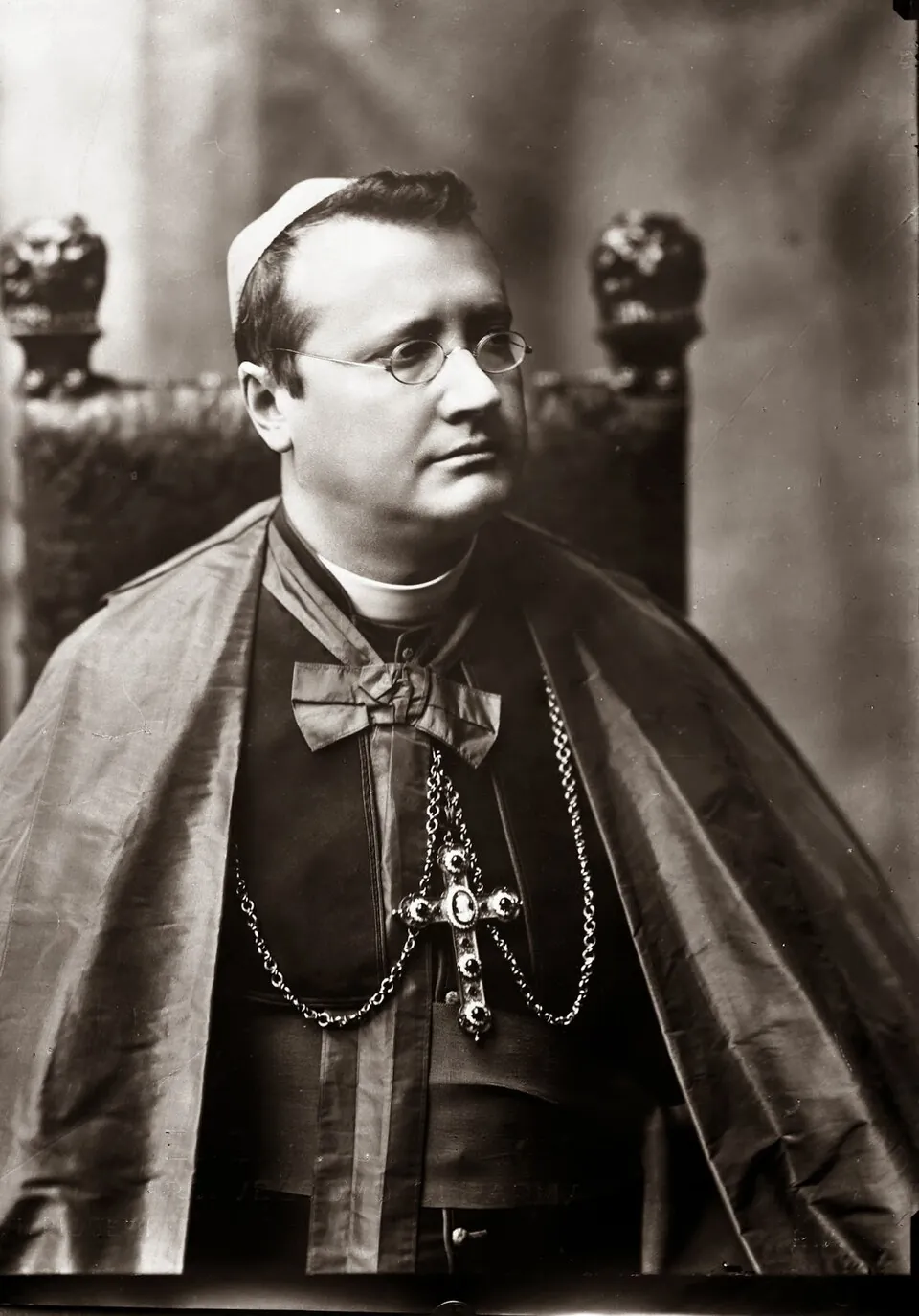
Saint Guido Maria Conforti wanted to be a missionary in China and was never well enough to go, so in 1895 he founded a congregation to go in his place: the Xaverian Missionaries, named for Saint Francis Xavier. 13 He spent most of his life as a bishop at home, briefly in Ravenna and then for more than two decades in Parma, and in 1928, ill and past sixty, he finally traveled to China to visit the missionaries he had sent. 135 Benedict XVI canonized him on World Mission Day 2011. 2
A crucifix on the way to school
He was born on March 30, 1865, at Casalora di Ravadese in the farmland outside Parma, and baptized the same day. 14 He was the eighth of ten children of Rinaldo Conforti and Antonia Adorni, and the Xaverians say his father meant him to run the family farm and its properties. 45
He went to school with the Christian Brothers in Parma. On the way he would stop in the Church of Peace in front of a large crucifix, and as a bishop he remembered it this way: "I looked at him and He looked at me and it seemed to me that he said many things." 3 The Holy See's profile puts the beginning of his priestly vocation in that encounter. 3 The Xaverians add that later in life, when the crucifix had been brought to his residence at his request, his sister often found him "rapt in ecstasy" before it. 45
His father opposed his entering the seminary. 23 With his mother's support he went anyway, in 1876, at the age of eleven. 135 There, under the rector Andrea Ferrari, he read a life of Saint Francis Xavier, the Jesuit who had died on the island of Shangchuan at the gateway to China in 1552. 3 He took Xavier as his model, and the Holy See's profile calls this the spark of a second vocation, to the missions. 35
Too ill for the missions
An illness with epileptic symptoms held up his ordination, and his classmates were ordained without him. 15 In the meantime he was made vice-rector of the seminary, still a cleric, and kept the post after ordination; the Holy See biography says he showed remarkable talent as a formator. 13 He was ordained on September 22, 1888, at the Marian shrine of Fontanellato, according to the Holy See's missionary profile and the Xaverians; the Holy See biography gives the year alone. 135
He had looked into joining an institute for the foreign missions, and his health ruled it out. 13 He was made director of the Society for the Propagation of the Faith and, before he was thirty, vicar general of Parma. 1 Then, on December 3, 1895, the feast of Saint Francis Xavier, he opened a seminary for the foreign missions, recognized on December 3, 1898, as the Congregation of St. Francis Xavier for Foreign Missions. 35 Its single purpose, in the Holy See biography's words, was "evangelizing the non-Christians." 1
Benedict XVI described it as "a religious family completely at the service of evangelization, under the patronage of the great 'Patron of the Orient', St Francis Xavier," with the motto "Caritas Christi urget nos," the love of Christ urges us on. 2 In March 1899 Conforti handed the mission cross to the first two Xaverians bound for China, Caio Rastelli and Odoardo Mainini (the Xaverians' timeline spells the second name Manini). 35
Ravenna, and a resignation
In 1902, at thirty-seven, he was appointed Archbishop of Ravenna by Leo XIII. 1 The Xaverians say he told the pope of his wish to go to China and was told that his field was Ravenna. 4 On the day of his episcopal ordination, June 11, 1902, in the Basilica of St. Paul Outside the Walls, he made his religious profession together with a vow to give himself without reserve to proclaiming the Gospel to the nations. 34
Two years of work in Ravenna were more than his health could carry. 1 The Holy See biography says his sense of responsibility for his people led him to offer his resignation, which Pius X accepted, and he went back to the institute in Parma to form its students. 13
Bishop of Parma
When his health improved, Pius X asked him to govern Parma, first as coadjutor to the dying Bishop Magani; he became its bishop in December 1907 and stayed until his death. 13456 Religious instruction came first. He set up schools of Christian doctrine in every parish, trained catechists in religious culture and teaching, and was the first in Italy to hold a catechetical week. 16 He held two diocesan synods and promoted Catholic Action, the Catholic press, popular missions and Eucharistic, Marian and missionary congresses. 13 The Holy See biography counts four complete pastoral visits of the diocese and a fifth cut short by his death; the Holy See's missionary profile and the Xaverians say he made five. 136
The Xaverians remember his episcopal motto as "In Omnibus Christi (Christ in all things)" and say they later took it as their own. 46 They also describe a bishop drawn into the troubles of his city: he supported workers during the strikes of 1908 while condemning violence, and in the First World War he helped prisoners of war, displaced people and families that had lost their breadwinner, and sent his seminarians to work in the hospitals set up during the war. 6 By their account, Fascist troops withdrew from Parma the day after he offered to mediate. 6
He kept his missionary family going alongside the diocese. 1 In 1912 he consecrated Luigi Calza, one of his missionaries, in Parma Cathedral as the first Xaverian bishop, for Cheng-chow in China. 35
The Missionary Union and China
In 1916 he helped found the Missionary Union of the Clergy and served for ten years as its first president. 1 The idea came from Father Paolo Manna of the Milan missionary institute, PIME, and the Xaverians describe it as an effort to wake priests up to having been ordained for the whole world. 37 When he stepped down in 1927 it was established in forty-four Italian dioceses. 7
From September to December 1928, ill and in his sixties, he made the journey to China to visit his missionaries and the Christian communities in their care, in western Honan. 135 He called it "a duty and a need of my heart." 8 The Xaverians record what he told the missionaries before leaving: "I'm amazed at what you have accomplished for the good of these Chinese people. How I would like to be young again, and dedicate all my energies to them!" 8
Death and canonization
Back in Parma, against orders to rest, he began another pastoral visit. 8 On October 25, 1931, he ordained eight subdeacons and then took to his bed. 8 He died on November 5, 1931, after receiving the anointing of the sick and Viaticum and publicly professing his faith. 38 The Holy See biography says an extraordinary number of people attended his funeral; the Xaverians describe a procession five miles long to his burial on November 8. 18
John Paul II declared him venerable on February 11, 1982, and beatified him on March 17, 1996, together with Daniel Comboni. 38 The Holy See biography says the miracle for his beatification took place in Burundi and the one for his canonization in Brazil. 1 Benedict XVI canonized him in St. Peter's Square on October 23, 2011, World Mission Day, with Luigi Guanella and Bonifacia Rodríguez de Castro. 2
What is Saint Guido Maria Conforti the patron saint of?
Saint Guido Maria Conforti's feast day
His feast is November 5, the day he died in 1931. 910 The Xaverian Missionaries call the day "the Feast of St. Guido Conforti" and describe their communities around the world gathering for it in 2024 to pray, celebrate the Eucharist and renew vows. 9
The Holy See biography gives November 5 only as his date of death and does not set a feast. 1
Praying with Saint Guido Maria Conforti
Benedict XVI chose a line from the psalms for him, a call "to abandon ourselves with trust into the hands of the Lord," and said that "even in debilitating periods of illness, he knew how to recognize God's plan." 2 The illness was real and it kept deciding things for him. It delayed his ordination, ruled out the missions, and ended his time in Ravenna after two years. 1 What he did each time was the next available thing: a seminary for other men to go, then the formation of its students. 13
The Holy See biography locates his holiness in "the humble, faithful and constant fulfillment of God's will in every moment of life." 1 Benedict said much the same, that he "first experienced and testified what he taught his missionaries, namely, that perfection consists in doing the will of God." 2 Most of that life was ordinary diocesan work: catechism classes, synods, visits to mountain parishes. 16 The Xaverians quote him on coming home from one of those visits: "Every pastoral visit reminds me of being a missionary! How hard it is to be heading home!" 6
He did get to China in the end, for a few months, at an age when he could not stay. 58 His words there, wishing he were young again, are in the sources as he said them. 8
And it began with a crucifix in a church on the way to school. Benedict XVI said that "in contemplating the Cross he saw the horizon of the entire world open wide to him." 2
Saint Guido Maria Conforti, pray for us.
Sources
- 1."Guido Maria Conforti (1865-1931)," biography in the booklet for the Mass of Canonization, October 23, 2011, Office for the Liturgical Celebrations of the Supreme Pontiff (English text).
- 2.Benedict XVI, Homily for the Canonization of Blesseds Guido Maria Conforti, Luigi Guanella and Bonifacia Rodríguez de Castro, St. Peter's Square, October 23, 2011.
- 3."Saint Guido Maria Conforti," Witnesses, Extraordinary Missionary Month October 2019 (Holy See).
- 4."The Life of our Founder," Xaverian Missionaries USA.
- 5."Conforti: Early Years and Priestly Formation," with "Brief Life" timeline, Xaverian Missionaries USA (PDF).
- 6."Bishop of Parma, but Missionary to the World" and "The Love of God's People," Xaverian Missionaries USA (PDF).
- 7."President of the Missionary Union of the Clergy," Xaverian Missionaries USA (PDF).
- 8."Visit to China and Death of a Saint," Xaverian Missionaries USA (PDF).
- 9."Fresh News from the Worldwide Network of the Xaverian Missionaries," Xaverian Missionaries USA, November 19, 2024.
- 10.Patricia Mathson, "Celebrating Saints: Guido Conforti (Feast Day: November 5)," Catechist, November-December 2019.
Saints to turn to next
Others in this collection who are turned to for some of the same things.
- Saint Carmen RendilesAugust 11, 1903 - May 9, 1977DiscernmentSuffering and illnessWork and vocation
- Saint Giuseppe AllamanoJanuary 21, 1851 - February 16, 1926Work and vocationDiscernmentSuffering and illness
- Saint José Gregorio HernándezOctober 26, 1864 - June 29, 1919Work and vocationDiscernmentSuffering and illness
- Saint Paul VISeptember 26, 1897 - August 6, 1978Work and vocationDiscernmentSuffering and illness