Saint Gudula of Brussels
c. 650 - c. 712
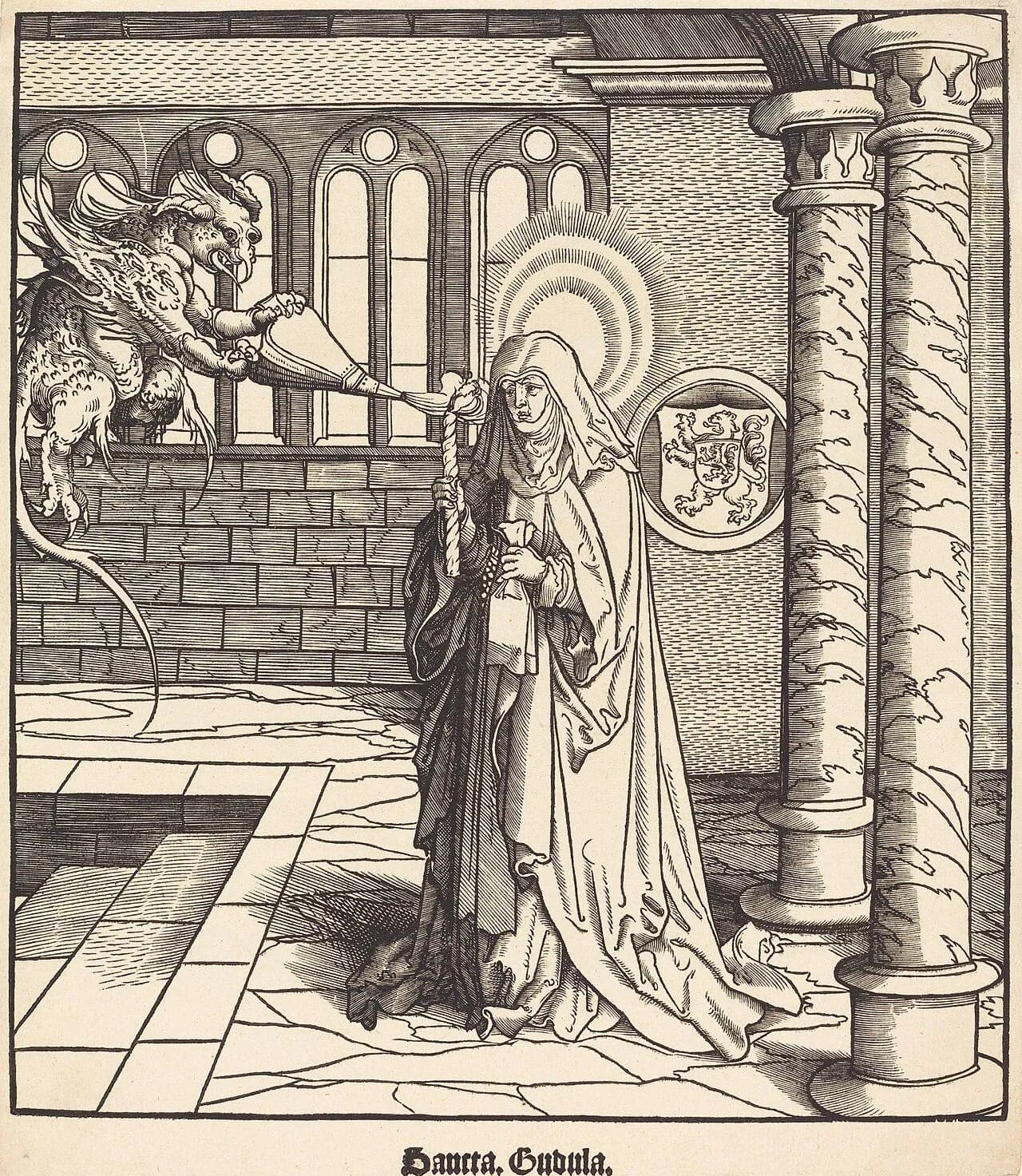
Saint Gudula is the patroness of Brussels, a Frankish noblewoman of the seventh century who spent her life in prayer and in looking after the poor and the sick of Brabant, and whose name the city's cathedral carries beside the archangel Michael's. 168 Almost nothing she said or wrote survives. What survives is a picture: a young woman walking to church in the dark before dawn, holding a light that the devil keeps blowing out. 14 The 1910 Catholic Encyclopedia found that picture on a church seal of 1446, and the cathedral of Brussels still puts a lantern in her hand. 14
A family of saints
Gudula was born in Brabant, in what is now Belgium, in the seventh century, to Witger and Amalberga. 1 The cathedral that bears her name gives the year as 650 and the place as Moorsel, near Aalst; the Archdiocese of Granada, telling her story on her feast in 2022, also says 650. 46 Granada calls her father a duke of Lorraine, and the Catholic Church in Norway's biography calls him Duke Witger. 36
She grew up among saints. Her mother, Amalberga, is venerated as one herself, and after Gudula's birth she took up the religious life; tradition says she received the veil from Saint Aubert, bishop of Cambrai, who died about 668. 1 Her sister was Saint Reinelda. 13 Her brother became a bishop, though the sources do not agree on his name: Emebertus, who followed Saint Vindician as bishop of Cambrai about 695, in Léon van der Essen's encyclopedia article; Adalbert, bishop of Arras and Cambrai, in the Norwegian biography; Aldeberto in the Spanish one. 136
The great Merovingian abbess Saint Gertrude of Nivelles stands somewhere near her too, and again the relationship changes with the teller. The cathedral says Gertrude was Gudula's aunt and godmother and that her education was entrusted to her; Granada calls Gertrude her godmother and says she was raised in the convent at Nivelles until Gertrude's death in 659; the Norwegian biography calls Gertrude her cousin. 346 The encyclopedia does not mention Nivelles at all. 1
Prayer before dawn
Once home again, Gudula lived what the encyclopedia calls "an atmosphere of piety and good works" with her sister and brother. 1 She made a habit of walking to the church at Moorsel, which van der Essen puts two miles from her parents' house and the Norwegian biography three kilometers. 13 The Roman Martyrology, which keeps her among the saints of January 8, sums up her life in a single line: at Moorsel in Brabant, a virgin who devoted herself at home to charity and to prayer. 2
Granada records that opinions differ on how she lived. Some say she was enclosed in the oratory of St. Saviour at Moorsel; others that she stayed in her parents' house and led a life of extraordinary prayer and recollection there. 6 The Norwegian biography adds that she later built herself a cell and lived a strict life of penance in it until she died, and that people saw in her a mother to everyone in misfortune. 3
The chroniclers, Granada says, describe her as a woman given body and soul to the relief of her neighbor. Two stories are told. Coming back from the chapel at Moorsel one day, she met a poor woman carrying a ten-year-old boy who was paralyzed in his hands and feet; Gudula took him in her arms, prayed, and he was healed. Another time a woman with leprosy named Emenfreda came to her, and Gudula looked at her sores, comforted her and cured her. 6 After that, Granada says, crowds of the unfortunate came looking for her. 6
The lantern
The story everyone in Brussels knows belongs to those early walks. In the encyclopedia's version, the saint "frequently repaired to the church before cock-crow." The demon, "wishing to interrupt this pious exercise, extinguished the light which she carried, but the saint obtained from God that her lantern should be rekindled." 1 The cathedral tells it with an angel: the devil blew out the flame to stop her reaching a nearby chapel in the evening, she knelt and begged Heaven for help, and an angel came and lit it again. 4 In Granada's telling she knelt in the mud and the lamp relit itself. 6
Van der Essen traces the image back to a seal of the church of St. Gudula from 1446, on which she holds a candle in her right hand and in her left a lamp, "which a demon endeavours to extinguish." 1 He adds that a small growth which bears fruit at the beginning of January was known in Flemish as "Sinte Goulds lampken," St. Gudula's lantern. 1 The cathedral reads the scene plainly as an allegory: the small flame of faith, shining in a troubled time, with forces trying to put it out. 4
Death, and the long road to the cathedral
She died at the beginning of the eighth century. 1 Several sources give the year 712, including the encyclopedia's own article on the Archdiocese of Mechlin, and Granada adds that it was probably on January 8, after a short illness. 369 She was buried at Ham in East Flanders, according to van der Essen, or before the church door at Hamme, according to the Norwegian biography. 13
Her body then traveled for three centuries. About a hundred years after her death it was taken to the church of St. Saviour at Moorsel and buried behind the altar. 1 Granada mentions a community of nuns at Moorsel that did not last; the Norwegian biography credits Charlemagne with founding a convent in her honor. 36 Under Duke Charles of Lorraine, between 977 and 988 by the encyclopedia's reckoning, she was brought to the chapel of St. Gery in Brussels; the Norwegian biography says 978, Granada probably 977. 136
In 1047 the count of Louvain had the relics moved again, to the church of St. Michael on the hill called the Molenberg, and a chapter of canons was founded there in her name. 156 The encyclopedia names the count as Balderic; Granada calls him only the count of Louvain. 16 A notice for the KTO documentary on her, carried by CathoBel, gives the date of the move as 1074 rather than 1047. 7 From then on the church carried both names. 34
It did not keep her. On June 6, 1579, the encyclopedia says, the collegiate church was pillaged and wrecked by "the Gueux and heretics," and "the relics of the saint disinterred and scattered." 1 The Norwegian biography says the same in one line, naming the Calvinists. 3 The church itself survived, and the gilded neo-Gothic statue in what is now the cathedral shows her crowned, holding an open Bible with a miniature of the building resting on it, and the lantern in her right hand. 4
What is Saint Gudula the patron saint of?
Saint Gudula is the patron saint of Brussels. 36 Van der Essen puts it neatly: "If St. Michael is the patron of Brussels, St. Gudula is its most venerated patroness." 1 Benoît Lobet, writing for CathoBel in 2025, describes the cathedral as placed under two patrons, the archangel who protects the whole city and the more local Gudula, whom he calls loved and venerated by everyone in Brussels. 8
Saint Gudula's feast day
Saint Gudula's feast day is January 8. The Roman Martyrology enters her on that day, and the Norwegian biography and the KTO notice give the same date. 237 The encyclopedia, writing in 1910, records two local observances: Brussels keeps her on January 8, and the Diocese of Ghent, in which Ham and Moorsel lie, on January 19. 1 In 1330, it adds, great indulgences were granted on her feast to everyone who helped decorate and complete her church in Brussels. 1
Praying with Saint Gudula
There is very little to go on, and the sources do not hide it. Her brother has three names, Gertrude of Nivelles is her aunt, her godmother or her cousin, and the date her relics reached the church that now carries her name depends on who is counting. 13467 The KTO documentary still found it worth asking why a Merovingian woman, hardly known in France, has been venerated without a break in Belgium, to the point of having her name joined to an archangel's. Its answer was that her example has inspired Christian life. 7
What the tradition kept is a habit. She got up in the dark and walked to church, over and over, and the one story everyone remembers is about an interruption. 14 Lobet reads it beside the Gospel parable of the widow and the unjust judge, which ends with Jesus telling his disciples to pray always and not lose heart. The devil, who as Lobet puts it does not like prayer, keeps putting out her lantern, and an angel keeps relighting it. 8 He does not say the walk got easier. The lantern went out more than once.
Lobet also points out that "prayer" and "precarious" come from the same late Latin verb, and that persevering prayer starts from an admission of weakness, of something missing in us. 8 The story of Gudula on the road to Moorsel fits that. She is not shown holding a steady light. She is shown kneeling in the mud with a lamp that has just gone out, asking for it to be lit again. 46
Saint Gudula of Brussels, pray for us.
Sources
- 1.Léon van der Essen, "St. Gudula," The Catholic Encyclopedia, Vol. 7 (New York: Robert Appleton Company, 1910).
- 2.Roman Martyrology, entry for January 8, "Santa Gúdila, vergine," as printed in "Santo del giorno," Conferenza Episcopale Italiana (in Italian).
- 3."Den hellige Gudula (~648-712)," Helgener, salige og andre, katolsk.no, the Catholic Church in Norway (in Norwegian).
- 4."The Statue of Saint Gudula," Cathedral of Saints Michael and Gudula, Brussels.
- 5."Lecture by Ms Marie-Claude Van Grunderbeek: Tussen de lijntjes van een Vita: Sint Goedele van Brussel," Cathedral of Saints Michael and Gudula, Brussels.
- 6."Santa Gúdula," Archidiócesis de Granada, January 8, 2022 (in Spanish).
- 7."KTO met à l'honneur Sainte Gudule, patronne de Bruxelles," CathoBel, January 2023 (in French).
- 8.Benoît Lobet, "Sainte Gudule et la prière persévérante," Gospel commentary, CathoBel, October 2025 (in French).
- 9.Albert Kempeneer, "Mechlin," The Catholic Encyclopedia, Vol. 10 (New York: Robert Appleton Company, 1911).
Saints to turn to next
Others in this collection who are turned to for some of the same things.
- Saint Agnes of Bohemiac. 1200-1205 - March 1281 or 1282Poverty and simplicityPrayer
- Saint Aidan of Lindisfarnec. 590 - August 31, 651Poverty and simplicityPrayer
- Saint Alexius of RomeFifth century, by traditionPoverty and simplicityPrayer
- Saint André BessetteAugust 9, 1845 - January 6, 1937PrayerPoverty and simplicity