Saint Gregory Nazianzen
c. 325 or c. 330 - 389 or 390
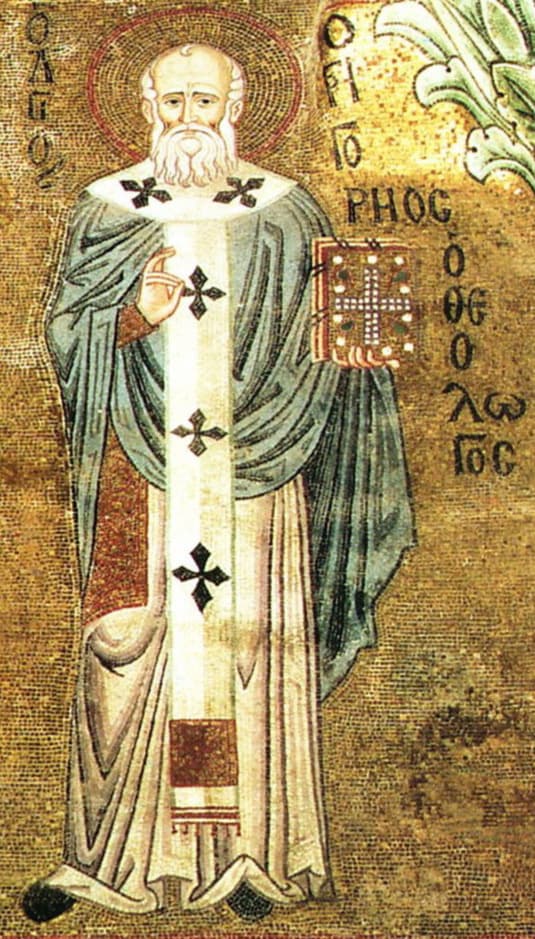
- Feast day
- January 2, kept with Saint Basil the Great 45. A joint feast with Basil and John Chrysostom on 30 January dates from 1081 6
- Born
- Arianzus, near Nazianzus in Cappadocia, about 325 according to Hunter-Blair and Franciscan Media; about 330 according to Benedict XVI 135
- Parents
- Gregory, Bishop of Nazianzus, and Nonna 3
Saint Gregory Nazianzen spent most of his life being pushed into jobs he did not want, and in one of them, a borrowed house in Arian Constantinople, he preached five sermons on the Trinity that earned him the name "the Theologian." 13 He wanted solitude and was ordained priest under pressure from his father, consecrated bishop against his will by his closest friend, Basil, and out of the see of Constantinople within months of taking it. 13 He is a Doctor of the Church, and his feast is January 2, which he shares with Basil. 345
One soul in two bodies
He was born at Arianzus in Cappadocia, one of three children of Nonna and of Gregory, Bishop of Nazianzus, who had belonged to a sect called the Hypsistarii and was brought into the Church by his wife. 3 Hunter-Blair dates the birth to about 325; Benedict XVI to about 330. 13 His mother consecrated him to God at birth, but he was not baptized as an infant. 13 His sister Gorgonia and brother Caesarius are both venerated as saints. 4
The schooling was long and expensive. He studied at Caesarea in Cappadocia, where he first met Basil, then at Caesarea in Palestine, then Alexandria, and then for about ten years at Athens, where the two friends met again and studied rhetoric together. 13 One of their fellow students was Julian, later the Apostate, and Gregory claimed afterward that he had distrusted him even then. 3 Years later he described the friendship with Basil in a funeral oration: "This was our competition: not who was first but who allowed the other to be first. It seemed as if we had one soul in two bodies." 1
He came home around thirty, was baptized, and wanted the monastic life. 135 For two or three years he lived with Basil in Pontus, editing Origen with him and helping with the rules Basil was writing for his monks. 3 Benedict XVI quotes his own description of what he was after: "to converse with oneself and with God, to lead a life that transcends the visible." 1
A priest and a bishop against his will
His elderly father wanted him at home, and around Christmas 361, by Hunter-Blair's reckoning, ordained him priest over his objections. 3 Gregory fled back to Basil. After some weeks he returned, preached his first sermon on Easter Sunday, and wrote an oration defending his flight that is really a treatise on the priesthood; the encyclopedia calls it the foundation of John Chrysostom's work on the subject and of Gregory the Great's Pastoral Care. 3 Benedict XVI puts the reluctance plainly: he knew he would one day be made a bishop and could no longer be absorbed in pure meditation. 1
It happened in 371, and it was Basil who did it. 1 Basil, now Bishop of Caesarea and in a jurisdictional fight over a newly divided province, founded a see at Sasima and had Gregory consecrated its first bishop. 3 Gregory thought himself unsuited to the place and the place to him, and never took possession of it. 13 Franciscan Media calls Sasima "a miserable and unhealthy town" and says Basil reproached him for not going. 5 The encyclopedia says the estrangement was never altogether removed, and that no letter between the two survives from after Sasima. 3
He stayed on at Nazianzus as his father's coadjutor. When both parents died in 374, he gave the large fortune he inherited to the poor and kept a small piece of land at Arianzus. 3 At the end of 375 he withdrew to a monastery at Seleucia. 3 Basil died while he was there, and illness kept Gregory from the funeral. 3
Five sermons in a borrowed house
Constantinople had been held by the Arians for some thirty years when its remaining Catholics, with many bishops behind them, asked Gregory to come and lead them. 35 He went early in 379 and began in a private house that he called the Anastasia, "the scene of the resurrection of the faith." 3 Vatican News says he was greeted by a hail of rocks. 4 He was attacked by a mob while baptizing at Easter, accused of tritheism by some of his own people, and taken in by a Cynic philosopher named Maximus, whom he praised in public and who was then consecrated bishop of the city by Egyptian bishops, at night, while Gregory lay sick. 3
In that chapel he preached the five Theological Orations, which defend the divinity of the Son and of the Holy Spirit against the Arians and the Macedonians. 13 Benedict XVI says they made clear that "this was the divine logic," and that for Gregory theology was never mere speculation but sprang "from a life of prayer and holiness, from a persevering dialogue with God." 1 Benedict XVI quotes his answer to Apollinaris, who denied that Christ had a human mind: "What has not been assumed has not been healed." 2 Jerome became his pupil in these years. 3
What happened next depends on the source. Hunter-Blair says Theodosius banished the Arian bishop in November 380 and personally escorted Gregory to Saint Sophia to be enthroned. 3 Benedict XVI says he was elected bishop during the Council of Constantinople in 381 and presided over it. 1 Vatican News says he did not become bishop of the city at all. 4
Jackdaws and wasps
The council went badly for him. When the council had to fill the see of Antioch, Gregory urged the bishops to keep the elderly Paulinus for the sake of peace. 3 They answered that Christ was born in the East; he replied, "Yes, and it was in the East that he was put to death." 3 He later described the response as "a cry like that of a flock of jackdaws," and said the younger bishops "attacked him like a swarm of wasps." 3 Ill and opposed, he offered to be another Jonah to calm the waves, and resigned. 3
His farewell sermon, delivered in June 381 before the council and a packed church, ended: "Farewell, great city, beloved by Christ.... My children, I beg you, jealously guard the deposit [of faith] that has been entrusted to you." 13 Benedict XVI also quotes an earlier lament of his that fits the occasion: "We have divided Christ, we who so loved God and Christ!" 1
A poet at the end
He went home, ran the diocese of Nazianzus for about two years until his cousin Eulalius was made bishop late in 383, and then retired to Arianzus. 13 There, in all probability, he wrote most of his poetry, including an autobiography in verse of nearly 2,000 lines, beside a fountain on the plot of land he had kept. 3 Jerome and the Suda credit him with more than 30,000 lines of verse, according to the encyclopedia; Benedict XVI counts almost 18,000. 23
Many of the late poems are about illness and spiritual suffering. 3 Benedict XVI quotes one: "I have been let down, O my Christ, by my excessive presumption: from the heights, I have fallen very low. But lift me now again." 2 He died at Arianzus in 389 or 390. 13
What is Saint Gregory Nazianzen the patron saint of?
None of the sources consulted for this profile names a patronage for Saint Gregory Nazianzen. 12345 Franciscan Media, which lists patronages for most saints, lists none for him. 5 He is a Doctor of the Church and is known as the Theologian, but that is a title rather than a patronage, so this page claims none. 34
Saint Gregory Nazianzen's feast day
Saint Gregory Nazianzen's feast is January 2, kept together with Saint Basil the Great. 45 Vatican News lists the two on that date as "bound by a deep friendship," and Franciscan Media says he "shares the celebration of his liturgical feast with St. Basil the Great on January 2." 45 Franciscan Media's own page on Gregory is nonetheless headed "Saint of the Day for January 14." 5
The friends were joined on the calendar long before. The Catholic Encyclopedia's article on Basil records that in 1081 John, Patriarch of Constantinople, established a feast honoring Basil, Gregory of Nazianzus and John Chrysostom together on 30 January. 6 The encyclopedia's article on Gregory himself gives no feast date. 3
Praying with Saint Gregory
Very little in his life went the way he chose. He wanted solitude and was made a priest, then a bishop of a town he never entered, then the leader of a beleaguered minority in the capital, and then he was driven from that post by the bishops who were supposed to confirm him. 13 Benedict XVI describes him as letting himself be "carried by Providence where he did not wish to go." 1 The encyclopedia, less tactfully, calls his career one that "seemed, externally, one almost of failure." 3 Both are true.
He is also a saint of an injured friendship. The man he called the other half of his soul was the one who forced Sasima on him, and the sources do not record a reconciliation. 13 After Basil died, Gregory wrote twelve memorial poems for him and later delivered the great oration in his honor. 13 Whatever was unresolved between them did not stop him from praising Basil.
His theology came out of prayer, by his own account and Benedict XVI's. "It is necessary to remember God more often than one breathes," he said, and he spoke of God as thirsting for us to thirst for him. 2 The Theological Orations were preached to a small and persecuted congregation in a private house. 3
At the end he was sick, retired and writing poems about his own weakness. 3 The prayer Benedict XVI quotes from those years asks Christ to lift him up again and admits that if he trusts himself too much he will fall. 2 It is not the prayer of a man who thought he had succeeded.
Saint Gregory Nazianzen, pray for us.
Sources
- 1.Benedict XVI, "Saint Gregory Nazianzus (1)," General Audience of 8 August 2007 (Libreria Editrice Vaticana).
- 2.Benedict XVI, "Saint Gregory Nazianzus (2)," General Audience of 22 August 2007 (Libreria Editrice Vaticana).
- 3.Oswald Hunter-Blair, "St. Gregory of Nazianzus," The Catholic Encyclopedia, Vol. 7 (New York: Robert Appleton Company, 1910).
- 4."Sts. Basil the Great and Gregory Nazianzus, Bishops and Doctors of the Church," Saint of the Day, Vatican News.
- 5."Saint Gregory Nazianzen," Saint of the Day, Franciscan Media.
- 6.Joseph McSorley, "St. Basil the Great," The Catholic Encyclopedia, Vol. 2 (New York: Robert Appleton Company, 1907).
Saints to turn to next
Others in this collection who are turned to for some of the same things.