Saints Gervase and Protase
Martyred at Milan, probably in the second century
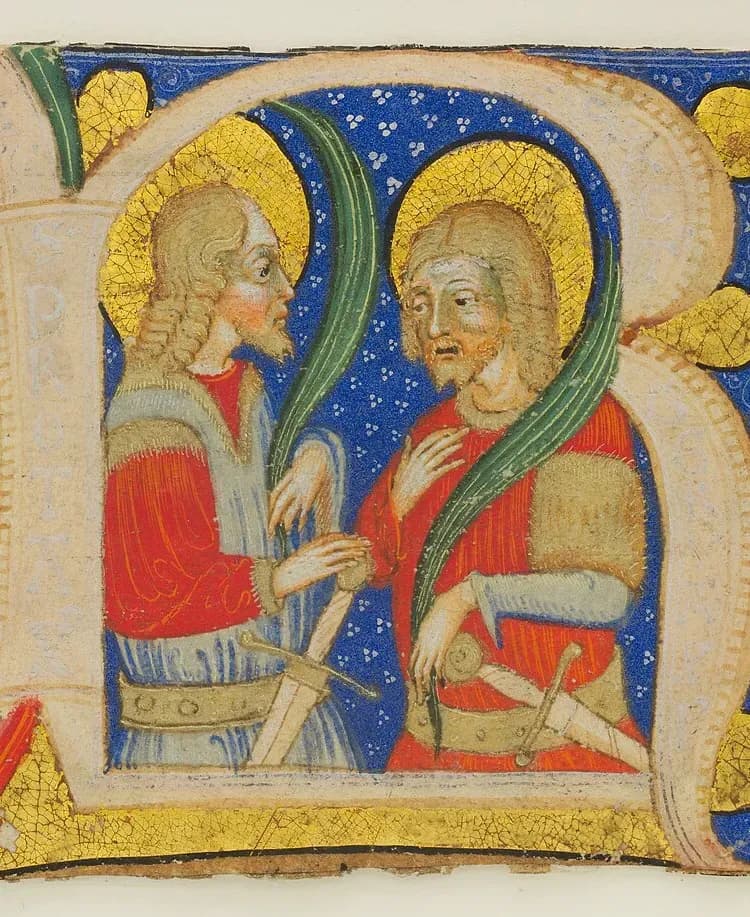
- Died
- Unknown; "probably in the second century" 1; Catholic Culture gives 165, and its excerpt from Pius Parsch about 170 5
- Emblems
- Scourge, club and sword 1
Saints Gervase and Protase are two martyrs of Milan about whom almost everything known begins on the day their bodies were dug up. In 386 Saint Ambrose, the city's bishop, found two skeletons under the floor of a cemetery church, carried them to his new basilica, and wrote to his sister to tell her about it. 12 Saint Augustine was in Milan at the time and described the event twice. 34 Their feast, June 19, marks that day and not the day they died. 16
Milan in 386
Ambrose had just finished a basilica. The people of Milan, he told his sister Marcellina, began to press him "with one mouth": "Consecrate this as you did the Roman basilica." He goes on, "And I answered: Certainly I will if I find any relics of martyrs." 2 Milan had none of its own. Ambrose later called it a church "barren of martyrs hitherto," a city that "had carried off the martyrs of other places" and "had lost her own." 2
It was also a bad year for him. Augustine, who had not yet been baptized, remembered it as the time when Justina, the mother of the boy-emperor Valentinian, "persecuted Your servant Ambrose in the interest of her heresy, to which she had been seduced by the Arians," and when the people "kept guard in the church, prepared to die with their bishop." 3 The 1909 Catholic Encyclopedia calls it "the great struggle between St. Ambrose and the Arian Empress Justina." 1
How Ambrose knew where to dig is told two ways. The encyclopedia says he was shown the place in a dream, and Augustine says much the same in both of his accounts: God "by a vision" made the spot known to the bishop, and the bodies were "made known to the bishop Ambrose in a dream." 134 Ambrose's own letter is more reserved. After he promised to look for relics, he writes, "at once a kind of prophetic ardour seemed to enter my heart." 2
What Ambrose found
He had the ground opened "before the chancel screen of SS. Felix and Nabor," a church that the encyclopedia describes as a cemetery church outside the city. Even the clergy, he admits, were afraid. 12 Then: "We found two men of marvellous stature, such as those of ancient days. All the bones were perfect, and there was much blood." 2
In the sermon he preached over them he added details. "The tomb is wet with blood. The marks of the bloody triumph are present, the relics are found undisturbed in their order, the head separated from the body." And there was a memory to go with the bones: "Old men now repeat that they once heard the names of these martyrs and read their titles." 2 Ambrose names them in that sermon as "Protasius and Gervasius long unknown." 2
The crowds lasted two days. As evening came on, the bodies were moved to the basilica of Fausta, where watch was kept through the night. "On the following day we translated the relics to the basilica called Ambrosian." 2 The Roman Martyrology still describes June 19 in these terms, as the day the bodies Ambrose had found were solemnly carried into the new basilica he had built. 6
The blind butcher
"During the translation a blind man was healed," Ambrose wrote. 2 He gave the man's name and trade in his second sermon, because the Arians were denying the cure: "The man is known: so long as he was well he was employed in the public service; his name is Severus, a butcher by trade." Severus had touched the hem of the cloth that covered the relics, and his sight came back. 2
Augustine tells the same story from the street. The blind man, "a well-known citizen of that city," asked what the noise was about, had himself led to the place, "begged to be permitted to touch with his handkerchief the bier" of the saints, and put the cloth to his eyes, which "were immediately opened." 3 In the City of God he cited it again as a miracle that many could vouch for, since Milan was a large city, the emperor was there, and "an immense concourse of people" had gathered to the bodies. 4
Ambrose did not pretend the timing was an accident. "Thanks be to You, Lord Jesus, that at this time You have stirred up for us the spirits of the holy martyrs, when Your Church needs greater protection," he preached. The martyrs were the kind of defenders he wanted, "who are able to defend, but desire not to attack." 2 Augustine drew the same conclusion: the discovery came "to repress the feminine but royal fury," and the empress, though not converted, was "restrained from the fury of persecuting." 3
Under the altar
Ambrose buried them under the altar of the new church. "Let these triumphant victims be brought to the place where Christ is the victim," he said. "But He upon the altar, Who suffered for all; they beneath the altar, who were redeemed by His Passion." He had meant the place for his own grave, and gave up half of it: "I yield the right hand portion to the sacred victims; that place was due to the martyrs." 2
He joined them eleven years later. Ambrose died in 397, and his body was laid in his basilica beside the two martyrs, as he had wished. 1 In 835 one of his successors, Angilbert II, placed the relics of all three in a sarcophagus of porphyry, and there they were found again in January 1864. 1 Catholic Culture says they rest there together now. 5
Who were they?
On this the sources have much less to offer. Ambrose himself says only that they were martyrs, that they were tall, that a head lay apart from its body, and that old men remembered their names. 2 Catholic Culture's excerpt from Pius Parsch is candid: "Little is known about their lives. The finding of their remains by St. Ambrose is well attested." 5
Their Acts fill the gap, and the encyclopedia does not trust them far. They were perhaps compiled from a letter falsely ascribed to Ambrose, it says, and "it has been found impossible to establish their age." According to these Acts the two were twins, sons of the martyrs Vitalis and Valeria, and were scourged and then beheaded under Nero. 1 The encyclopedia marks the date with a question, and reports that some writers prefer the persecution of Diocletian, against which others object that names and graves could hardly have been forgotten by Ambrose's time. Its own verdict is that their death "probably occurred during the reign of Antoninus." 1 Catholic Culture gives 165, and Parsch "about the year 170." 5
The encyclopedia also records, without endorsing it, a more radical doubt: "Some deny their existence, and make them a Christianized version of the Dioscuri of the Romans." It names the book that argued this and points the reader to a reply. 1
From Milan to Gaul and Africa
Devotion to them spread at once. The encyclopedia lists churches in their honor at Pavia and Nola, and, by about the year 400, at Le Mans, Rouen and Soissons in Gaul. Pope Innocent I (402-417) dedicated a church to them in Rome, to whose title the name of Saint Vitalis was later added. 1 Their names went into the Litany of the Saints very early, it says; Catholic Culture specifies the Litany as it stood before the Second Vatican Council. 15
Augustine found them in Africa too. At a country estate called Victoriana, "less than thirty miles from Hippo-regius," there was "a monument to the Milanese martyrs, Protasius and Gervasius," and he records a healing there in the same chapter of the City of God. 4
What are Saints Gervase and Protase the patron saints of?
The Catholic Encyclopedia describes Gervase and Protase as "patrons of the city of Milan and of haymakers; invoked for the discovery of thieves." 1 Catholic Culture lists the haymakers and the discovery of thieves as well. 5 Neither source says how those patronages arose. Ambrose, on the day he buried them, used the word in its older sense when he told his people, "we had patrons and knew it not." 2
Saints Gervase and Protase's feast day
The feast of Saints Gervase and Protase is June 19. The encyclopedia calls it "the day of the translation of the relics," and the current Roman Martyrology commemorates them on that day in the same terms. 16 Vatican News lists "Sts. Gervasius and Protasius, Martyrs of Milan" on June 19, and Catholic Culture places them among the day's other commemorations from the Martyrology. 57 In the Greek Church, according to the encyclopedia, they are kept on October 14, "the supposed day of their death." 1
Praying with Saints Gervase and Protase
These two are saints without a story. What the Church has is their bones, their names, and the testimony of a bishop who was honest about how little he knew: "long unknown," he called them, in the same breath in which he honored them. 2 Everything in the Acts about their parents and their trial came later, and the encyclopedia says plainly that it cannot be dated. 1
Ambrose's sermon is about being remembered. "Our eyes were shut, so long as the bodies of the saints lay hidden," he said. "That knowledge of the martyrs, which they lost, we have regained." 2 Milan had forgotten its own martyrs, and he treated the finding of them as a gift to a frightened city.
He was also careful about what kind of help he was claiming. The martyrs were to be defenders who "may help all and injure none," and he said he wished their protection even for the people who begrudged them to him. 2 In a year when his people were keeping guard in the church, ready to die with him, that was a deliberate thing to say. 3
And he gave up his own grave. The place under the altar he had kept for himself went to two men whose names the city had nearly lost, because "that place was due to the martyrs." 2 He is buried beside them still. 15
Saints Gervase and Protase, pray for us.
Sources
- 1.Francis Mershman, "Sts. Gervasius and Protasius," The Catholic Encyclopedia, vol. 6 (New York: Robert Appleton Company, 1909).
- 2.Saint Ambrose, Letter 22, to his sister Marcellina, trans. H. de Romestin, E. de Romestin and H.T.F. Duckworth, Nicene and Post-Nicene Fathers, Second Series, vol. 10 (1896); New Advent.
- 3.Saint Augustine, Confessions, Book IX, chapter 7, trans. J.G. Pilkington, Nicene and Post-Nicene Fathers, First Series, vol. 1 (1887); New Advent.
- 4.Saint Augustine, The City of God, Book XXII, chapter 8, trans. Marcus Dods, Nicene and Post-Nicene Fathers, First Series, vol. 2 (1887); New Advent.
- 5.Liturgical Year, June 19, 2025, "Saints Gervase and Protase, Martyrs," Catholic Culture (Trinity Communications); with an excerpt from Pius Parsch, The Church's Year of Grace.
- 6.Santo del giorno, 19 giugno, from the Roman Martyrology, Conferenza Episcopale Italiana (in Italian).
- 7."Sts. Gervasius and Protasius, Martyrs of Milan," Saint of the Day, 19 June, Vatican News (Dicastery for Communication).
Saints to turn to next
Others in this collection who are turned to for some of the same things.