Saint Frumentius
Fourth century - c. 383
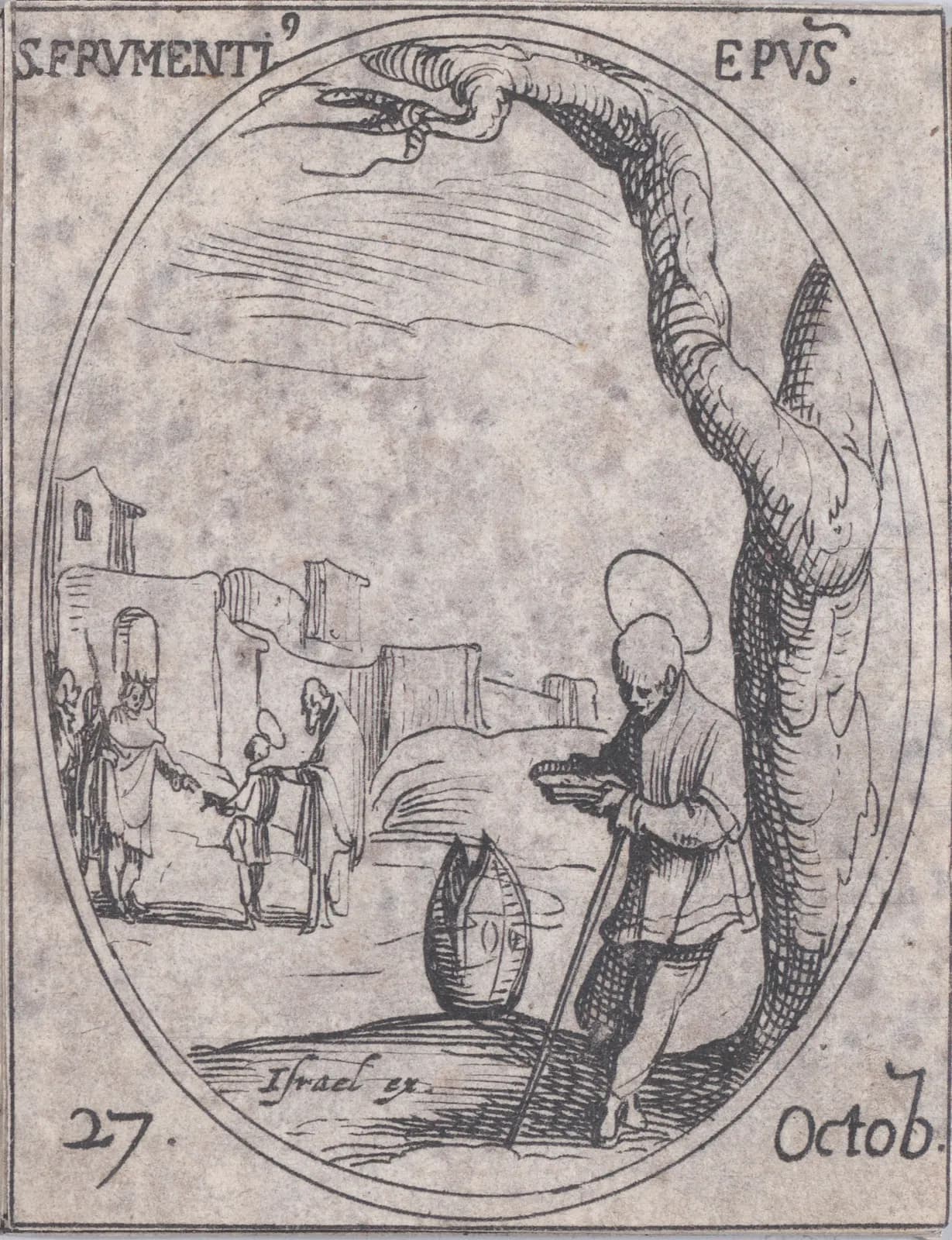
- Taken captive
- As a boy, when his ship was attacked in a Red Sea harbor; about 316, says the Catholic Encyclopedia 123
- Consecrated
- By Saint Athanasius of Alexandria, in 328 or between 340 and 346, says the encyclopedia 123
- Died
- About 383 1
Saint Frumentius was a boy from Tyre who survived the massacre of his ship's crew on the Red Sea, was carried as a slave to the king of Aksum, and rose to govern the kingdom for a widowed queen. 123 Freed, he went to Alexandria and asked Athanasius to send the country a bishop, and Athanasius sent him. 12 He is honored as the Apostle of Ethiopia, and his people called him Abba Salama, Father of Peace. 17
Captured on the Red Sea
The story was first written down by Rufinus of Aquileia, and Socrates, the fifth-century church historian who retells it, adds that "Rufinus assures us that he heard these facts from Edesius," Frumentius's companion. 2 Socrates and Sozomen both name the man who took the two boys traveling as Meropius, a philosopher of Tyre and a relative of theirs. 23 The 1909 Catholic Encyclopedia calls him Metropius, their uncle, and treats Edesius and Frumentius as probably brothers. 1
On the way home the ship put in at a harbor for water or supplies. 23 Relations between the Romans and the local people had just broken down, and the crew were killed, all except the two boys, who were spared because they were young. 23 Vatican News names the port as Adulis on the Red Sea. 6 Ott dates the capture about 316. 1 Socrates and Sozomen call the country "India"; Ott identifies it as Abyssinia and the court as that of the king of Axum. 123
The boys were given to the king. Socrates says he made Edesius his cupbearer and entrusted Frumentius "with the care of the royal records." 2 Sozomen puts Frumentius over the king's house and treasures, "for he perceived that he was intelligent and very capable in business." 3 Both served for years, and the king freed them shortly before he died. 123
Governing for the queen
The king left a widow and a son too young to rule, and the queen asked the two young men to stay and run the kingdom until the prince came of age. 123 Ott names the prince Erazanes; Vatican News names the heir Ezana. 16 They agreed, and Socrates says that "Frumentius controlled all things." 2
He used the position to look for Christians. Among the Roman merchants trading in the country he found some, and urged them to choose places where they could meet for worship. 23 Sozomen says he gathered them for prayer "after the Roman usage" and built houses of prayer. 3 Socrates adds that some of the local people were instructed and brought into the worship as well. 2 Ott sums it up: first the merchants were encouraged to keep their faith openly, and later some of the natives were converted. 1
When the prince came of age, the two handed back the government and asked leave to go home. 23 The king and his mother pressed them to stay, but they went. 2 Edesius returned to his family at Tyre and was ordained a priest there. 123
Bishop of Aksum
Frumentius did not go home. Sozomen says that "with him patriotism and filial piety were subordinate to religious zeal," and he went to Alexandria instead. 3 There he told Athanasius, newly made bishop, what had happened and asked him to send a bishop and clergy to the Christians he had left behind. 2 Sozomen says Athanasius consulted his priests; Socrates says he asked Frumentius himself to accept the office, "declaring that he could appoint no one more suitable than he was." 23 Ott dates the consecration 328, and notes that others put it between 340 and 346. 1
He went back as bishop, set up his see at Axum, and built churches. 12 Ott says he baptized King Aeizanas, who had by then come to the throne, and spread the faith throughout the country. 1 Socrates and Sozomen speak of healings and signs, and Sozomen says he "was revered as no less than an apostle." 23 Ott records the titles the people gave him, Abuna (Our Father) and Abba Salama (Father of Peace), and notes that they were still used for the head of the Ethiopian Church in his own day. 1 Vatican News gives a longer form of the name, which it renders as peaceful father and bearer of light. 6
Ott says that Abyssinian tradition credits Frumentius with the first Ethiopic translation of the New Testament. 1 Vatican News goes further, saying he translated the Bible and the Alexandrian liturgy into the language of the country. 6 Ott dates his death about 383. 1
The emperor's letter
The one contemporary document naming Frumentius comes from the Arian controversy. In his Apology to Constantius, Athanasius says he heard that letters had been written to the rulers of Aksum demanding that Frumentius be brought out of the country, and he quotes the letter in full. 4 Addressed by the emperor Constantius to Aezanes and Sazanes, it orders: "Send therefore speedily into Egypt the Bishop Frumentius to the most venerable Bishop George," so that George and the bishops with him could examine how he had been appointed. 4 Athanasius says the same letters threatened death to clergy and laity who would not communicate with the Arians. 4
The reason given is Frumentius's consecrator. The emperor writes that "this Frumentius was advanced to his present rank by Athanasius, a man who is guilty of ten thousand crimes." 4 Ott dates the letter 365 and says it asked the kings, without success, to replace Frumentius with the Arian bishop Theophilus. 1 On either reading the demand failed: Ott says the emperor made it "vainly." 1
What is Saint Frumentius the patron saint of?
None of the sources consulted names a patronage for Saint Frumentius. He is remembered as the Apostle of Ethiopia. 16 When John Paul II, in Ecclesia in Africa, recalled the saints of the early African Church, he repeated Paul VI's words naming "Saint Frumentius, known by the name of Abba Salama, who was consecrated Bishop by Saint Athanasius and became the first Apostle of Ethiopia." 7
Saint Frumentius's feast day
The current Roman Martyrology enters Saint Frumentius on July 20, as a bishop in Ethiopia who was first a prisoner and, ordained bishop by Saint Athanasius, spread the Gospel in that region. 5 That is the date this page follows. The 1909 Catholic Encyclopedia gives the older Latin feast of October 27, with November 30 among the Greeks and December 18 among the Copts. 1 Vatican News still lists him on October 27. 6
Praying with Saint Frumentius
Frumentius came to the country that would make him a bishop as a captive, after watching the crew of his ship killed. 23 The sources do not dwell on that, and nothing in them says he sought the work that followed. He served a king as a slave, and then a queen as a free man, and did both well enough to be trusted with the kingdom. 123
What he did with that trust was small at first. He looked for the few Christians among the foreign merchants and gave them somewhere to pray. 23 The Church in Ethiopia began from a handful of traders meeting in a house of prayer that an official of the court had built for them. 12
When he was free to go home he went to Alexandria instead, to ask for a bishop for other people, and came back carrying the office himself. 23 Years later an emperor demanded that he be sent away to answer for the bishop who had consecrated him, and the demand came to nothing. 14 Ott dates his death about 383, half a century after the consecration he dates 328, in the country Frumentius had first entered as a slave. 1
Saint Frumentius, pray for us.
Sources
- 1.Michael Ott, "Edesius and Frumentius," The Catholic Encyclopedia, Vol. 5 (New York: Robert Appleton Company, 1909).
- 2.Socrates Scholasticus, Ecclesiastical History, Book I, chapter 19, trans. A. C. Zenos, Nicene and Post-Nicene Fathers, Second Series, Vol. 2 (1890), via New Advent.
- 3.Sozomen, Ecclesiastical History, Book II, chapter 24, trans. Chester D. Hartranft, Nicene and Post-Nicene Fathers, Second Series, Vol. 2 (1890), via New Advent.
- 4.Athanasius, Apologia ad Constantium (Defense before Constantius), chapters 29-31, Nicene and Post-Nicene Fathers, Second Series, Vol. 4 (1892), via New Advent.
- 5.Roman Martyrology, entry for July 20, "San Frumenzio, vescovo," as printed in "Santo del giorno," Conferenza Episcopale Italiana (in Italian).
- 6."S. Frumêncio, bispo, apóstolo da Etiópia," Santo do dia, Vatican News, October 27 (in Portuguese).
- 7.John Paul II, Post-Synodal Apostolic Exhortation Ecclesia in Africa, 31 (September 14, 1995), quoting Paul VI.
Saints to turn to next
Others in this collection who are turned to for some of the same things.