Four Crowned Martyrs
Martyred c. 305-306
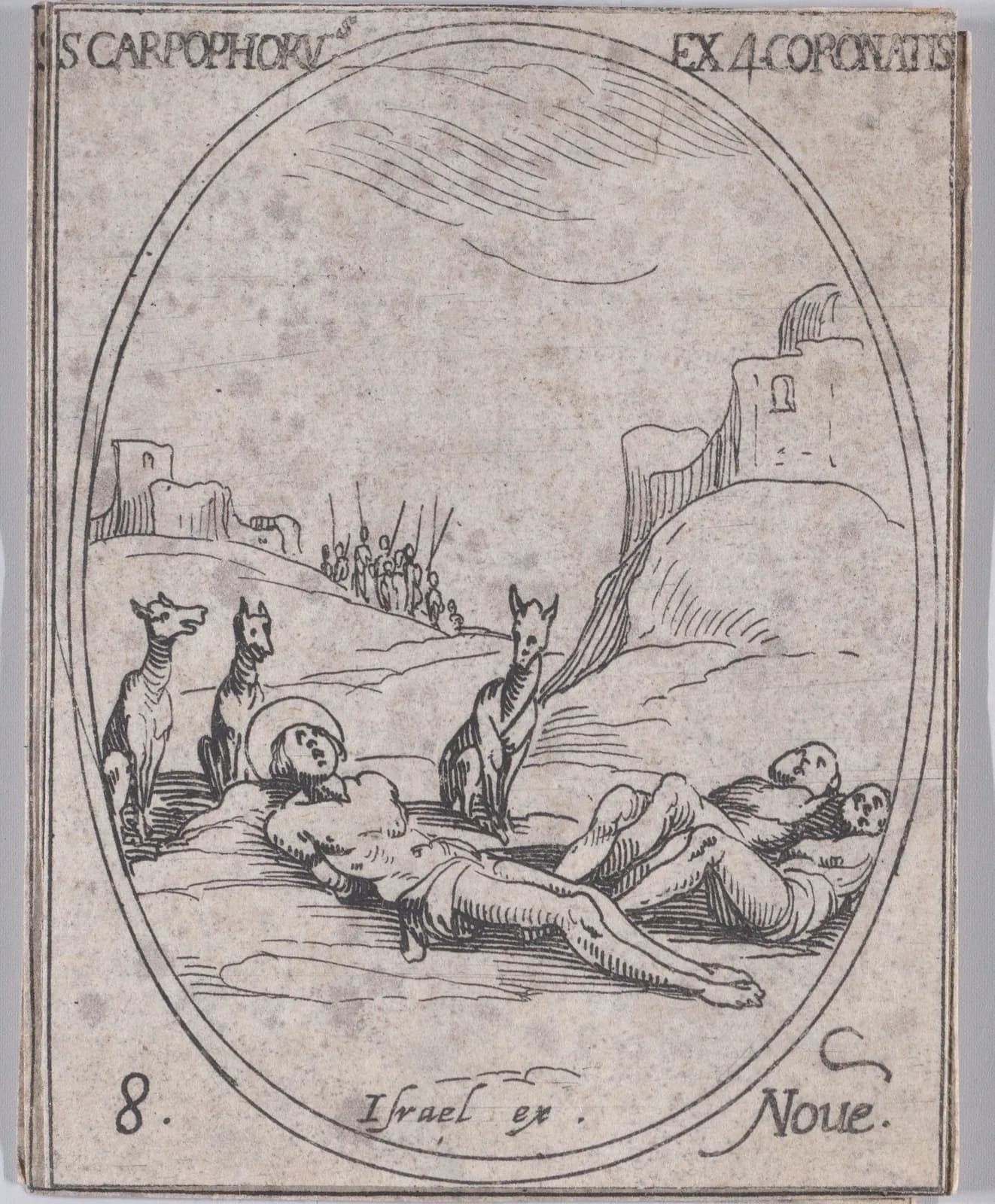
- Named today as
- Symphorian, Claudius, Nicostratus, Castorius and Simplicius, stonecutters of Pannonia 23
- Buried
- The Four Crowned were venerated in the catacomb of Saints Peter and Marcellinus on the Via Labicana 3
- Patron of
- Stonecutters and sculptors 1
- Emblems
- Chisel, compass, pick-hammer and other stonemason's tools 1
The Four Crowned Martyrs are a group of early Roman martyrs whose names were forgotten, venerated since antiquity at a basilica on the Caelian Hill that still bears their title. 13 The Roman Martyrology now gives the feast of November 8 to five stonecutters from Pannonia who refused to carve a statue of Aesculapius and were drowned on the orders of Diocletian. 2 How four became five, and how a second set of four names came to be attached to them, is the puzzle at the center of their story. 13
Four names that were lost
The oldest evidence is a grave. Johann Peter Kirsch, in the 1909 Catholic Encyclopedia, says the guidebooks used by pilgrims to the Roman catacombs mention "the Four Crowned Martyrs (Quatuor Coronati), at whose grave the pilgrims were wont to worship," in the catacomb of Saints Peter and Marcellinus on the Via Labicana. 3 Of them, he writes, "we know only that they suffered death for the Faith and the place where they were buried." 3
The Norwegian bishops' saints database (katolsk.no) explains that "crowned" refers to the martyr's crown. 1 The difficulty begins when names are added. One of the itineraries Kirsch cites lists them as "Claudius, Nicostratus, Simpronianus, Castorius, Simplicitus": four martyrs, as he puts it, "in reality five." 3
The stonecutters of Pannonia
Those five names belong to a group of sculptors who worked the quarries of Pannonia under Diocletian. 3 Kirsch says their Acts were written by a revenue officer named Porphyrius, probably in the fourth century, and that they agreed to carve "such profane images as Victoria, Cupid, and the Chariot of the Sun" but refused to make a statue of Aesculapius for a pagan temple. 3 For that they were condemned as Christians, shut in lead caskets and drowned in the River Save, toward the end of 305. 3 He calls this account "substantially authentic." 3
katolsk.no tells the Pannonian narrative at more length and notes that it is livelier than the Roman one, with a Diocletian who is unstable and complicated and has a passion for building. 1 In its telling the emperor, having abdicated in 305, often visited the imperial marble and porphyry quarries in the mountains north of Sirmium, today Mitrovica in Serbia, and chose his materials himself. 1 He noticed five unusually skilled stonecutters: Claudius, Nicostratus, Symphorian and Castor, who were Christians, and Simplicius, who had become one because he thought their skill came from their faith. 1
They made the statues he ordered except the Aesculapius. katolsk.no observes that this was somewhat inconsistent, since they had already carved a sun god, and that Diocletian at first let it pass and gave the work to other sculptors. 1 The local people were less tolerant. The five were jailed for refusing to sacrifice; when the officer Lampadius died suddenly, his relatives blamed the Christians, and the emperor ordered them executed. 1 Each was put in a lead coffin and thrown into the river, and the bodies were recovered three weeks later. 1 katolsk.no adds that one source has them always marking their work with a small cross. 1
The current Martyrology keeps this outline: Symphorian, Claudius, Nicostratus, Castorius and Simplicius were stonecutters at Srijem in Pannonia, in what is now Croatia, who refused in the name of Christ to carve a statue of Aesculapius and were thrown into the river by order of Diocletian. 2
Four soldiers in a Roman legend
A second story grew up at Rome to explain the name. Kirsch summarizes it: four Christian soldiers, cornicularii, were martyred at Rome two years after the sculptors for refusing to sacrifice to an image of Aesculapius, and were buried on the Via Labicana by Saint Sebastian and Pope Melchiades. 3 Since their names could not be established, the pope ordered them remembered on November 8, the anniversary of the five, under the five sculptors' names. 3
katolsk.no adds the details of this Roman passion: Diocletian had built a temple of Aesculapius in the Baths of Trajan and ordered his troops to sacrifice; the four who refused were beaten to death with lead-weighted whips and their bodies thrown into a sewer. 1 Kirsch is blunt: "This report has no historic foundation. It is merely a tentative explanation of the name Quatuor Coronati." 3 katolsk.no offers one explanation of why it was written: once the Pannonian story was known, it was awkward that the four were five, and the second passion made them four Roman soldiers. 1
The four of Albano
Then came the names that Callot engraved. katolsk.no quotes the older Roman Martyrology for November 8, which commemorated the five Pannonians and also four brothers, Severus, Severian, Carpophorus and Victorinus, beaten to death with lead-weighted whips; their names were "revealed" only later, and their feast was kept under the title of the Four Holy Crowned. 1 Kirsch gives the four revealed names as Secundus, Severianus, Carpoforus and Victorius. 3
Both sources trace those names to Albano, outside Rome. Kirsch says those martyrs were buried in the catacomb of Albano, were listed on August 7 in the Roman calendar of 354, and "have no connection with the Roman martyrs." 3 katolsk.no says the names were borrowed from the martyrology of the diocese of Albano, which kept their feast on August 8. 1 The current Martyrology has separated them: it commemorates Secundus, Carpophorus, Victorinus and Severian on August 8, at Albano on the fifteenth mile of the Appian Way. 4
Scholars have not agreed on what lies underneath. Kirsch treats the Four Crowned of the catacomb as "really authenticated martyrs" whose origin is unknown, joined to the five of Pannonia "in a purely external relationship." 3 katolsk.no reports that the Bollandist Hippolyte Delehaye concluded, after very detailed research, that there was only one group, the stonecutters of Pannonia, whose relics were later brought to Rome, and says that recent research inclines to agree. 1
The basilica on the Caelian and the church at Canterbury
Whoever they were, Rome honored them. Kirsch says a basilica was built and dedicated to them on the Caelian Hill in the fourth or fifth century, probably near the place where tradition put their execution; it became a titular church and is first mentioned among the signatures of a Roman council in 595. 3 About 850 Pope Leo IV moved their relics there from the Via Labicana, together with the relics of the five Pannonians, which had reached Rome at some unknown time. 3 katolsk.no says the present church took its form under Pope Paschal II (1099-1118), after the Normans sacked Rome and destroyed the old one. 1
Their cult traveled early. katolsk.no notes that Bede records a church dedicated to them at Canterbury in the seventh century, perhaps because Augustine of Canterbury came from a monastery near their basilica in Rome. 1 Bede places it in his account of a fire in 619, when the gout-ridden archbishop Mellitus had himself carried toward the flames: "The church of the four crowned Martyrs was in the place where the fire raged most." 5 The wind turned and the fire died, Bede says, by the bishop's prayer. 5
What are the Four Crowned Martyrs the patron saints of?
katolsk.no names the Four Crowned Martyrs as patron saints of stonecutters and sculptors, and says they were held in particular honor by the stonemasons' guilds of the Middle Ages. 1 In art they are shown as stonemasons with the tools of the trade: chisel, compass, pick-hammer and scribing tools. 1 It adds that the stonecutters were something more than laborers and something less than sculptors in the modern sense. 1
The Four Crowned Martyrs' feast day
The Four Crowned Martyrs' feast day is November 8. 12 The current Roman Martyrology gives the day to Symphorian, Claudius, Nicostratus, Castorius and Simplicius, and notes that their cult flourished at Rome from antiquity in the basilica on the Caelian Hill called the Four Crowned. 2 Kirsch wrote that in his day both groups were commemorated on November 8. 3
katolsk.no says the feast was once kept by the whole Church but was moved to particular calendars in the 1969 revision of the Roman calendar, with the explanation that their history raises many difficulties. 1 The four martyrs of Albano now have their own day, August 8. 4
Praying with the Four Crowned Martyrs
For most of the Church's history, the people who prayed at this grave did not know whose it was. 3 The pilgrims came anyway, a basilica rose over the memory, and a pope moved the relics into it. 3
The stonecutters of Pannonia, if they are the ones, drew their line at a single statue. They carved what the emperor asked for until the work required them to make a god, and they would not. 13
The legends that followed tried to fill the silence with soldiers and revealed names, and the Church's historians have spent a long time taking them apart again. 13 What is left is a feast kept for martyrs whose names may never be certain.
Four Crowned Martyrs, pray for us.
Sources
- 1."De hellige Fire kronede martyrer (Quatuor Coronati) (d. ~306?)," Den katolske kirke (katolsk.no), Catholic Diocese of Oslo (in Norwegian).
- 2.Roman Martyrology, entry for November 8, "Santi Simproniano, Claudio, Nicostrato, Castorio e Simplicio, martiri," as printed in "Santo del giorno," Conferenza Episcopale Italiana (in Italian).
- 3.Johann Peter Kirsch, "Four Crowned Martyrs," The Catholic Encyclopedia, Vol. 6 (New York: Robert Appleton Company, 1909).
- 4.Roman Martyrology, entry for August 8, "Santi Secondo, Carpóforo, Vittorino e Severiano, martiri," as printed in "Santo del giorno," Conferenza Episcopale Italiana (in Italian).
- 5.Bede, The Ecclesiastical History of the English Nation, Book II, chapter 7 (London: J. M. Dent; New York: E. P. Dutton, 1910), Internet Medieval Sourcebook, Fordham University.
Saints to turn to next
Others in this collection who are turned to for some of the same things.