Saint Ferreolus of Vienne
d. c. 304
- Also called
- Ferréol or Forget, in French; Ferreolus the Tribune 1
- Office
- A tribune in the imperial army at Vienne 12; a centurion, in the account of the diocese of Grenoble 6
- Died
- Beheaded beside the Rhône near Vienne, about 305 (303 or 304), says katolsk.no 1; the Grenoble account dates the persecution 287-290 6
- Emblem
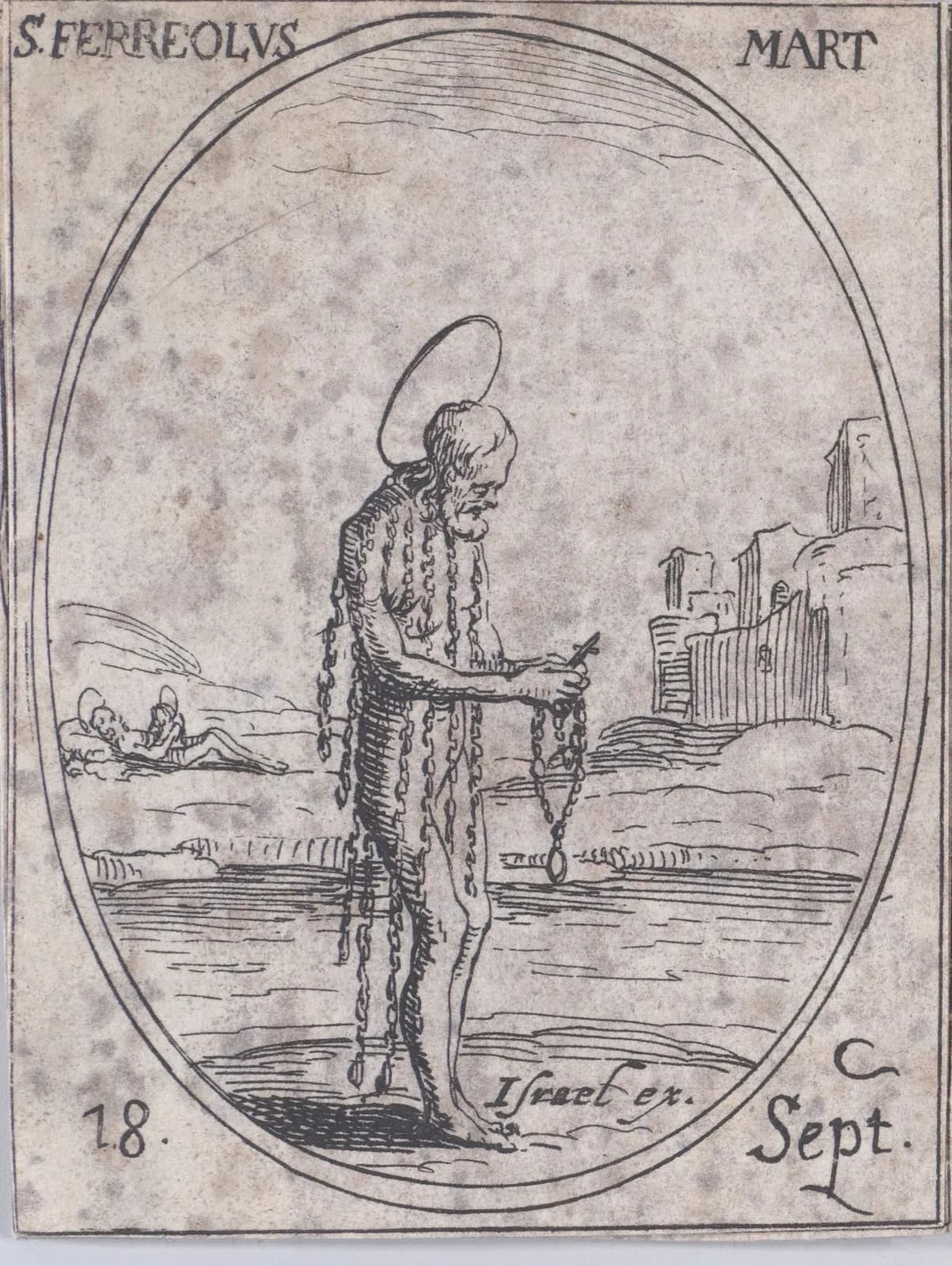
- Broken chains 1
Saint Ferreolus was a Roman officer at Vienne on the Rhône who, the Martyrology says, refused as a tribune to arrest Christians, was flogged and jailed, escaped, and was caught and beheaded. 2 His story survives in a passio that the Norwegian bishops' saints database calls more or less worthless, but it adds that there is no doubt he died a martyr, and that his cult is very old. 1 Gregory of Tours knew his tomb, which by then also held the head of Saint Julian of Brioude. 3
An officer at Vienne
Nothing is known of his birth except that it fell some time in the third century. 1 The passio, as katolsk.no tells it, makes him a tribune of the imperial army in Gaul, living at Vienne, who had been baptized but kept his faith hidden. 1 The current Roman Martyrology keeps the rank, and introduces the story with a phrase meaning that it is told so, its usual sign that it is passing on a tradition rather than vouching for it. 2
The figure most often set beside him is Julian, the martyr of Brioude in the Auvergne. katolsk.no reports a tradition that Ferreolus was Julian's commanding officer and that Julian lived for a time in his house. 1 Gregory of Tours, writing in the sixth century, says that Julian was born at Vienne and that while he lived with the most blessed Ferreolus he already burned for martyrdom. 3 When persecution broke out in the city, Julian left his property and family and went to the Auvergne, Gregory says, remembering the Lord's command to flee from one city to another. 3 He was found at Brioude and beheaded there. 3
The diocese of Grenoble, quoted on Nominis, the French bishops' site, tells the friendship differently. It makes Julian a legionary and Ferreolus a centurion of the same legion, and says that Ferreolus, who kept his faith quiet, heard of the measures being prepared and urged Julian, who did not, to escape to the Auvergne. 6
Arrest, escape and death
According to the passio, the governor, Crispin, had Ferreolus arrested because he would not arrest Christians himself. 1 katolsk.no gives the exchange. The judge reminded him that the state paid his wages and expected him to obey. 1 Ferreolus answered that he would gladly do without the money if he could live in peace and serve God, but that he would rather lose his life than give up his religion. 1 The diocese of Le Puy, also quoted on Nominis, gives his words as a refusal to sacrifice: he was a Christian, it was enough for him to live as one, and if that was not possible he was ready to die. 6
He was flogged and put in the worst cell of the prison. 12 On the third day, the passio says, his chains fell off, and finding the guards asleep and the doors open he walked out, left the city by the Lyon gate and swam the Rhône. 1 He had gone as far as the Gère, a stream that joins the Rhône about ten kilometers above Vienne, when his pursuers caught him. 1 They tied his hands behind his back to lead him back to the city, and then, in a sudden fit of savagery, cut off his head near the riverbank. 1 The Martyrology tells the same sequence in a sentence: flogged, imprisoned, escaped, recaptured, beheaded. 2
The date is uncertain. katolsk.no gives about 305, with 303 and 304 as alternatives, and notes that the Martyrology says the third century; the Grenoble account sets the trouble in the army between 287 and 290. 16 Julian's death is usually dated about 250, under Decius, katolsk.no adds, which would separate the two martyrdoms by half a century. 1
One tomb for two martyrs
The Christians of Vienne buried him with honor outside the city and built a church over the grave. 1 What happened to Julian's head is told three ways. Gregory says that Ferreolus received it and that, after his own martyrdom, the two were laid in a single tomb. 3 The Grenoble account says the soldiers carried it back to Vienne as proof that they had done their work. 6 Sidonius Apollinaris, writing in the fifth century, says it was "the executioner's gory hand" that brought it "to the raging persecutor." 4
Gregory heard the rest at the tomb itself. On a journey to meet Bishop Nicetius of Lyon he turned aside to Vienne to pray there, because, he says, he thought of himself as the foster son of Ferreolus as much as of Julian. 3 On the apse he read a couplet: this hall holds two heroes of Christ, Julian by his head and Ferreolus by his body. 3 He asked the sacristan why, and was told that the old church stood on the very bank of the Rhône, and that when the river brought down its portico, Bishop Mamertus built a new one of the same size and resolved to move the martyr there. 3
Abbots and monks kept a night vigil and dug, the sacristan said, and found three tombs, and no one knew which was the martyr's. 3 Someone remembered an old saying that Julian's head was kept in the grave of Ferreolus. The bishop had everyone pray, then opened the tombs. 3 In the third lay a man whose body and clothes were whole, his own head cut off, holding another head in his arm. 3 He was carried to the new church with psalms. 3 Gregory adds that "our Sollius," meaning Sidonius, bore witness to it in a letter to Mamertus. 3
That letter survives. Sidonius, then bishop of Clermont, wrote that since Ambrose found Gervasius and Protasius, it had been granted to Mamertus "alone in the West to translate the relics of two martyrs - all the holy body of Ferreolus, and the head of our martyr Julian." 4 He asked, "in compensation for the loss of this hallowed relic," for some share in Vienne's protection. 4 Dalton dates the letter 474, and katolsk.no gives 474 for the translation and about 469 for the new church; the diocese of Le Puy says 473. 416 katolsk.no also reports that the Bollandist Hippolyte Delehaye gave no credence to the finding of the head and called it historical romance. 1
The cult after Mamertus
Gregory's book on Julian shows how closely the two were bound in the Auvergne. Near Brioude, about ten stadia from the town, stood a church of Saint Ferreolus beside the spring where Julian's head had been washed. 3 Gregory went there once with a headache from the sun that had turned to fever, poured the water over his head, and says the pain left him at once. 3 In another chapter the possessed at Julian's feast complain of the saints he invites, and name among them Ferreolus, his colleague from Vienne. 3
Venantius Fortunatus, later in the sixth century, gives him one part of a church dedicated by a Bishop Felix, as a martyr who shines like a gem through the wound of the sword. 5 In a poem on virginity he lists the martyrs each city gives to heaven, and fair Vienne offers Ferreolus beside Julian of the Auvergne. 5
katolsk.no follows the relics further. The church at Vienne became a pilgrimage of more than local importance until it was destroyed by the Saracens about 725, after which Bishop Wilicarius brought the remains of both martyrs into the city. 1 Some later went to a church of Saint Ferreolus in the diocese of Girona. 1 The Vienne church was sold in the Revolution and is now a private house; only its crypt survives, rediscovered in 1859. 1
What is Saint Ferreolus the patron saint of?
None of the sources consulted names a patronage for Saint Ferreolus. katolsk.no says he is shown with broken chains, for his escape from prison, and lists the churches and places named for him, from Marseille to an island of the Lérins group. 1 Both katolsk.no and Nominis note that the village of Saint-Ferréol keeps his name. 16
Saint Ferreolus's feast day
Praying with Saint Ferreolus
The passio gives Ferreolus a soldier's argument. He did not deny that the state paid him or that it had a claim on his obedience; he said he would give up the pay before he would give up God. 1
He did not go looking for death, either. He kept his faith quiet, and in one account he urged his friend to run. 16 When the prison doors stood open he ran himself, across a river, and was caught anyway. 1
Gregory of Tours, who called himself the foster son of both men, remembered them as friends who could not be separated even in the grave. 3 Whether or not the head in the tomb was really Julian's, the church at Vienne laid them in one grave, and the couplet on its apse said so. 31
Saint Ferreolus of Vienne, pray for us.
Sources
- 1."Den hellige Ferreolus av Vienne (d. ~305)," Den katolske kirke (katolsk.no), Catholic Diocese of Oslo (in Norwegian).
- 2.Roman Martyrology, entry for September 18, "San Ferréolo, martire," as printed in "Santo del giorno," Conferenza Episcopale Italiana (in Italian).
- 3.Gregory of Tours, De passione et virtutibus sancti Iuliani martyris (Miraculorum liber II), chapters 1-3, 25 and 30, in J. P. Migne, Patrologia Latina 71 (Paris, 1849), as transcribed on Latin Wikisource (in Latin).
- 4.Sidonius Apollinaris, Letters, Book VII, letter 1, "To the Lord Bishop Mamertus," trans. O. M. Dalton (Oxford: Clarendon Press, 1915), via tertullian.org.
- 5.Venantius Fortunatus, Carmina (Miscellanea), Book III, poem 7, and Book VIII, poem 6, in J. P. Migne, Patrologia Latina 88, as transcribed on Latin Wikisource (in Latin).
- 6."Saint Ferréol, martyr à Vienne, en Dauphiné (IIIe siècle)," Nominis, Conférence des évêques de France (in French).
Saints to turn to next
Others in this collection who are turned to for some of the same things.