Saint Felix of Valois
1127 - November 4, 1212
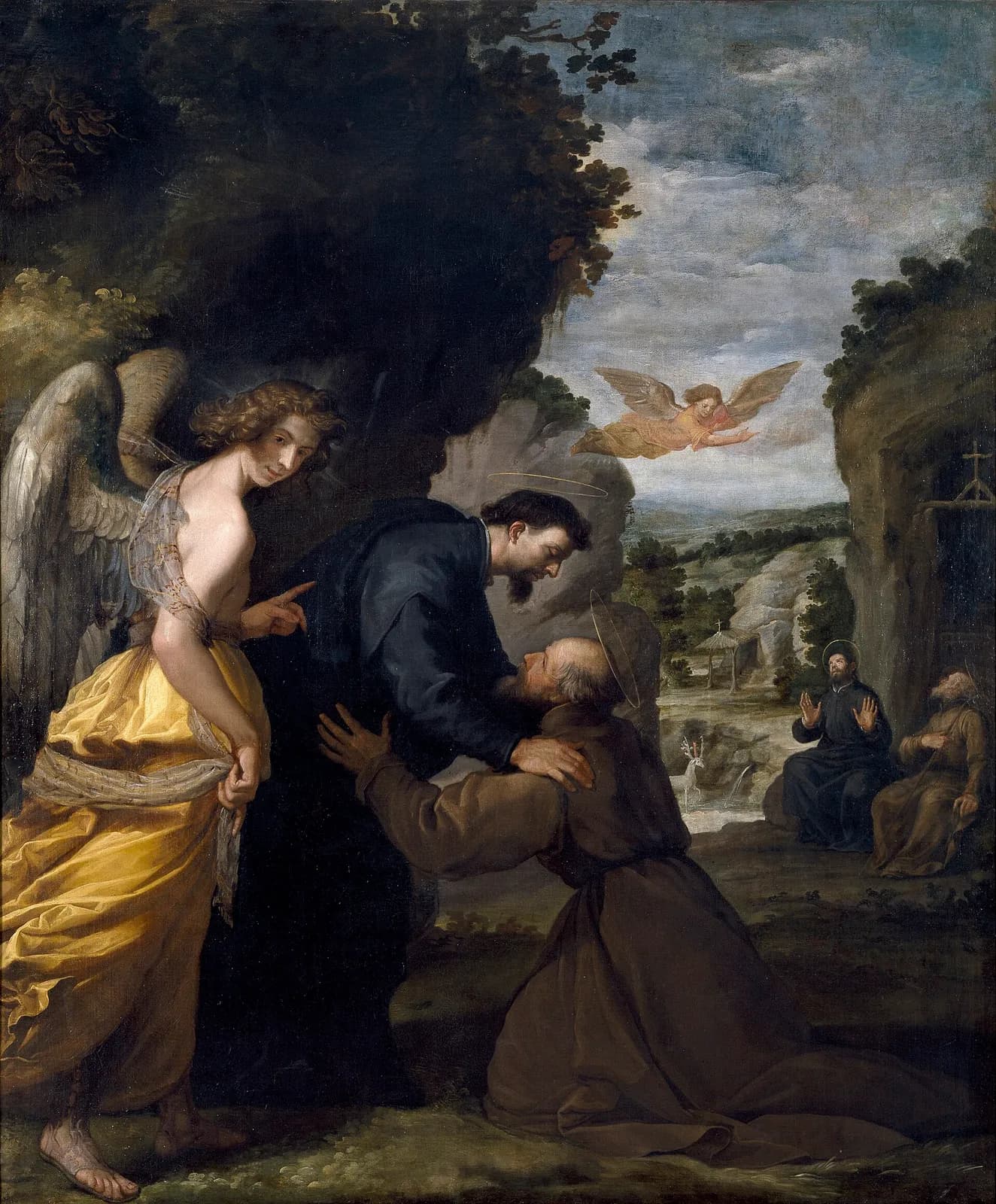
- Known for
- Co-founding, with Saint John of Matha, the Order of the Holy Trinity for the Redemption of Captives 145
- Cult
- Confirmed by Pope Alexander VII in 1666 12; a canonization by Urban IV in 1262 is a tradition of the order 12
- Patron saint of
- No patronage is stated by the sources consulted
Saint Felix of Valois was a French hermit who, by the tradition of the Trinitarian Order, helped Saint John of Matha found it in 1198 to ransom Christians held captive in Muslim lands. 134 He died at Cerfroid, the order's first house, on November 4, 1212. 13 His own order says frankly that the documents for his life are "rather weak," and the Roman Martyrology says only that he is believed to have been John's companion. 35
The hermit of Cerfroid
The Catholic Encyclopedia gives his birth as 1127 and says that "at an early age he renounced his possessions and retired to a dense forest in the Diocese of Meaux, where he gave himself to prayer and contemplation." 1 Michael O'Kane, who wrote the entry, says he was surnamed Valois either because he belonged to the royal branch of that name or simply because he came from the province of Valois. 1
The tradition is grander. katolsk.no and the Trinitarians both say he was born Hugh, a son of Raoul, Count of Vermandois, and Eleanor of Champagne; katolsk.no dates his birth to April 19, 1127, the Trinitarians to April 9, at Amiens. 23 Both say he was taught by Saint Bernard of Clairvaux, went on crusade, and on his return gave up his titles and took the name Felix. 23 katolsk.no calls this a legend and adds that he became a priest. 2
John of Matha and the stag
The sources tell the meeting differently. O'Kane says Felix "was joined in his retreat by St. John of Matha, who proposed to him the project of founding an order for the redemption of captives." 1 Charles Moeller, writing on the Trinitarians for the same encyclopedia, reverses the credit: John, a doctor of the University of Paris, "conceived the project under the pious inspiration of a pious solitary, St Felix of Valois," at a hermitage called Cerfroid. 4
The Trinitarians' own account says John joined a group of hermits in the forest of Cerfroid, about seventy kilometers northeast of Paris, and that their leader, "a certain Felix of Valois," met him and "enthusiastically offered his person and possessions to the Trinitarian project." 3 katolsk.no places the meeting near Montigny in 1193 or 1194, soon after John's ordination, with other disciples gathering around them. 2
Then comes the stag. katolsk.no tells it as legend: a white stag that came to drink at the hermits' spring appeared in 1197 with a red and blue cross in its antlers, recalling the vision John had seen at his first Mass, and both men took it as a sign from God. 2 The Trinitarians tell it as part of a conversation by the spring. 3 katolsk.no says the place was renamed Cerfroid, in Latin Cervus frigidus, in memory of the stag. 2
Rome, 1198
The two men went to Rome at the start of the pontificate of Innocent III, carrying letters from the Bishop of Paris. 1 O'Kane says the pope lodged them in his palace and, after the plan had been considered "in several solemn conclaves of cardinals and prelates," judged them inspired by God. 1 He named their institute the Order of the Holy Trinity for the Redemption of Captives, and had the Bishop of Paris and the Abbot of Saint Victor draw up a rule, which he confirmed on December 17, 1198. 14 katolsk.no names the two as Bishop Odo and Abbot Absalon and says the rule was based on Saint Augustine's, with a white habit bearing a red and blue cross. 2
Moeller describes the rule. Each house was to have seven brothers, one of them superior, and its revenues were to be divided into three parts: one for the brothers, one for the poor, and one "for the ransom of captives." 4 The friars were forbidden to travel on horseback, which earned them the popular name of "Friars of the Ass." 4
Founder at home
Felix went back to France to establish the order, and King Philip Augustus authorized it. 1 Margaret of Blois gave the order twenty acres of the wood where Felix had built his first hermitage, and on almost the same spot he built Cerfroid, the mother house of the order. 12 O'Kane says Felix also founded a house in Paris attached to the church of Saint Maturinus. 1 Moeller says the Paris house was founded in 1228 and eventually eclipsed Cerfroid, and that the friars were known in France as Mathurins. 4
The Trinitarians give Felix a quieter role than John. After the first ransoming expedition returned in the spring of 1199, they say, John set about spreading the order in Europe while Felix took charge of "the internal administration and especially the spiritual formation of the candidates." 3 They identify him with the Felix whom documents of the time name as minister of Marseilles, and say he held that post from 1200 to 1208 before going back to Cerfroid. 3
The order grew quickly. O'Kane says that within forty years it had six hundred monasteries "in almost every part of the world." 1 katolsk.no gives eight hundred at its height in the fourteenth century and says the order is credited with ransoming 900,000 captives; Moeller estimates 90,000 over three centuries, the most famous of them Miguel de Cervantes, ransomed in 1580. 24
Death, and the question of the documents
On the night of September 7-8, 1212, the feast of the Nativity of Mary, Felix is said to have gone into the church at Cerfroid for matins and found the Virgin and a choir of angels, all in the habit of the order, singing the office. 23 katolsk.no adds that the sacristan had forgotten to ring the bell. 2 It also says John came to Cerfroid a few days later to see his old friend. 2 Felix died there on November 4, 1212, at eighty-five by katolsk.no's reckoning, and was probably buried there. 23
katolsk.no says plainly that some historians doubt that Felix existed at all, and John of Matha to a much lesser degree. 2 The Trinitarians answer with unusual candor: "We must humbly acknowledge that the documentation proving his existence and worship at the origin of the Order is rather weak." 3 They add that the silence of the documents is not proof for the other side, and that generations of Trinitarians have seen in Felix "the contemplative dimension of the Order." 3 The Roman Martyrology chooses its words with the same care: it says that Felix, after a long solitary life, is believed to have been John's companion in the founding. 5
The cult, at least, is old. O'Kane says his feast was kept in the diocese of Meaux in 1215. 1 katolsk.no says the canons of Meaux had invoked him since 1219 and that the order's general chapter fixed his feast in 1291. 2 The order holds that Pope Urban IV canonized him and John in 1262, but no bull survives; Pope Alexander VII confirmed their cult in 1666. 12
What is Saint Felix of Valois the patron saint of?
None of the sources consulted names a patronage for Saint Felix of Valois, so this page does not give one. katolsk.no says he is shown in the white habit of his order, often with the stag and its red and blue cross, and often with broken chains for the order's work of ransom. 2 It notes that the stag has led to his being confused with Saints Hubert and Eustace, whose legends also put a cross between a stag's antlers. 2
Saint Felix of Valois's feast day
Saint Felix of Valois has two dates. For nearly three centuries his feast was November 20: O'Kane and katolsk.no both say Innocent XI moved it there in 1679, and katolsk.no adds that Innocent XII extended it to the whole Church in 1694. 12 In 1969 it was taken out of the universal calendar and left to local and particular calendars. 2 The current Roman Martyrology enters him on November 4, the day of his death. 5
Praying with Saint Felix of Valois
Felix comes to us mostly through what his order needed him to be. The Trinitarians say as much: popular hagiography, especially from the fifteenth century on, gave them a figure "that can be embellished but wonderfully expresses the apostle's need of God for his mission, the redeemer for the redemption of his brethren." 3
That is the shape of the story. A man of prayer in a forest is found by a younger man with a plan to buy back prisoners, and gives himself and everything he has to it. 13 In the order's telling he did not lead the expeditions. He trained the novices, kept the house, and went to the church at night to sing the office. 23
Ransoming captives needed people who would sail to North Africa with the money. 4 It also needed people at home to pray, and to form the next ones who would go. Felix is remembered as the second kind, and generations of Trinitarians have seen in him the contemplative side of their work. 3
Saint Felix of Valois, pray for us.
Sources
- 1.Michael O'Kane, "St. Felix of Valois," The Catholic Encyclopedia, Vol. 6 (New York: Robert Appleton Company, 1909).
- 2."Den hellige Felix av Valois (1127-1212)," Den katolske kirke (katolsk.no), Catholic Diocese of Oslo (in Norwegian).
- 3."Trinitarian Saints," Order of the Most Holy Trinity and of Captives (Trinitarian Order).
- 4.Charles Moeller, "Order of Trinitarians," The Catholic Encyclopedia, Vol. 15 (New York: Robert Appleton Company, 1912).
- 5.Roman Martyrology, entry for November 4, "San Felice di Valois," as printed in "Santo del giorno," Conferenza Episcopale Italiana (in Italian).
Saints to turn to next
Others in this collection who are turned to for some of the same things.
- Saint Agnes of Bohemiac. 1200-1205 - March 1281 or 1282Poverty and simplicityPrayer
- Saint Aidan of Lindisfarnec. 590 - August 31, 651Poverty and simplicityPrayer
- Saint Alexius of RomeFifth century, by traditionPoverty and simplicityPrayer
- Saint André BessetteAugust 9, 1845 - January 6, 1937PrayerPoverty and simplicity