Saint Felix I
Died 274
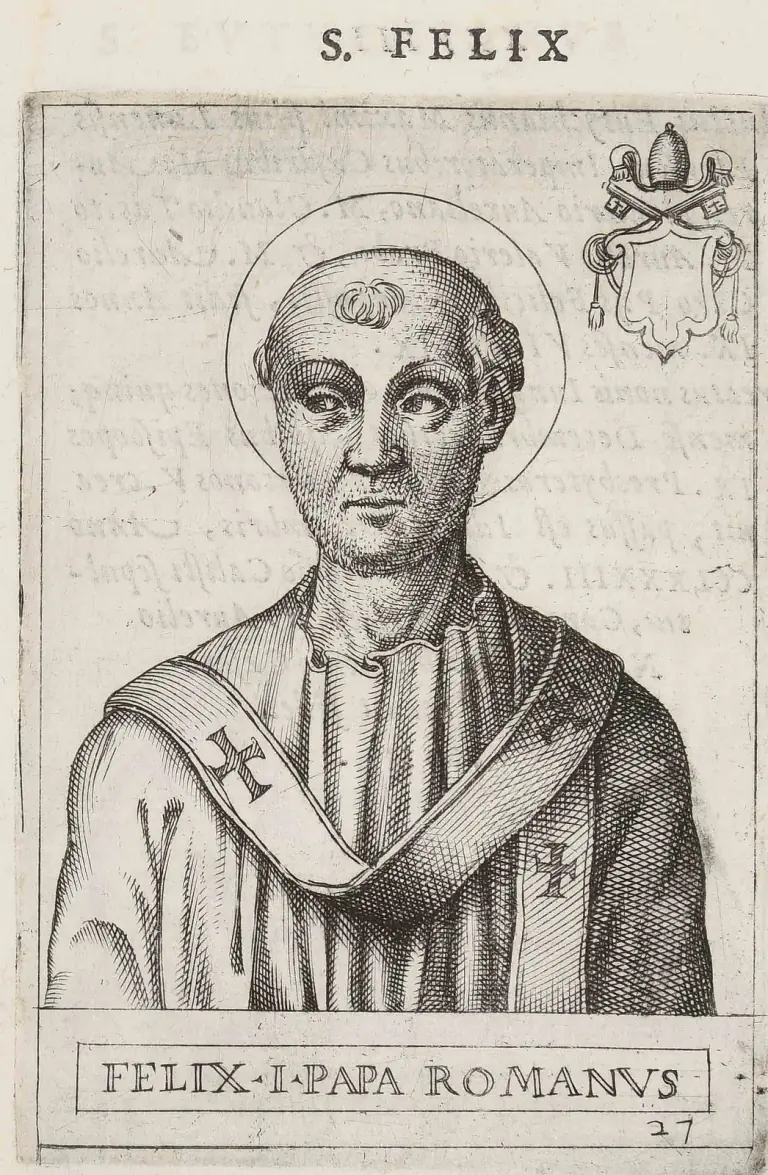
- Origin
- A Roman, son of Constantius, says the Liber Pontificalis 6; born in Rome about 210, son of Constantinus, says katolsk.no 2
- Pope
- January 5, 269, to December 30, 274, says the Holy See 4; from early 269 to 274, says Kirsch 1; five years, say Eusebius and Butler 57; the 26th pope in the Holy See's list 4
- Known for
- The judgment that settled the Antioch church on Paul of Samosata's successor; a letter on the Incarnation read at the Council of Ephesus 1259
- Died
- In 274 14; a martyr, say the Liber Pontificalis and Butler 67; not a martyr, say Kirsch and katolsk.no 12
- Buried
- In the Catacomb of Callistus on the Via Appia, December 30 123; on the Via Aurelia, says the Liber Pontificalis 6
Saint Felix I was bishop of Rome from 269 to 274, the successor of Saint Dionysius, and so little is known of him that even his dates are uncertain. 24 His name survives because of a quarrel at Antioch: when its deposed bishop, Paul of Samosata, refused to give up the church, the pagan emperor Aurelian ruled that it belonged to whoever the bishops of Rome and Italy said it did. 5 Later legend made him a martyr, a story the Catholic Encyclopedia and the Norwegian bishops trace to a confusion with another Felix. 12
One of the least known popes
The Liber Pontificalis, the old book of the lives of the popes, calls him "by nationality a Roman, son of Constantius." 6 katolsk.no, citing the same book, names the father Constantinus and puts his birth in Rome around 210, and then adds frankly that he is one of the least known of the popes, with uncertain dates. 2 Kirsch, writing for the Catholic Encyclopedia in 1909, gives the date of his birth as unknown. 1
He succeeded Dionysius early in 269, Kirsch says. 1 The Holy See dates his pontificate from January 5, 269, to December 30, 274, and counts him the 26th pope. 4 Eusebius of Caesarea, writing a generation later, says only that Dionysius held office for nine years "and was succeeded by Felix," and that Felix "presided over the church of Rome for five years." 5 The Liber Pontificalis is less sure of itself. Its two versions give him either 2 years and 10 months or 4 years, 3 months and 25 days, and place him "in the time of Claudius and Aurelian," from 269 to 274. 6 It also records that he held two ordinations in December, making nine priests, five deacons and five bishops. 6
The letter from Antioch
The business that filled his years began before them. Paul of Samosata, bishop of Antioch, held "low and degraded views of Christ," Eusebius says, "namely, that in his nature he was a common man." 5 Butler, following the older historians, describes him as teaching that Christ was "no more than a mere man, in whom the Divine Word dwelt by its operation, and as in its temple." 7 Bishops came to Antioch from all over the East to examine him, and two councils, Butler says, failed to pin him down. 57
At a final synod a presbyter named Malchion drew him out in a debate taken down by stenographers, and Paul was excommunicated. 5 The bishops chose Domnus, the son of an earlier bishop of Antioch, in his place, and wrote a circular letter to "Dionysius, bishop of Rome, and Maximus of Alexandria," and to the whole Church. 5 It asked them to write to Domnus and receive letters of communion from him. 5 Eusebius copied out its account of Paul's pride: a bishop who preferred to be called by a civil title, kept a throne and a private chamber like a magistrate, and had hymns sung to himself in church at Easter. 5
The letter was addressed to Dionysius, but it was his successor who had to deal with it. 157 Kirsch says the synod's report reached Rome "about this time," and Butler that it was delivered to Felix because his predecessor was dead. 17 katolsk.no thinks Felix probably received it, and that he seems to have entered into communion with Domnus as a result. 2
Aurelian's ruling
Deposed or not, Paul would not leave. "As Paul refused to surrender the church building," Eusebius writes, "the Emperor Aurelian was petitioned; and he decided the matter most equitably, ordering the building to be given to those to whom the bishops of Italy and of the city of Rome should adjudge it. Thus this man was driven out of the church, with extreme disgrace, by the worldly power." 5
Butler tells it the same way, though in his account what Paul held was the episcopal house, and it was Domnus who appealed to the emperor. 7 katolsk.no places the appeal at the moment Aurelian passed through Antioch, and names a different beneficiary: Domnus had died in 270 or 271, and his successor Timaeus held the see when the case came to Rome. 2 Either way, katolsk.no concludes, the judgment must have been Felix's, and it secured Paul's expulsion. 2 None of the sources records what Felix wrote. The emperor, who was not a Christian, had simply taken communion with Rome as the test of who was the Catholic bishop of Antioch, and Felix gave the answer. 257
Eusebius adds that Aurelian later changed his mind about the Christians and was on the point of ordering a persecution, "in the very act of signing the decrees against us," when, as Eusebius tells it, divine judgment came upon him and stopped him. 5
A letter read at Ephesus
Felix seems also to have answered the synod in writing. 12 Butler says that he wrote "a learned epistle" to Maximus of Alexandria, setting out the Catholic doctrine of the Incarnation, and that it was quoted at the Council of Ephesus, by Saint Cyril of Alexandria and by Saint Vincent of Lerins. 7 Vincent, who wrote shortly after the council of 431, lists the authorities read there and says that, "lest Greece or the East should seem to stand alone," the council also heard "certain Epistles of St. Felix, martyr, and St. Julius, both bishops of Rome." 9
Kirsch is more cautious. A letter probably sent by Felix to the East, setting out the doctrine of the Trinity, was later interpolated by a follower of the heretic Apollinaris, and the altered text was what reached Ephesus; the surviving fragment stresses the unity of the Son of God and the Son of Man in Christ. 1 katolsk.no allows that the fragment may be an edited extract of a letter to Maximus, but notes that modern scholars think it false. 2
Mass over the martyrs
The Liber Pontificalis credits him with one decree: "He instituted the celebration of masses over the memorials of the martyrs." 6 katolsk.no reads it as the beginning of the custom of burying martyrs beneath church altars and celebrating Mass at their graves. 2 Kirsch doubts Felix issued any such decree. In his reading the compiler was describing the custom of his own day, when Mass was said privately at altars by the martyrs' tombs in the catacombs while the solemn liturgy was held in the basilicas above; that custom grew out of the yearly services at the martyrs' graves, held as early as the third century, and the compiler gave it to Felix because Felix had changed nothing. 1 Loomis notes that the poet Prudentius saw Masses offered at the martyrs' tombs at the end of the fourth century. 6
Two men named Felix
The Liber Pontificalis says flatly that "he was crowned with martyrdom," that he built a basilica on the Via Aurelia, and that he was buried there, two miles from the city, on May 30. 6 Butler repeats the story with color: in Aurelian's persecution Felix "strengthened the weak, encouraged all, baptised the catechumens," and won the martyr's crown, a title Butler says the Council of Ephesus, Cyril and Vincent all gave him. 7 The 1897 English Martyrology entered "the birthday of St. Felix, pope and martyr," on the Aurelian road. 8
Kirsch calls the martyrdom "manifestly due to a confusion of names." 1 The fourth-century Roman calendar lists Felix among the bishops of Rome, not among the martyrs, and gives his burial as "III Kal. Januarii, Felicis in Callisti," that is, December 30 in the Catacomb of Callistus on the Via Appia. 1 The church on the Via Aurelia stood over the grave of a Roman martyr of the same name. 1 Loomis, after Duchesne, says the pope was merged with two martyrs called Felix who were associated with a basilica there, and that he was buried with his predecessors in Callistus; katolsk.no puts his grave in the papal crypt. 26 The current Martyrology agrees with them: it records the "deposition" of Felix I at Callistus, a word for burial and not for martyrdom. 3
What is Saint Felix I the patron saint of?
Saint Felix I's feast day
Saint Felix I's feast day is December 30. 3 The current Roman Martyrology, as the Italian bishops print it, commemorates his burial that day in the Catacomb of Callistus on the Via Appia and notes that he governed the Roman Church under the emperor Aurelian. 3 December 30 is the date of his burial in the fourth-century Roman list, and the date the Holy See gives for the end of his pontificate. 14
The older books kept him on May 30, the date of his death in the Liber Pontificalis, and both Butler and the 1897 Martyrology have him there. 678 Kirsch thought May 30 probably a copyist's error, "Jun." written for "Jan." in the Roman date, and katolsk.no says it remained in the Roman calendar until 1969. 12
Praying with Saint Felix I
Almost nothing is known of what he did, and the one act the sources most nearly agree on was asked of him by a pagan emperor, about a building in another city. 25 The Church at Antioch had already judged Paul's teaching; what remained was the ordinary, unglamorous question of who should have the building, and a bishop of Rome was asked to say which side was in communion with him. 5
His legend gave him a martyrdom he did not suffer, and the record has had to take it back. 12 What is left is a bishop buried with his predecessors in the crypt of Callistus, listed among the bishops and not the martyrs, whose day the Church keeps as the day he was laid in the ground. 136
The custom the Liber Pontificalis credited to him, of offering Mass at the graves of the martyrs, was not his invention, Kirsch thinks, but the practice of a Church that prayed where its dead were buried. 16 He kept it, and was buried in one of those cemeteries himself. 12
Saint Felix I, pray for us.
Sources
- 1.J.P. Kirsch, "Pope St. Felix I," The Catholic Encyclopedia, Vol. 6 (New York: Robert Appleton Company, 1909).
- 2."Den hellige pave Felix I (~210 - ~274)," Den katolske kirke (katolsk.no), Catholic Diocese of Oslo (in Norwegian).
- 3.Roman Martyrology, entry for December 30, "San Felice I, papa," as printed in "Santo del giorno," Conferenza Episcopale Italiana (in Italian).
- 4."Felix I," The Supreme Pontiffs, The Holy See.
- 5.Eusebius of Caesarea, Church History, Book 7, chapters 27-30 and 32, trans. Arthur Cushman McGiffert, Nicene and Post-Nicene Fathers, Second Series, Vol. 1 (1890), at New Advent.
- 6.The Book of the Popes (Liber Pontificalis), trans. Louise Ropes Loomis (New York: Columbia University Press, 1916), "Felix I (269-274)," with the translator's notes.
- 7.Alban Butler, "St. Felix I., Pope, Martyr," The Lives of the Fathers, Martyrs, and Other Principal Saints, Vol. 5, May 30 (Derby: Thomas Richardson and Son).
- 8.The Roman Martyrology, May 30 (Baltimore: John Murphy Company, 1897).
- 9.Vincent of Lerins, The Commonitory, chapter 30, trans. C.A. Heurtley, Nicene and Post-Nicene Fathers, Second Series, Vol. 11 (1894), at New Advent.
Saints to turn to next
Others in this collection who are turned to for some of the same things.