Saint Ezra
Fifth century BC
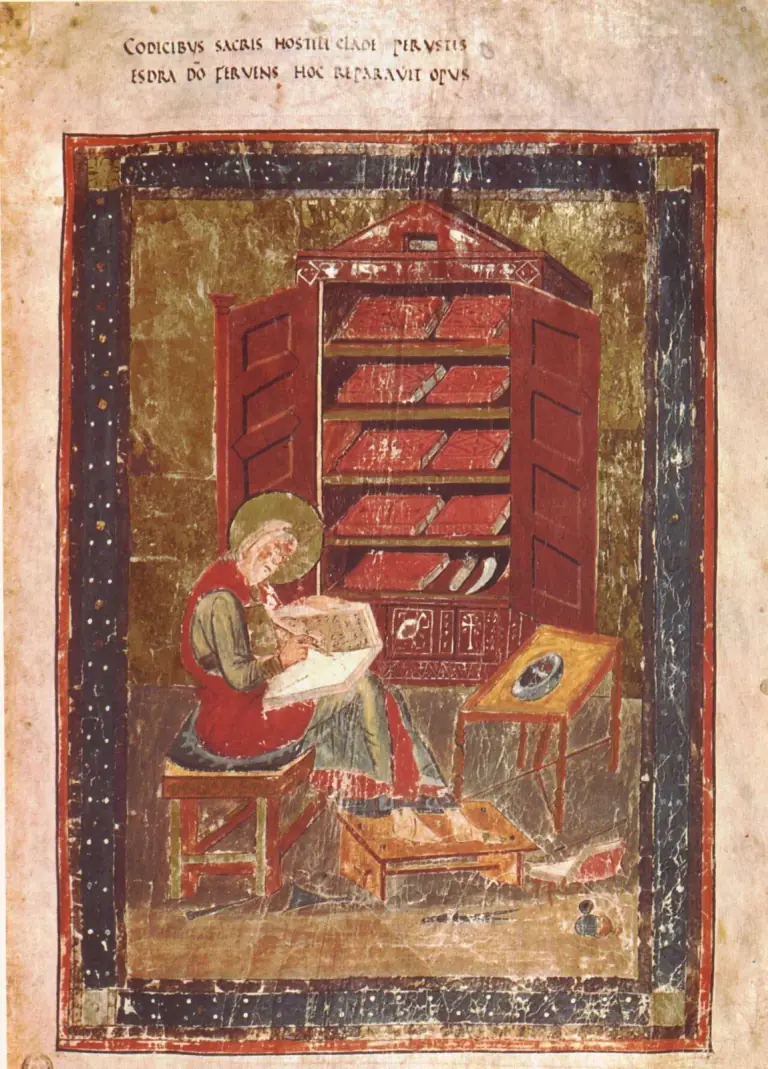
Saint Ezra was a priest and scribe of the Jewish exile in Babylon who led a company back to Jerusalem under the Persian king Artaxerxes and set out to restore the people's observance of the law of Moses. 12 He is remembered above all for reading the law aloud to the whole people, from daybreak until noon, at the Water Gate. 5 His feast is July 13. 6
A scribe in Babylon
Ezra was of priestly descent, from the line of Zadok, and the book that bears his name traces his ancestry back to Aaron. 12 It calls him "son of Seraiah," and both the Catholic Encyclopedia and the notes of the New American Bible say this cannot be meant literally: Seraiah was the chief priest put to death by the Babylonians at the fall of Jerusalem. 12
He was known less as a priest than as a scribe. 1 Scripture describes him as "a scribe, well-versed in the law of Moses," who "had set his heart on the study and practice of the law of the LORD and on teaching statutes and ordinances in Israel." 2
The exiles had long had leave to go home, and a community had resettled and rebuilt the Temple. The Catholic Encyclopedia describes its state as "most precarious," pressed by the Persian governors and grown careless of the law. 1 Ezra, who stood in favor at the Persian court, obtained a royal decree with wide powers and money from the royal treasury, and freedom for any Jew who wished to go with him. 12
When he came
The date is one of the most disputed questions of the period. 1 Read in its traditional order, the text puts Ezra's mission first, about 458 BC, with Nehemiah following in 444; some scholars reverse the order, which would put Ezra as late as 397. 1 The notes of the New American Bible take the "seventh year of King Artaxerxes" to be the seventh year of Artaxerxes I, 458 BC, and call the arguments for 398 or 428 "inconclusive." 2
The fast at the river Ahava
Ezra gathered the travelers by the river that flows toward Ahava, near Babylon, and camped for three days. 3 He found laymen and priests but not a single Levite, and sent for some; "since the favoring hand of our God was over us," a group of them came. 3 The Catholic Encyclopedia counts some eighteen hundred men in the company. 1
Then he proclaimed a fast "that we might humble ourselves before our God to seek from him a safe journey." 3 He gives the reason himself: he was ashamed to ask the king for soldiers and horsemen, having told the king that "the favoring hand of our God is over all who seek him." 3 They fasted, and the journey was granted. 3 They set out on the twelfth day of the first month, and after about four months, the Catholic Encyclopedia says five, they reached Jerusalem. 321
The mixed marriages
Soon after his arrival the leaders came to Ezra with a report that many of the people, including priests and Levites and the leaders themselves, had married women of the surrounding peoples. 41 His own account of his reaction is vivid: "I tore my cloak and my mantle, plucked hair from my head and beard, and sat there devastated" until the evening sacrifice. 4
Then he knelt and prayed aloud: "My God, I am too ashamed and humiliated to raise my face to you." 4 The prayer is a confession in the first person plural, for the sins of the whole people. 4 The Catholic Encyclopedia says it so moved the assembly that a man named Sechenias, or Shecaniah, proposed, in their name, that the foreign wives and the children born of them be sent away. 1
Ezra took an oath from the people that they would do it, and a commission under him sat for three full months; at the end the wives were dismissed. 1 "What was the outcome of this drastic measure we are not told," the Catholic Encyclopedia says; Ezra's memoirs break off there. 1
The reading of the law
On the first day of the seventh month the whole people gathered in the square before the Water Gate and asked Ezra to bring out the book of the law of Moses. 5 Standing on a wooden platform built for the occasion, he read from it "from daybreak till midday" to the men, the women, and the children old enough to understand, while Levites explained it to the people. 5
The people wept as they heard it, and were told: "Today is holy to the LORD your God. Do not lament, do not weep!" and "rejoicing in the LORD is your strength!" 5 The next day the heads of families gathered around Ezra to study the law and found in it the command to live in booths for the feast of the seventh month. They kept the feast for seven days, and Ezra read from the law every day of it. 51
Nehemiah 8 names Nehemiah the governor beside Ezra that day, and the Catholic Encyclopedia has Nehemiah adjourn the weeping assembly. 51 The notes of the New American Bible say the mention of Nehemiah is a later gloss and that there is "no clear evidence" the two men were in Jerusalem at the same time. 5
The second Moses
After this, canonical Scripture says nothing more about him, and the time and place of his death are unknown. 1 The Catholic Encyclopedia notes a tomb on the banks of the Tigris, long a place of Jewish pilgrimage. 1
His memory grew. Jewish life afterward was shaped along the lines he laid down, and the Catholic Encyclopedia thinks there is "probably a great deal of truth" in the tradition that he organized the synagogues and fixed the books held sacred. 1 Legend went further and made him a second Moses who restored from memory all the books of the Old Testament thought lost in the Exile. 1 It is this Ezra, the restorer of the sacred books, whom the eighth-century miniature reproduced on this page shows at work before a cupboard full of them. 1
He had nothing to do with the books called Third and Fourth Esdras. 1 Fourth Esdras, though not Scripture, left its mark on the liturgy: the Catholic Encyclopedia notes that its second chapter gave the verse "Requiem æternam" to the Office of the Dead. 1
What is Saint Ezra the patron saint of?
Saint Ezra's feast day
Saint Ezra's feast day is July 13. The current Roman Martyrology commemorates him on that day as priest and scribe, who in the time of the Persian king Artaxerxes returned from Babylon to Judea, gathered the scattered people, and worked to study, practice and teach the law of the Lord in Israel. 6
Praying with Saint Ezra
Scripture sums him up in one line: he had set his heart on the study and the practice of the law, and on teaching it. 2 The three go together in that order.
Before the journey he did not ask the king for soldiers, because he had already told the king that God protects those who seek him. He fasted instead. 3
His prayer over the people's sin is said in the first person plural. The report he had been given was about others, and he prayed as one of them. 4 What followed, the sending away of wives and children, is set down in the sources without comment on its cost, and this page does not supply one. 14
At the Water Gate the people wept to hear the law, and were told the day was holy and that joy in the Lord was their strength. 5
Saint Ezra, pray for us.
Sources
- 1.Charles L. Souvay, "Esdras," The Catholic Encyclopedia, vol. 5 (New York: Robert Appleton Company, 1909).
- 2.Ezra 7, with notes, New American Bible, Revised Edition, United States Conference of Catholic Bishops.
- 3.Ezra 8, with notes, New American Bible, Revised Edition, United States Conference of Catholic Bishops.
- 4.Ezra 9, with notes, New American Bible, Revised Edition, United States Conference of Catholic Bishops.
- 5.Nehemiah 8, with notes, New American Bible, Revised Edition, United States Conference of Catholic Bishops.
- 6.Roman Martyrology, entry for July 13, "Sant'Esdra, sacerdote e scriba," Santo del giorno, Conferenza Episcopale Italiana (in Italian).
Saints to turn to next
Others in this collection who are turned to for some of the same things.
- Saint Abercius of HieropolisSecond century; died at seventy-two or laterPrayerStudy and teaching
- Saint Aelred of Rievaulx1109 - January 12, 1166 (or 1167)PrayerStudy and teaching
- Saint Ambrosec. 340 - April 4, 397PrayerStudy and teaching
- Saint Anselm of Canterbury1033 or 1034 - April 21, 1109Study and teachingPrayer