Saint Evaristus
Died about 105, 107 or 112
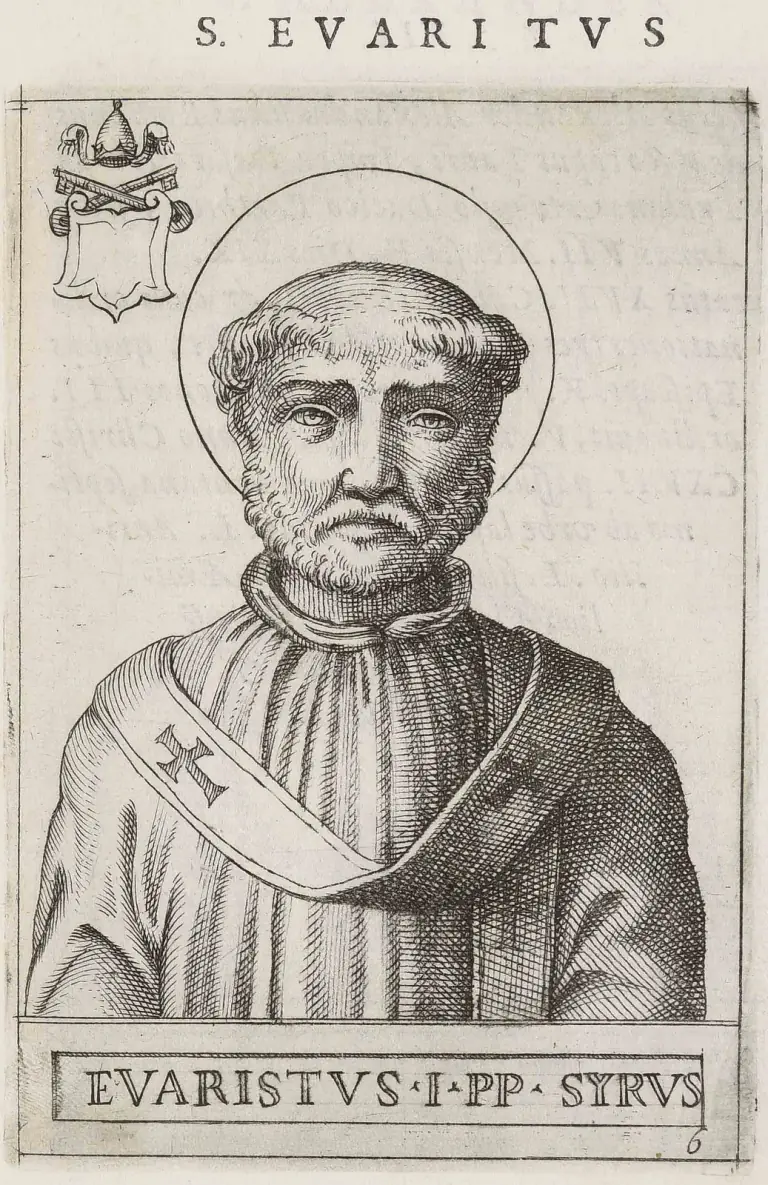
- Born
- Date unknown; the Liber Pontificalis calls him a Greek of Antioch, son of a Jew named Judah from Bethlehem 17
- Pope
- Fourth bishop of Rome after Peter 345; about 98 or 99 to about 106 or 107, by Kirsch's reckoning 1; eight years, says Eusebius 6
Saint Evaristus was bishop of Rome for about eight years around the year 100, in the reign of the Emperor Trajan, succeeding Clement and followed by Alexander. 136 Saint Irenaeus names him in the oldest list of the Roman bishops, and that place in the list is nearly all that history keeps of him: "The earliest historical sources offer no authentic data about him," the Catholic Encyclopedia says. 14 The current Roman Martyrology keeps his memory on October 27. 3
Fourth after Peter
Irenaeus of Lyons, writing in the second century, set down the bishops of Rome to show that the apostles' teaching had come down by a public succession. Linus came first, then Anacletus, then Clement, who "had seen the blessed apostles, and had been conversant with them," and in whose time the Roman church wrote its letter to the quarreling Christians of Corinth. 4 Then: "To this Clement there succeeded Evaristus. Alexander followed Evaristus; then, sixth from the apostles, Sixtus was appointed." 4
Eusebius of Caesarea heads a chapter of his Church History "Evarestus, the Fourth Bishop of the Church of Rome." 5 Clement, he writes, "committed the episcopal government of the church of Rome to Evarestus" in the third year of the emperor whose reign he has just been describing, Trajan, after nine years of his own. 5 Johann Peter Kirsch, in the Catholic Encyclopedia, notes that the papal lists of the second century used by Irenaeus and Hippolytus put him immediately after Clement, and he calls that order "undoubtedly correct." 1 The current Roman Martyrology says the same in its own words: he governed the Church of Rome fourth after blessed Peter, under the Emperor Trajan. 3
Not every later account agrees. Alban Butler, in the eighteenth century, has him succeed Anacletus. 9 The Liber Pontificalis, the collection of papal lives compiled at Rome centuries afterward, numbers him sixth. Its translator Louise Ropes Loomis explains why: "The fifth bishop of Rome was not Anencletus but Evaristus," and the compiler, following the Liberian Catalogue, had taken Cletus and Anencletus, two forms of one name, for two different men. 7 The Liberian Catalogue itself, Kirsch adds, gives his name as Aristus. 1
How long, and when
Eusebius gives him eight years: in about the twelfth year of Trajan, "Alexander, the fifth in the line of succession from Peter and Paul, received the episcopate at Rome, after Evarestus had held the office eight years." 6 Kirsch follows the same lists and puts the reign from about 98 or 99 to about 106 or 107. 1
The other figures scatter. The Liber Pontificalis survives in two forms, one giving thirteen years, seven months and two days, the other nine years, ten months and two days, and it dates him by the consuls of 96 to 108, "in the time of Domitian and Nerva and Trajan." 7 The Norwegian bishops' saints database (katolsk.no) sets his election in 97, with a question mark, gives the Liberian Catalogue's thirteen years and ten months, and dates his death to 105; then it adds that all of this is guesswork. 2 Butler gives nine years and a death in 112. 9
A family from Bethlehem
The Liber Pontificalis is the only early source to say where he came from. In Loomis's translation he was "by nationality a Greek of Antioch," and the "son of a Jew named Judah, from the city of Bethlehem." 7 Kirsch reports it as a Hellenic family and a father who was a Bethlehem Jew, and katolsk.no as a Greek whose father was the Greek Jew Judah of Bethlehem. 12 Neither of them vouches for it. Kirsch's judgment on the early sources stands over the whole notice: they "offer no authentic data about him." 1
Parishes and deacons
The same book credits him with two acts of government. "He divided the parish churches in the city of Rome among the priests, and ordained 7 deacons to keep watch over the bishop when he spoke, for the sake of the word of truth." 7 Loomis connects the first with the life of Cletus before him, who is said to have ordained twenty-five priests for the city: Cletus supplied the priests, and Evaristus gave them their churches. 7 The number, she notes, seems chosen to give apostolic sanction to the twenty-five parish churches that Rome actually had at the close of the fifth century. 7 For the deacons she quotes a canon of the apocryphal council of Sylvester, which wanted seven deacons beside the bishop "lest in speaking we say Father in place of Son or Holy Spirit in place of Father." 7
Later writers built on this. Butler records that "the institution of cardinal priests is by some ascribed to him," because he first divided Rome into titles or parishes with a priest assigned to each. 9 katolsk.no says the seven deacons have been reckoned the origin of the College of Cardinals, and then that none of these reports has any historical value. 2 Kirsch puts it more exactly: the Liber Pontificalis "arbitrarily refers to the time of Evaristus a later institution of the Roman Church." 1
The book also says he held three ordinations in December, making seventeen priests, two deacons and fifteen bishops. 7 It says much the same of Clement and Anencletus before him. 7 Butler, taking the notice at face value, explains the month with Mabillon and Claude de Vert: bishops were busiest at Lent and Pentecost and freer in Advent, and "holy orders were always conferred in seasons appointed for fasting and prayer." 9
The Church under Trajan
Eusebius describes the reign Evaristus lived through. Pliny the Younger, then a provincial governor, wrote to Trajan that the Christians he was condemning did nothing unlawful "except that they arose at dawn and sang hymns to Christ as a God." 5 Trajan answered "that the race of Christians should not be sought after, but when found should be punished," and local persecutions went on under that rule. 5 In the same reign, Eusebius writes, Ignatius of Antioch was taken under guard to Rome to die by the beasts, and wrote ahead to the church there "entreating them not to secure his release from martyrdom." 5 No source consulted says who was leading the Roman church when that letter arrived, and this page does not guess. 15
Martyr or not
The Liber Pontificalis says, "He was crowned with martyrdom." 7 The 1897 English edition of the Roman Martyrology entered him on October 26 as "pope and martyr, who, under the emperor Adrian, adorned the Church of God with his blood," which puts his death in Hadrian's reign rather than Trajan's. 8 Butler notes that he "is honoured with the title of martyr in the Pontificals and in most Martyrologies." 9 katolsk.no gives the tradition as a martyrdom in Rome under Trajan in 105 and says it is not historically proven. 2 Kirsch says the same in fewer words: "The martyrdom of Evaristus, though traditional, is not historically proven." 1 The current Martyrology names him only as pope, and so does Vatican News. 310
His grave is better attested. The Liber Pontificalis says he "was buried near the body of the blessed Peter" on the Vatican, on October 27, and that the see then stood empty for nineteen days. 7 Kirsch calls this "more trustworthy" than the rest of the notice, and katolsk.no agrees that it is the more probable report. 12
Two decretals were later ascribed to him in the Pseudo-Isidorian collection. Kirsch calls them forged, and katolsk.no counts two letters and two decretal fragments ascribed to him as apocryphal. 12
What is Saint Evaristus the patron saint of?
Saint Evaristus's feast day
Saint Evaristus's feast day is October 27. The Roman Martyrology, in the text the Italian bishops publish, keeps his memory on that day, and Vatican News lists him under the same date. 310 It is also the day the Liber Pontificalis gives for his burial. 7
Older sources keep October 26. Kirsch writes, "His feast occurs 26 Oct.," and katolsk.no, the 1897 Martyrology and Butler all have him on that day. 1289 None of the sources consulted says when or why the date changed.
Praying with Saint Evaristus
What survives of Evaristus is his place between two names. Irenaeus did not record anything he did; he recorded that he came after Clement, the man who had heard the apostles, and before Alexander. 4 For Irenaeus that was the point of the list: the teaching handed on in Rome could be traced, bishop by bishop, back to those who had received it first. 4
Later centuries wanted more and supplied it: a family from Bethlehem, the parishes of Rome, the seven deacons, the forged letters. 127 The sources that report these things are also the ones that say how little they can bear. 12
He led the Roman church in years when Christians, by the emperor's own rule, were not to be hunted down but were to be punished when found. 5 Whether he died a martyr is not known. 1 The Church today remembers him simply as a pope, buried near Peter. 37
Saint Evaristus, pray for us.
Sources
- 1.Johann Peter Kirsch, "Pope St. Evaristus," The Catholic Encyclopedia, vol. 5 (New York: Robert Appleton Company, 1909).
- 2."Den hellige pave Evaristus ( -~105)," Den katolske kirke (katolsk.no), Catholic Diocese of Oslo (in Norwegian).
- 3.Roman Martyrology, entry for October 27, "Sant'Evaristo, papa," Santo del giorno, Conferenza Episcopale Italiana (in Italian).
- 4.Saint Irenaeus, Against Heresies, Book III, chapter 3, translated by Alexander Roberts and William Rambaut, Ante-Nicene Fathers, vol. 1 (Buffalo: Christian Literature Publishing Co., 1885), as hosted by New Advent.
- 5.Eusebius, Church History, Book III, chapters 33, 34 and 36, translated by Arthur Cushman McGiffert, Nicene and Post-Nicene Fathers, Second Series, vol. 1 (Buffalo: Christian Literature Publishing Co., 1890), as hosted by New Advent.
- 6.Eusebius, Church History, Book IV, chapter 1, translated by Arthur Cushman McGiffert, Nicene and Post-Nicene Fathers, Second Series, vol. 1 (Buffalo: Christian Literature Publishing Co., 1890), as hosted by New Advent.
- 7.The Book of the Popes (Liber Pontificalis), I: To the Pontificate of Gregory I, translated by Louise Ropes Loomis (New York: Columbia University Press, 1916), lives of Cletus through Evaristus, with the translator's notes.
- 8.The Roman Martyrology, October 26 (Baltimore: John Murphy Company, 1897).
- 9.Alban Butler, "St. Evaristus, Pope and Martyr," October 26, in The Lives of the Fathers, Martyrs, and Other Principal Saints, vol. X (Derby: Richardson and Son, 1842), at archive.org.
- 10."St. Evaristus, Pope," Saints of the Day, October 27, Vatican News.
Saints to turn to next
Others in this collection who are turned to for some of the same things.