Saint Euthymius the Great
377 - January 20, 473
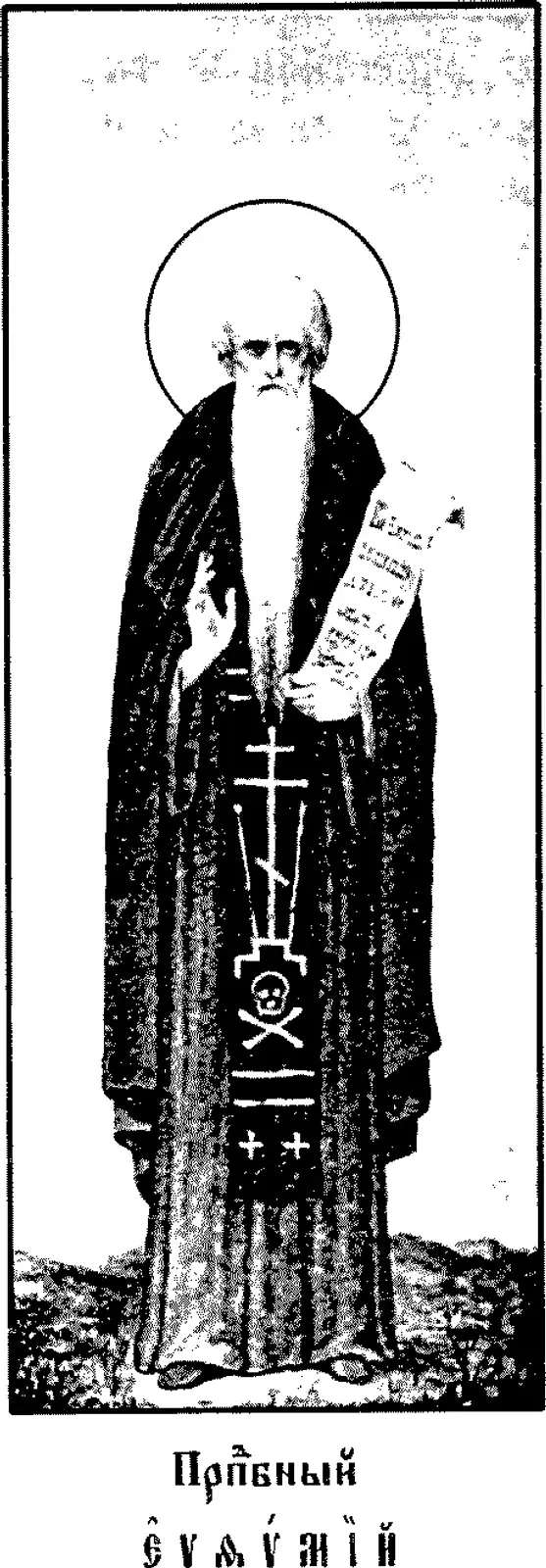
Saint Euthymius was a priest of Armenia who walked away from a bishop's trust at twenty-nine to live in a cave in the Judean desert, and spent the next sixty-eight years trying to stay alone while disciples, sick people, Arab tribesmen and an empress kept finding him. 12 He founded the laura on the road from Jerusalem to Jericho, helped bring the monks of Palestine to accept the Council of Chalcedon, and died in 473. 12 The Greeks call him the Great, and his feast is January 20. 14
A child of Melitene
He was born in 377 at Melitene in Lesser Armenia. 2 His parents, Paul and Dionysia, were noble, wealthy and childless for years, and Butler says the birth was "the fruit of the prayers of his pious parents, through the intercession of the martyr Polyeuctus," whose tomb was in the city. 13 His father died when he was three. His mother kept a vow she had made and gave the boy to the bishop, Otreius, who baptized him, raised him in his own household and made him a reader. 23
He was ordained priest young; Arduino, following his ancient biographer Cyril of Scythopolis, says at nineteen. 3 The bishop made him overseer of all the monasteries of the diocese. 12 He spent nights in prayer on a mountain outside the city, and every year went up there alone from the octave of the Epiphany until nearly the end of Lent. 13
To the desert of Judea
The office weighed on him. At twenty-nine he left secretly, prayed at the holy places in Jerusalem, and took a cell at the laura of Pharan, six miles from the city; Ott puts it six miles east. 12 A laura, Butler explains, "consisted of cells at a little distance from one another, and not under the same roof, as a monastery." 1 He learned to make baskets and sold them, keeping enough to live on and giving the rest away. 13
At Pharan he became friends with a hermit named Theoctistus. Butler says that after five years the two of them moved ten miles further toward Jericho; Ott dates the move to 411. 12 They lived on raw herbs in a large cave on the bank of a torrent, and when shepherds told others about them and men came asking to join, the cave became a church and a monastery grew on the ledge above it. 123 Euthymius gave the community to Theoctistus and kept a hermitage further off, seeing visitors only on Saturdays and Sundays. 1
Terebon
About 420 a party of Arabs came to the monastery asking for him. Theoctistus told them it was impossible: Euthymius stayed in his cave all week. Their chief answered that he had brought his son, half of whose body was paralyzed, and that Euthymius had appeared to the boy in the night and promised to heal him. 3 Butler names the father Aspebetes, an idolater who had spent a fortune on Persian physicians and magicians. 1 Euthymius came, made the sign of the cross over the boy, and he was cured. 123
The father asked for baptism and took the name Peter, and many of his people followed him. 13 Butler says the patriarch Juvenal made him bishop of the Arabs; Ott says he was ordained priest and became bishop over his tribe. Both say he attended the Council of Ephesus in 431. 12 It was this cure, Ott writes, that made the hermit's name known far beyond Palestine. 2
Running from the crowds
He did not want the fame. He took a single disciple, Domitian, and went south to the wilderness of Ruba near the Dead Sea, to a mountain called Marda, and then to the desert of Ziph, where David had hidden from Saul. 23 Crowds followed him there too, and Arduino says that near Ziph he converted a group of Messalians, a sect that rejected the sacraments and held that prayer alone overcame the devil. 3
In the end he settled in a cave about three miles from the monastery of Theoctistus and came down only for the Sunday liturgy. 23 Disciples kept arriving. In 420, Butler and Ott agree, he founded a laura of his own on the right of the road from Jerusalem to Jericho; Ott adds that Juvenal, the first patriarch of Jerusalem, dedicated its church in 428. 12 Arduino tells of four hundred Armenian pilgrims arriving at once to see their countryman, and of Domitian finding the storeroom, which held food for ten, so full he could not open the door. 3
His rule was moderate in one particular way. He told his monks "never to eat so much as to satisfy their hunger," Butler says, "but strictly forbade among them all singularity in fasts, or any other common observances, as savoring of vanity and self-will." 1 They worked with their hands, kept silence, gave their surplus to the poor, and every year went out into the desert from the octave of the Epiphany to Holy Week. 1 No woman was admitted inside the laura. 13
Butler tells of a drought, when crowds came to his cell carrying crosses and singing Kyrie eleison. "I am a sinner," he said; "how can I presume to appear before God, who is angry at our sins? Let us prostrate ourselves all together before him, and he will hear us." 1 He went into his chapel and lay on the ground with some of his monks, and Butler says the rain came. 1
Chalcedon and the empress
The Council of Chalcedon condemned the teaching of Eutyches in 451, and much of Palestine refused it. Ott writes that it was "greatly due to the authority of Euthymius that most of the Eastern recluses accepted its decrees." 2 When a rival claimant seized the see of Jerusalem by force, Euthymius would not recognize him and withdrew to the desert of Ruba until Juvenal was restored. Butler names the usurper Theodosius; Arduino calls him Dioscorus. 13
The widowed empress, living in Palestine, had protected the opposing party. Butler calls her Eudocia; Ott and Arduino call her Eudoxia. 123 Shaken by the sack of Rome and the capture of her daughter and granddaughters by the Vandals, she wrote to Simeon Stylites for advice. In Arduino's telling, Simeon answered: why go looking for water far away when the spring is beside you? She had Euthymius; she should follow him. 13
Since he admitted no woman to his laura, she built a tower in the desert thirty furlongs away and asked him to meet her there. 1 He told her to leave the Eutychians and accept Chalcedon. Butler says she did, returned to communion with Juvenal, and "an incredible number followed her example." 1 In 459 she asked to meet him again, meaning to endow the laura. He sent word that she should spare herself the trouble and prepare for death. She died soon after. 1
His death
Among his last disciples was the young Sabas, whom Butler says he "tenderly loved." 1 In January 473 Martyrius and Elias, both of whom he had told would one day be patriarch of Jerusalem, came to take him out on his Lenten retreat. He said he would stay with them that week and leave them on the Saturday, meaning by death. 1 He named Elias his successor and told Domitian he would follow him within seven days, which happened. 13 Arduino adds that he foretold the laura would become a cenobium, as it did, and that he was buried in his own cave, where his relics stayed until the middle of the eighth century. 13
Butler says he died "being ninety-five years old, of which he had spent sixty-eight in the deserts." 1 The Greek Church, Arduino writes, regards him as one of the chief shapers of its liturgy and credits him with the first codification of the monastic rules later taken into the typicon of Saint Sabas. 3
What is Saint Euthymius the patron saint of?
Saint Euthymius's feast day
Saint Euthymius's feast day is January 20, the day on which the current Roman Martyrology commemorates him: an abbot in Palestine, Armenian by birth, consecrated to God from childhood, steadfast in humility and charity until his death. 4 Ott says the Church keeps his feast on January 20, "the day of his death," and Arduino gives January 20, 473, as the date he died. 23
Butler also places him on January 20 and says Sabas kept his festival immediately after his death, a feast "observed both by the Latins and Greeks." 1 His printed text, though, says that Euthymius "died on Saturday the 28th day of January." This page keeps the date of the Martyrology and of Ott and Arduino, and notes Butler's. 1234
Praying with Saint Euthymius
Most of the story is a man trying to be left alone with God and being found anyway. He went from Melitene to Pharan, from Pharan to a cave, from the cave to Marda and Ziph, and each time people followed. 123 In the end he took them in, and the laura that bears his name was built around the disciples he had tried to avoid. 23
His rule shows a particular kind of severity. His monks were never to eat their fill, and none of them was to fast more conspicuously than the rest. 1 He seems to have feared self-will dressed up as holiness more than he feared comfort. 1
When the crowds came begging for rain, he called himself a sinner and lay down on the floor with them. 1 When an empress wanted to give him money, he told her to get ready to die. 1 Neither answer was what was asked for.
He was ninety-five, by Butler's count, and had spent sixty-eight of those years in the desert. 1 At the end he was still getting ready to go out into the wilderness for Lent. 1
Saint Euthymius the Great, pray for us.
Sources
- 1.Alban Butler, "St. Euthymius, Abbot," January 20, in The Lives of the Fathers, Martyrs, and Other Principal Saints, Vol. I (New York, 1895), Project Gutenberg eBook #20450.
- 2.Michael Ott, "St. Euthymius," The Catholic Encyclopedia, Vol. 5 (New York: Robert Appleton Company, 1909).
- 3.Fabio Arduino, "Sant' Eutimio, Abate," Santi, beati e testimoni (santiebeati.it) (in Italian).
- 4.Roman Martyrology, entries for January 20, Santo del giorno, Conferenza Episcopale Italiana (in Italian).
Saints to turn to next
Others in this collection who are turned to for some of the same things.