Saint Eustochium
About 368 - 419 or 420
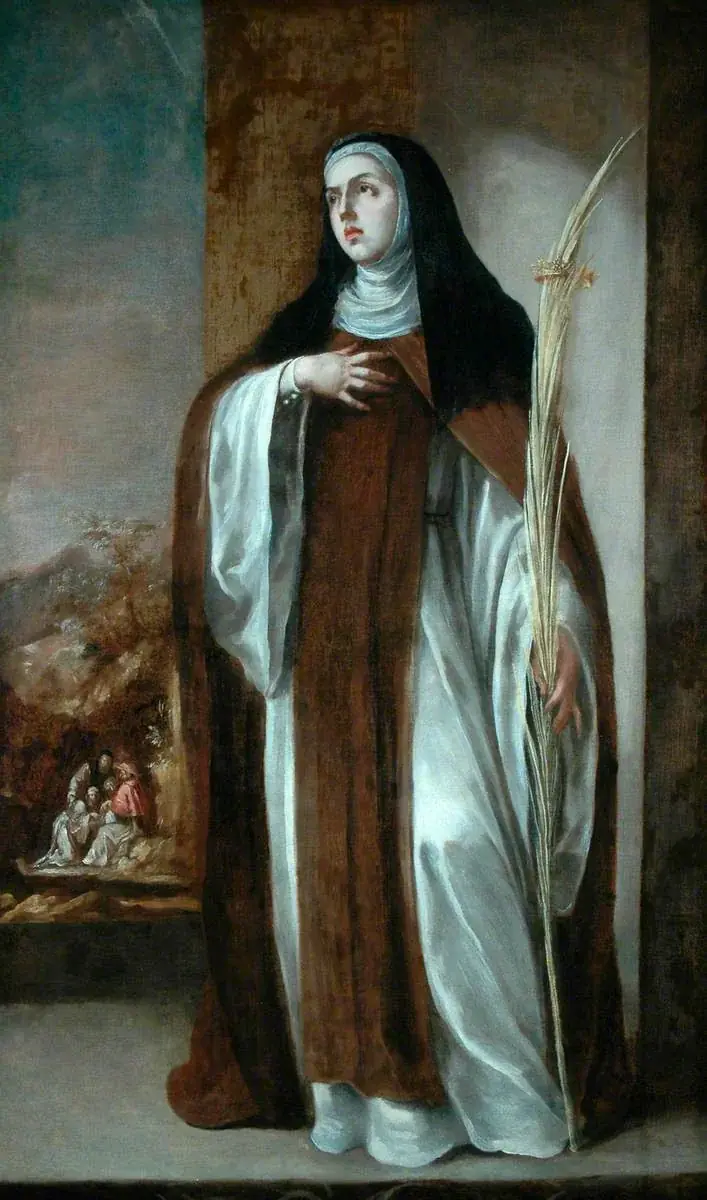
- Full name
- Julia Eustochium 1
Saint Eustochium was the daughter of Saint Paula, the young Roman noblewoman to whom Saint Jerome wrote his most famous letter, on keeping a vow of virginity. 12 She followed Jerome to the Holy Land with her mother, learned Hebrew well enough to read the Scriptures in it, and governed the women's monasteries at Bethlehem for some fifteen years after Paula died. 16 She died there on September 28, 419 or 420, and September 28 is her feast. 17
A daughter of Paula
Julia Eustochium was born at Rome about 368, the third of the four daughters of the senator Toxotius and his wife Paula, who traced her descent from the Scipios and the Gracchi. 1 Jerome lists the children in his memoir of Paula: Blesilla, Paulina, Eustochium, Rufina and a son, Toxotius, and calls Eustochium "a precious necklace of virginity and of the church." 5
After her father died, about 380, mother and daughter lived at Rome, Michael Ott writes in the Catholic Encyclopedia, "as austere a life as the Fathers of the desert." 1 Butler adds that the girl often visited Saint Marcella, "the first of her sex in Rome who embraced an ascetic or retired austere life," and learned from her. 6 When Jerome came to Rome in 382, both put themselves under his direction. 1
Her family did not all approve. Her uncle Hymettius and his wife Praetextata tried to draw her back to the world. 1 Jerome tells the story years later in a letter to her sister-in-law Laeta: Praetextata, at her husband's bidding, "altered that virgin's dress and appearance and arranged her neglected hair after the manner of the world," and that night dreamed of an angel who threatened her for laying "sacrilegious hands upon the head of one who is God's virgin." 4 Jerome says the threats came to pass and that Praetextata died soon after. 4
Letter 22
Ott dates her vow of perpetual virginity to about 384; Butler puts it about 382, and the letter that marked it "about the year 383," toward the end of the pontificate of Damasus. 16 The letter is Jerome's Letter 22. 2
"I write to you thus, Lady Eustochium," it begins, "(I am bound to call my Lord's bride lady)." 2 Jerome tells her she is "the first virgin of noble birth in Rome," and so must work the harder to keep what she has chosen. 2 He turns aside to her mother: "Are you angry with her because she chooses to be a king's wife and not a soldier's? She has conferred on you a high privilege; you are now the mother-in-law of God." 2
Most of the letter is instruction. Butler summarizes it as humility and the fear of losing what she had, constant watchfulness over the heart and the senses, and temperance at table, with prayer at the canonical hours and two or three times in the night. 6 In the middle of it Jerome tells her a story against himself: how, devoted to Cicero, he dreamed he stood before the judgment seat and answered that he was a Christian, and was told, "You lie. You are a follower of Cicero and not of Christ." 2
A small letter from the same years shows the friendship. On the feast of Saint Peter she sent Jerome doves, bracelets, a letter and a basket of cherries; he thanked her for the cherries, "blushing with such a virgin modesty that I can fancy them freshly gathered by Lucullus himself," and then could not resist a sermon on each of the gifts. 3
To Bethlehem
Jerome left Rome in 385, and Paula and Eustochium followed him east. 16 Jerome describes the ship leaving harbor, with Paula, "overcoming her love for her children by her greater love for God," concentrating "herself quietly upon Eustochium alone, the partner alike of her vows and of her voyage." 5 In 386 they went with Jerome to Egypt to visit the monks of the Nitrian desert, and in the autumn they settled for good at Bethlehem. 1
There, Ott says, Paula and Eustochium built four monasteries and a hospice near the place where Christ was born: one for monks under Jerome, and three for the many women who joined them, with a single oratory where all the nuns met several times a day to pray and chant the psalms. 1 Jerome testifies that mother and daughter took on the most menial work. 1
Eustochium, in Jerome's description, "always kept close to her mother's side, obeyed all her commands, never slept apart from her, never walked abroad or took a meal without her, never had a penny that she could call her own." 5 She spoke Latin and Greek with equal ease and read the Scriptures in Hebrew, and Ott credits her influence for many of Jerome's biblical commentaries. 1 He dedicated to her his commentaries on Isaiah and Ezekiel, and Butler adds that he translated the rule of Saint Pachomius into Latin for her nuns. 16
Abbess at Bethlehem
When Paula was dying in 404, Eustochium nursed her. "She sat by Paula's bedside, she fanned her, she supported her head, she arranged her pillows, she chafed her feet." 5 After the death she "could not be torn away from her parent" and "wished for nothing better than to be buried with her." 5 Jerome addressed his memoir of Paula to her: "Be not fearful, Eustochium: you are endowed with a splendid heritage." 5
She took over the women's monasteries. 16 Ott says it was a hard inheritance, because Paula's lavish almsgiving had left the community poor, and that Jerome helped her with encouragement and advice. 1
She also took in her niece. Jerome had advised Laeta, the wife of Eustochium's brother Toxotius, to send her small daughter, the younger Paula, to Bethlehem: "send her to her grandmother and aunt." 4 The child came, and in time succeeded Eustochium at the head of the nunnery. 14
In 416 or 417 a band of men attacked and pillaged the monasteries, burned one of them, and killed or mistreated some of those who lived there. 16 Ott dates it 417 and says it was probably instigated by John, the bishop of Jerusalem, and the Pelagians whom Jerome had attacked in print; Butler dates it 416 and blames "a troop of Pelagian heretics." 16 Pope Innocent I was told by letter, Ott says by Jerome and Eustochium, Butler says by Eustochium and the younger Paula, and he wrote sharply to John. 16
She died not long afterward, at Bethlehem: on September 28, 419 or 420, by Ott's account, about 419 by Butler's, who adds that she was buried near her mother. 16
What is Saint Eustochium the patron saint of?
Saint Eustochium's feast day
Saint Eustochium's feast day is September 28, the day she died. The current Roman Martyrology, in the text published by the Italian bishops, commemorates her on that day at Bethlehem, as the virgin who left Rome with her mother Saint Paula to be near the Lord's manger and the counsel of her teacher Saint Jerome. 7
Ott gives September 28 as the day the Church celebrates her feast, and Butler places her life on the same day. 16
Praying with Saint Eustochium
Almost everything known about her comes from a man writing to her or about her mother. 125 She is visible mostly at the edges of other people's lives: beside Paula on the ship, beside Paula's bed, at Jerome's elbow while he wrote. 51
That was not a small life. She learned Hebrew, kept a large community going after its founder died and left it in debt, and was still there when it was burned. 16
Jerome's letter to her is severe. 2 What came after it was more than thirty years of ordinary faithfulness in one place: the office sung in a single oratory, the Scriptures studied in three languages, the niece raised to take her place. 14
Saint Eustochium, pray for us.
Sources
- 1.Michael Ott, "St. Eustochium Julia," The Catholic Encyclopedia, Vol. 5 (New York: Robert Appleton Company, 1909).
- 2.Jerome, Letter 22, to Eustochium, trans. W. H. Fremantle, G. Lewis and W. G. Martley, Nicene and Post-Nicene Fathers, Second Series, Vol. 6 (1893), New Advent.
- 3.Jerome, Letter 31, to Eustochium, trans. W. H. Fremantle, G. Lewis and W. G. Martley, Nicene and Post-Nicene Fathers, Second Series, Vol. 6 (1893), New Advent.
- 4.Jerome, Letter 107, to Laeta, trans. W. H. Fremantle, G. Lewis and W. G. Martley, Nicene and Post-Nicene Fathers, Second Series, Vol. 6 (1893), New Advent.
- 5.Jerome, Letter 108, to Eustochium, trans. W. H. Fremantle, G. Lewis and W. G. Martley, Nicene and Post-Nicene Fathers, Second Series, Vol. 6 (1893), New Advent.
- 6.Alban Butler, "St. Eustochium, V.," September 28, in The Lives of the Fathers, Martyrs, and Other Principal Saints, Vol. IX (Derby: Richardson and Son, 1842), Internet Archive.
- 7.Roman Martyrology, entries for September 28, Santo del giorno, Conferenza Episcopale Italiana (in Italian).
Saints to turn to next
Others in this collection who are turned to for some of the same things.
- Saint Abercius of HieropolisSecond century; died at seventy-two or laterPrayerStudy and teaching
- Saint Aelred of Rievaulx1109 - January 12, 1166 (or 1167)PrayerStudy and teaching
- Saint Ambrosec. 340 - April 4, 397PrayerStudy and teaching
- Saint Anselm of Canterbury1033 or 1034 - April 21, 1109Study and teachingPrayer