Saint Eusebius of Samosata
Birth unknown - 379 or 380
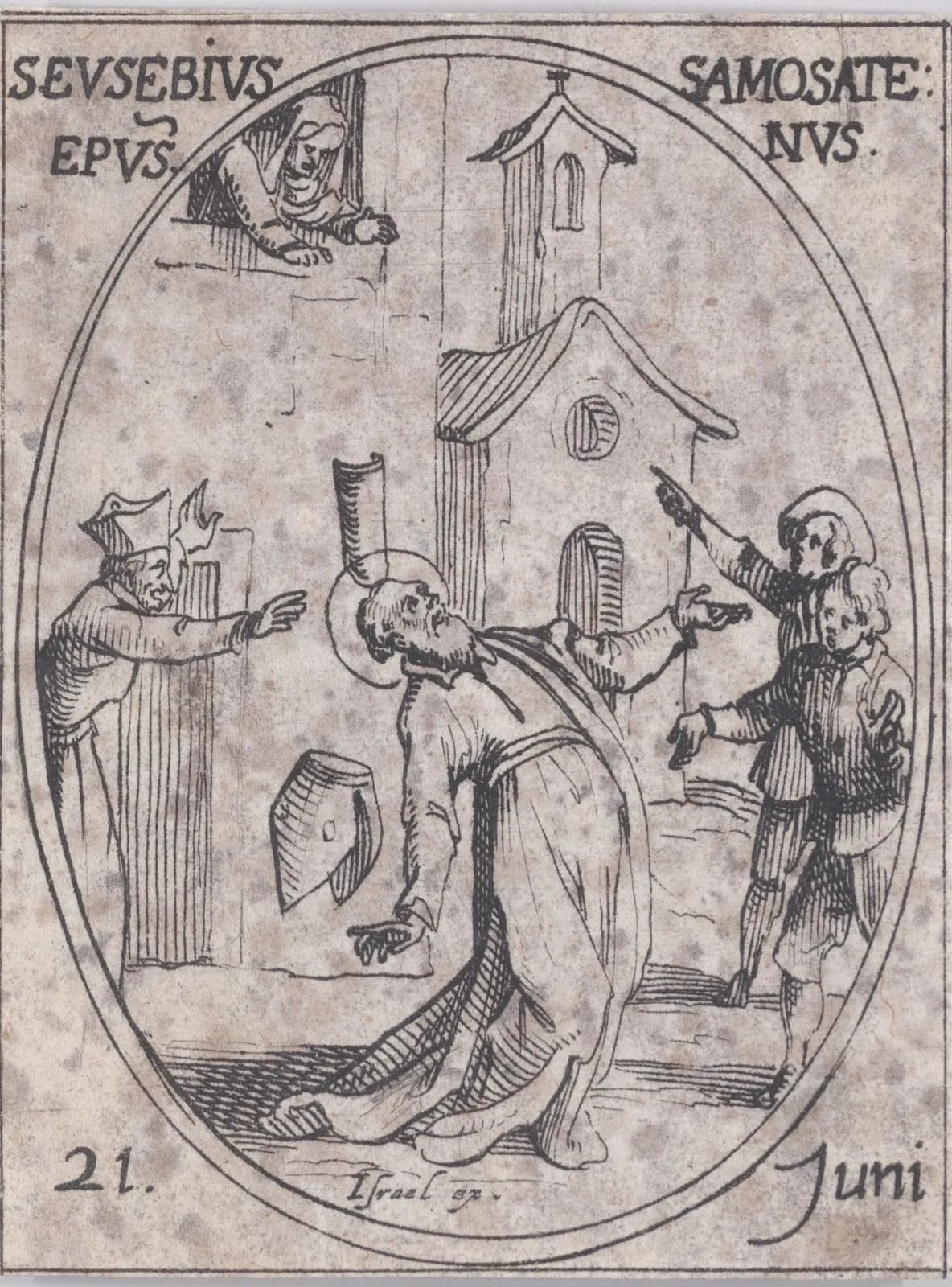
- See
- Samosata, on the Euphrates in Syria, now Samsat in Turkey 1
Saint Eusebius was bishop of Samosata, a city on the Euphrates, in the years when the bishops of the Eastern Church were divided over the teaching of Arius. 1 Told that the emperor would have his right hand cut off if he did not give up a document, he held out both hands. 12 He spent years in exile on the Danube, came home, and was killed by a roof tile thrown by a woman of the opposing party, having first made the bystanders swear that she would not be punished. 2
The document he would not surrender
Nothing is known of his birth. Michael Ott, writing in the 1909 Catholic Encyclopedia, says history first mentions him in 361, when as bishop of Samosata he took part in the election of Meletius as bishop of Antioch. 1 Most Eastern sees were then held by Arian bishops, and Meletius was chosen, Ott says, "only because the Arians believed him to be a supporter of their heresy." 1 Ott adds that Tillemont thought Eusebius himself was leaning that way at the time; in any case, at a synod in Antioch in 363 he was one of twenty-five bishops who signed the creed of Nicaea. 1
Theodoret of Cyrrhus, who wrote the history of these years in the following century, tells the story from the election. Both parties had put their resolution in writing and, as a pledge of the agreement, left it "to the safe keeping of a bishop who was a noble champion of the truth, Eusebius of Samosata." 2 When Meletius preached the Nicene faith in Antioch, his electors turned on him, and the Emperor Constantius sent him home. 2
The document now told against the men who had broken the agreement, and Constantius sent a courier to fetch it. Eusebius answered that he could not hand over what the whole assembly had given him until the assembly told him to. 2 A second letter followed, threatening to cut off his right hand. Theodoret says the threat was only meant to frighten him, and that the courier had orders not to carry it out. 2 Eusebius read it and "stretched out his right hand and his left, bidding the man cut off both. The decree, said he, which is a clear proof of Arian wickedness, I will not give up." 2 The emperor, Theodoret writes, "was struck with astonishment, and did not cease to admire it." 2
Friend of Basil and Gregory
According to katolsk.no, the Norwegian bishops' saints database, Eusebius gave up attending councils after 363, judging that the endless controversy did the Church no good, and stayed away for nine years. 5 What brought him back was a letter from Cappadocia. The bishop of Caesarea had died, and the elder Gregory of Nazianzus and his son, Gregory Nazianzen, wanted Basil to succeed him. 45
The letter, kept among the younger Gregory's, speaks in the voice of an old man: "O that I had the wings of a dove, or that my old age could be renewed, that I might be able to go to your charity." 4 It asks him to come before the winter, because "we have a man before our eyes, and you are not unacquainted with him." 4 The editors of the English translation say that Eusebius made a journey of three hundred miles over hard roads, persuaded the elder Gregory to come to the synod in spite of his age, and saw Basil elected unanimously. 4 Ott dates the election to 370; katolsk.no to 372, and says Eusebius consecrated Basil himself. 15
The younger Gregory wrote to thank him, and did not hold back: "The pillar and ground of the church, or a light in the world, using the very words of the apostle, or a crown of glory to the remaining portion of christendom; or a gift of God, or the bulwark of your country, or the standard of faith, or the ambassador of truth, or all these at once, and more than all?" 3 Ott says a close friendship with Basil dated from this time, attested by letters Basil wrote to him that still survive. 1
In a soldier's clothes
Under the Emperor Valens, who favored the Arian party, bishop after bishop was driven out. Theodoret says Eusebius, hearing that many churches had lost their shepherds, "travelled about Syria, Phœnicia and Palestine, wearing the garb of war and covering his head with a tiara, ordaining presbyters and deacons," and where he found like-minded bishops he put them into empty sees. 2 Ott tells it the same way, placing it in the persecution under Valens. 1 The sources do not agree on the date: the Martyrology puts the disguised visits in the time of Constantius, and katolsk.no after Basil's election. 56
In 374, katolsk.no says, Valens issued the edict that sent him to Thrace. 5 Theodoret describes the night it arrived. Eusebius told the official who brought it to keep quiet, since the people, if they learned why he had come, might drown him. 2 After evening prayer the old bishop walked to the river alone, with one servant "carrying nothing but a cushion and a book," and took a boat downstream to Zeugma. 2 By morning the city knew, and the river filled with boats. His people begged him to stay; he read them the apostle's command to be subject to the authorities, accepted a few small gifts from close friends, and left for the Danube. 2
On his way he passed through Cappadocia. Gregory was too ill to leave the house to meet him and wrote afterward asking for his prayers, saying that the prayers of a man who had "endured such persecutions" would give him "as much strength as I should have gained through one of the holy martyrs." 3 A second letter, which the edition gives to Gregory while noting that it is sometimes attributed to Basil, consoled him in exile: "Others possess the threshold of their fathers — we the heavenly City; others perhaps hold our throne, but we Christ." 3
The city that would not come to church
Theodoret thought the people of Samosata deserved their own chapter. The Arian party installed a bishop named Eunomius, and nobody came to church: "not a servant, not a handicraftsman, not a hind, not a gardener, nor man nor woman." 2 When Eunomius, who by Theodoret's account was a courteous man, shared his bath with some townsmen, they had the water drained and fresh water drawn for themselves. He left the city. 2
His successor, Lucius, was harsher, and had clergy exiled to the edges of the empire, among them Antiochus, the son of Eusebius's brother. 2 Theodoret adds a small scene: when a ball the boys were playing with rolled under the hooves of Lucius's donkey, they passed it through a fire before they would play with it again. 2 Eusebius meanwhile was living by the Danube, where the Goths were raiding Thrace and besieging its cities. 2
Return and death at Doliche
Ott and katolsk.no say he came home after Valens died in 378; the Martyrology says he was recalled under Theodosius. 156 On the way back and after, he filled empty sees with bishops of the Nicene faith. Theodoret names Acacius at Beroea, Theodotus at Hierapolis, a namesake Eusebius at Chalcis, and Isidore at Cyrrhus, which Theodoret calls "our own city." 2 Ott adds Eulogius at Edessa; Theodoret says it was Meletius who "is also reported" to have ordained him. 12
The last was Maris, for the small town of Doliche, which was still Arian. Theodoret writes that as Eusebius entered the town, "a woman thoroughly infected with the Arian plague let fall a tile from the roof, which crushed in his head." 2 He died of the wound a few days later. 1 Theodoret says that "as he lay a-dying he charged the bystanders not to exact the slightest penalty from the woman who had done the deed, and bound them under oaths to obey him," and compares him to Christ on the cross and to Stephen under the stones. 2 katolsk.no gives the date as June 22, 380; Ott, 379 or 380. 15
Theodoret ends the chapter plainly: "He had escaped the barbarians in Thrace, but he did not escape the violence of impious heretics, and by their means won the martyr's crown." 2 His nephew Antiochus was chosen to succeed him, and at the consecration pulled away the hand of a bishop who had been in communion with the Arians, saying he could not bear it on his head. 2
What is Saint Eusebius the patron saint of?
Saint Eusebius's feast day
Saint Eusebius's feast day is June 22 in the current Roman Martyrology, which places his memory at Dülük, the ancient Doliche, in Syria, now in Turkey. 6 The older sources do not agree on the day. katolsk.no gives his memorial as June 21 and says the Greeks keep the 22nd, while the 1909 encyclopedia says the Greeks honor him on June 21 and the Latins on June 22. 15
Praying with Saint Eusebius
Eusebius is remembered first for holding out his hands. Theodoret is honest that the emperor never meant to cut them off, and that does not change what Eusebius knew when he read the letter. 2 He kept a promise made to an assembly of bishops after one party to it had broken its word. 2
The night he left Samosata shows another side of him. He could have let the people rise in his defense, and instead he protected the official who brought the order, left in the dark with a cushion and a book, and told the crowd at the river to obey the emperor who was exiling him. 2 The people he left kept away from the bishops sent to replace him. 2
His friends called him a pillar and a gift of God, and asked for his prayers as they would ask a martyr's. 3 He was an old man by then, still traveling to install bishops in towns that did not want them. 2
He died of that last journey, and with his last strength saw to it that the woman who killed him would not be punished. 2 Theodoret compared him to Stephen and to Christ. 2
Saint Eusebius of Samosata, pray for us.
Sources
- 1.Michael Ott, "St. Eusebius," The Catholic Encyclopedia, Vol. 5 (New York: Robert Appleton Company, 1909).
- 2.Theodoret, Ecclesiastical History, II.27-28, IV.12-13 and V.4, trans. Blomfield Jackson, Nicene and Post-Nicene Fathers, Second Series, Vol. 3 (Buffalo, NY: Christian Literature Publishing Co., 1892), as printed by New Advent.
- 3.Gregory Nazianzen, Letters 44, 64 and 65, to Eusebius of Samosata, Division III, trans. Charles Gordon Browne and James Edward Swallow, Nicene and Post-Nicene Fathers, Second Series, Vol. 7 (Buffalo, NY: Christian Literature Publishing Co., 1894), as printed by New Advent.
- 4.Gregory Nazianzen, Letter 42, to Eusebius of Samosata, with the editors' introduction, Division II, trans. Charles Gordon Browne and James Edward Swallow, Nicene and Post-Nicene Fathers, Second Series, Vol. 7 (1894), as printed by New Advent.
- 5."Den hellige Eusebius av Samosata (d. ~379)," Den katolske kirke (katolsk.no), Catholic Diocese of Oslo (in Norwegian).
- 6.Roman Martyrology, entry for June 22, "Sant'Eusebio, vescovo di Samosata," as printed in "Santo del giorno," Conferenza Episcopale Italiana (in Italian).
Saints to turn to next
Others in this collection who are turned to for some of the same things.