Saint Emilian of Durostorum
Died 362 or 363
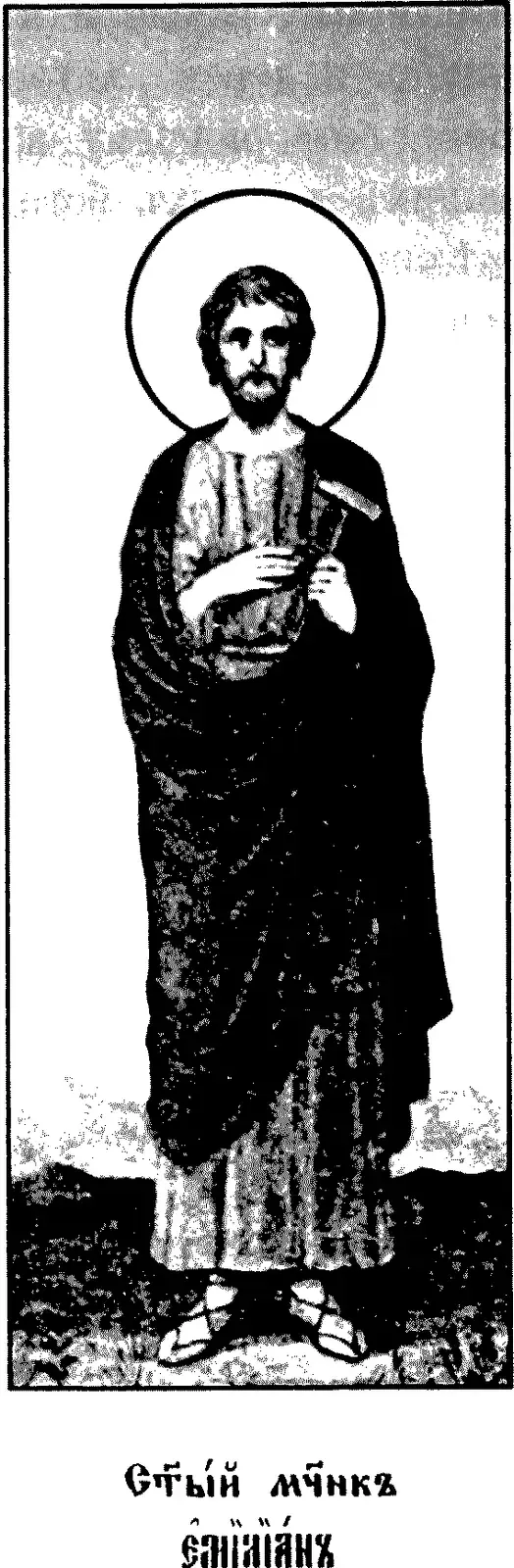
- Condition
- A pagan's slave, says the Greek Synaxarion; the son of the city's prefect, say the Greek Acts; possibly a soldier, by one reading of Theophanes 6
- Died
- Burned for overturning the altars, under Julian the Apostate 134; in 362, says Prosper, followed by the Bollandists; in 363, by Jerome's reckoning and the Greek Acts 6
- Not to be confused with
- Saint Emilian of La Cogolla, the Spanish hermit kept on November 12
Saint Emilian of Durostorum was a Christian of the city on the Danube that is now Silistra in Bulgaria, who in the reign of Julian the Apostate went into a pagan temple, overturned the altars and was burned alive for it. 14 Jerome and Theodoret each give him a single line, and a Greek legend fills in the rest: a hammer, a farmer beaten in his place, and a man who stepped forward to say that he was the one. 346 His feast is July 18. 12
A line in Jerome, a sentence in Theodoret
The oldest witness is Jerome's Chronicle. Under the reign of Julian it records that Aemilianus was burned by the vicarius because he had overturned the altars at Dorostorum. 4 Prosper copied the line into his own chronicle, but moved it to the year of the consuls Mamertinus and Nevitta, which is 362. 6
Theodoret, the Greek church historian, lists him among the outrages of Julian's reign, between a church at Emesa given over to Dionysus and the torture of Bishop Marcus of Arethusa. 3 At Dorostorum, "a famous city of Thrace," he writes, the victorious athlete Aemilianus was thrown on a burning pyre by Capitolinus, governor of all Thrace. 3 Durostorum in fact lay in Lower Moesia, but the Bollandist editor explains that Thrace was also the name of the wider civil diocese to which Moesia belonged, and concludes that Capitolinus was vicar of that whole diocese, which fits the title Jerome gives him. 6
That is almost everything the early writers say. The Bollandist notes that Nicephorus Callistus, a fourteenth-century historian, adds only that Capitolinus burned him alive. 6
The altar Ambrose remembered
Writing to the emperor Theodosius against his order to restore a burned synagogue, Saint Ambrose in passing reminded him of a martyr from Julian's time. 5 "How many have to offer themselves to such a choice," he asks, "when they remember that in the time of Julian, he who threw down an altar, and disturbed a sacrifice, was condemned by the judge and suffered martyrdom?" 5 He adds that nobody afterward treated that judge as anything but a persecutor, and that no one thought him worthy of a kiss. 5
Ambrose gives no name. Cardinal Baronius and the French historian Tillemont both took the martyr to be Emilian, and the Bollandist agrees, on the ground that no other martyr of Julian's reign was so well known among Latin writers for exactly this. 6 It remains their identification and not Ambrose's statement.
The story the Greeks told
In the Greek Church Emilian was honored far more than in the West. 6 The Bollandist translates the entry for July 18 in the Synaxarion of the emperor Basil. Emilian, it says, was a native of Dorostolum in Moesia under Julian; he was the slave of a pagan but himself a Christian. 6 Seizing his chance, he took a hammer, went into the temple of the idols, smashed every statue and scattered the sacrifices. 6
The pagans did not know who had done it, and they seized a farmer and began to beat him and drag him to the governor. 6 Emilian, seeing this, gave himself up: he was the one who had done it, he said. Brought before the governor, he reproached him for trusting in empty idols. He was beaten with rods, and when he still confessed Christ he was thrown into the fire, and there, blessing and glorifying God, he gave up his soul. 6
The printed Greek Menaia, the Bollandist notes, tell the same story with small differences: the idols were smashed at night, several farmers were seized, he was beaten with ox-sinews, and he died in the furnace without being burned. 6 Their verse for the day says that on the eighteenth Emilian went into the flames. 6
The longer Acts
The Bollandists also printed, in a Latin version, a longer set of Greek Acts from an old Vatican manuscript, and their editor did not think much of them. 6 In this telling Capitolinus arrives at Durostorum, sacrifices, and is told from the bench that everyone in the city honors the gods; delighted, he gives a banquet. 6 While the officials are feasting, Emilian goes into the temple with an iron hammer, breaks the idols, overturns the altars, smashes the lampstands, pours out the offerings and leaves unseen. 6
When a farmer coming down from the hills is seized and flogged for it, Emilian takes the whips out of the lictors' hands and tells them to spare the man: he has done nothing, and Emilian is the one. 6 Asked his name, he answers that if they want his common name it is Emilian, but his perfect name is Christian. 6 Asked who led him astray, he says God and his own soul moved him, to show that the idols are lifeless stones. He is stripped and beaten for hours, and between the blows he gives the same answer each time. 6
Asked whether he is slave or free, he says he is the servant of Christ and the son of Sabbatianus, prefect of the city. 6 Capitolinus sentences him to the furnace and fines his father a pound of silver. At a pyre near the bank of the Danube Emilian asks for time to pray, and is thrown in. The fire does not touch him, the Acts say, but leaps out and consumes the attendants; Emilian signs himself with the cross, asks the Lord Jesus to receive his spirit, and falls asleep in peace. 6 The governor's wife, a Christian, asks for his body and has it buried with psalms about three miles from the city. 6
What the Bollandist kept
Pieter van den Bosch, the Bollandist who signed the commentary, called the author of these Acts a wordy writer, as bold in inventing miracles as he was careless of history. 6 He pointed out that Julian issued no edict ordering Christians hunted down; he took pains instead to punish them on other charges, such as overturning temples or altars. 6 The Acts date the arrest to July 16 in Julian's fourth consulate, 363, and the death to September; but Julian was dead by June 26, 363, and every martyrology keeps Emilian on July 18. 6 Jerome's Chronicle, Theophanes and the Alexandrian Chronicle all give 363 as well. The Bollandist set them aside and followed Prosper's 362. 6
He found the prefect's son nowhere else, and could not say whether Emilian was a slave, as the Greek Synaxarion says, or a soldier, as one reading of Theophanes has it. 6 The unburned body he traced to late Greek writers; the oldest witnesses, Jerome, Prosper and Theodoret, say plainly that Emilian was burned. 346 The attendants consumed by the flames he thought borrowed from the story of the furnace in the Book of Daniel. 6 What he kept, he said, was the substance the Acts share with the oldest sources: the same cause, the same punishment by fire, the same emperor and the same vicar of Thrace. 6
A church in Constantinople
The martyr's name later stood on a gate of Constantinople. The Bollandist quotes the Byzantine writer Codinus, who says that the gate of Saint Emilian took its name from a nearby church of the saint, at first a small oratory, in the quarter called Rhabdos. 6 The life of the emperor Basil I by Constantine Porphyrogenitus says that Basil found the church of the holy martyr Emilian at Rhabdos falling into ruin and rebuilt it. 6 Tillemont doubted that the church belonged to this Emilian; the Bollandist argued that no other martyr of the name was honored enough in the Greek calendars to have one. 6
The Greek liturgy for his day, the Bollandist adds, honors Emilian as a worker of miracles, and its hymns speak of myrrh flowing from the casket of his relics and driving out disease. 6 He took it as certain that the people of Durostorum claimed his body after Julian's death, and guessed that some or all of it later went to Constantinople. 6
What is Saint Emilian of Durostorum the patron saint of?
Saint Emilian of Durostorum's feast day
Saint Emilian of Durostorum's feast day is July 18. 12 The Bollandist notes that both Latin and Greek martyrologies, down to the oldest, keep his day on July 18. 6 The 1897 English edition of the Roman Martyrology has him that day at Dorostorum in Mysia, cast into a furnace under the governor Capitolinus in the time of Julian the Apostate. 2 The current Roman Martyrology, in the text published by the Italian bishops, keeps him on July 18: at Silistra in Moesia, in present-day Bulgaria, Saint Emilian, martyr, who, defying the edicts of Julian the Apostate and the threats of his vicar Catulino, overturned the altar of the idols, stopped the sacrifice, and was thrown into the furnace. 1
Praying with Saint Emilian of Durostorum
What the oldest sources remember of Emilian is one act and its price. He overturned the altars and was burned for it, and Jerome recorded both in a single line. 4 Ambrose, if it was Emilian he meant, could still invoke that death to a later emperor, along with the judge nobody would kiss. 56
The Greek story adds a second act that the oldest witnesses do not mention. Someone else was being beaten for what Emilian had done, and he came forward. 6 He could have stayed hidden; the Synaxarion says the pagans did not know who had broken the idols. 6
His story is not offered here as a model for smashing other people's shrines. Theodoret opens the chapter in which he names Emilian by describing Christians and pagans returning insult for insult under Julian. 3 What the Greek story shows, whatever its other details are worth, is a man who would not let a stranger take his punishment.
Saint Emilian of Durostorum, pray for us.
Sources
- 1.Roman Martyrology, entry for July 18, "Sant'Emiliano, martire," as printed in "Santo del giorno," Conferenza Episcopale Italiana (in Italian).
- 2.The Roman Martyrology, July 18 (Baltimore: John Murphy, 1897), via the Internet Archive.
- 3.Theodoret, Ecclesiastical History, Book III, chapter 3, trans. Blomfield Jackson, Nicene and Post-Nicene Fathers, Second Series, Vol. 3, via New Advent.
- 4.Jerome, Chronicle, the reign of Julian, English translation at tertullian.org.
- 5.Ambrose, Letter 40, to the emperor Theodosius, section 17, trans. H. de Romestin, Nicene and Post-Nicene Fathers, Second Series, Vol. 10, via New Advent.
- 6.Pieter van den Bosch (P. B.), "De S. Aemiliano martyre Dorostori in Mysia sive Bulgaria," commentary and Latin version of the anonymous Greek Acts, in Acta Sanctorum, July, Vol. IV (Paris and Rome: Palmé, 1868), pp. 370-376 (in Latin), via the Internet Archive.
Saints to turn to next
Others in this collection who are turned to for some of the same things.