Saint Emilian of La Cogolla
473 - November 12, 574
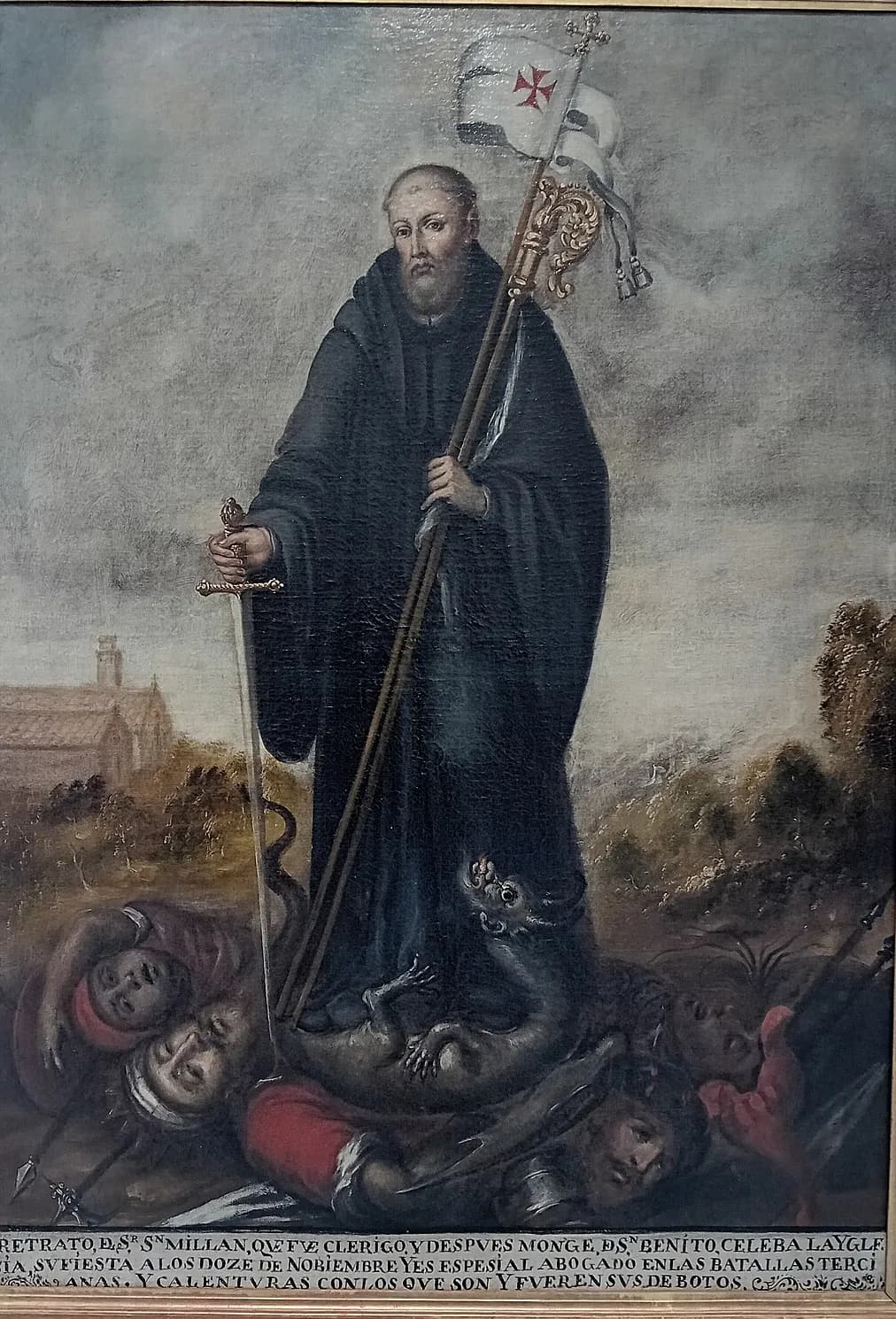
- Born
- 473, at Berceo, in the Rioja 3
- Died
- November 12, 574, at the age of 101 3
- Relics
- The monastery of Yuso at San Millán de la Cogolla, with those of his master Felix 4
Saint Emilian of La Cogolla, San Millán to Spaniards, was a shepherd from the Rioja who became a hermit, was made a parish priest by his bishop, was dismissed for giving the parish's goods to the poor, and went back to the mountain. 3 He died there in 574 at the age of 101, and the hermits who stayed on around his grave became the monastery of San Millán de la Cogolla, whose two houses of Suso and Yuso are now a World Heritage site. 35 Nearly all of this comes from one book, written about seventy-five years after his death by a bishop of Saragossa. 13
Braulio's book
Emilian wrote nothing. 3 What is known of him comes from the "Vita Sancti Emiliani," which Saint Braulio, bishop of Saragossa, wrote around 650. 3 ACI Prensa says Braulio drew on the stories he had heard from his own brother Fronimiano, a monk of the community at the Cogolla. 3 The Catholic Encyclopedia's article on Braulio lists the life of "St. Emilian (Æmilianus Cucullatus, or San Millan de la Cogolla)" first among his works, together with a hymn he wrote in the saint's honor, and describes Emilian as a priest of the Diocese of Turiasso, now Tarazona. 1
Braulio was no provincial. He was one of the leading bishops of Visigothic Spain, a friend of Isidore of Seville and the man who pressed Isidore to write his "Etymologies." 1 That such a figure took the trouble to write the life of a hermit from the hills of the Rioja says something about the reputation Emilian had left behind him. Centuries later Gonzalo de Berceo, whom the Augustinian Recollects call the first poet in Spanish, wrote his story again as the "Historia del Señor San Millán." 35
Shepherd and hermit
He was born in 473 at Berceo, in the Rioja, into a peasant family of Hispano-Roman stock, and he spent his youth as a shepherd. 3 The Martyrology places his life "on the heights of the region of Cogolla near Berceo," in the Italian bishops' wording translated here. 2 Drawn to a life of prayer, he became a disciple of a hermit named Felix who lived in the hills of Bilibio, near Haro, and stayed with him in a solitary and penitential life. 3
Even that was not enough for him. ACI Prensa says that he found the discipline too comfortable and withdrew alone into the mountains of Distercio, where he lived for forty-four years in the open, exposed to the weather and the harshness of the place. 3 The Augustinian Recollects, who keep his monastery today, point visitors to the Cave of the Saint, inside the mountain, where tradition says he lived as a hermit for forty years. 4
The priest who gave everything away
His reputation for holiness grew until, as ACI Prensa tells it, people with troubles of the soul came to him from everywhere. 3 Didymus, bishop of Tarazona, decided that such virtue should not be wasted on a mountainside. He ordained Emilian a priest and put him in charge of the parish church of Saint Eulalia in his native Berceo. 3
ACI Prensa calls the experiment a resounding failure. The administrative work did not suit him, and he gave the parish's property to the needy. 3 His fellow priests accused him of squandering the parish's money and complained to the bishop, who reprimanded him and removed him from the post. 3 The Martyrology puts the same life more gently, in three stages: first a hermit, then a cleric, and finally a monk. 2
The community at Suso
He went back to solitude, this time in the valley of Suso, "the upper one," close to Berceo, where he spent the last part of his life. 3 Others gathered around him. ACI Prensa names them: Aselo, Geroncio, Citonato, Sofronio, and two women, Oria and Potamia, who formed with him a primitive oratory. 3 He was visited, consulted and venerated, and seems seldom to have left his hermitage. 3 The last time he did, according to the tradition ACI Prensa follows, it was to foretell the destruction of certain cities of Cantabria. 3
The Martyrology remembers him as shining for his generosity to the poor and his spirit of prophecy. 2 Tradition credits him with many miracles, both in his lifetime and after his death. 3 He died on November 12, 574, at the age of 101, and was buried in the floor of his oratory. 3 His companions chose another abbot and stayed on as hermits around his tomb, and out of that small company grew the great monastery of San Millán de la Cogolla. 3
Suso, Yuso and the first words of Castilian
The monasteries of San Millán, Suso on the hill and Yuso in the valley below, were declared part of the patrimony of humanity by UNESCO in 1997. 5 The Augustinian Recollects, who have lived at Yuso since 1878, describe its library as "preserved unaltered for centuries," and say that its scriptorium holds "the first proofs of the Romance language" and was where Gonzalo de Berceo worked. 5 When one of their friars, Father Olarte, spent four years cataloguing the archive, he found more than 1,800 medieval documents and, among much else, copies of the "vows of San Millan" from Seville, Extremadura, Murcia, Madrid and Castile and León, where the monastery had held property in the Middle Ages. 5
Emilian's relics are still there, in a private oratory of the monastery, in a chest that also holds the relics of his master, Saint Felix of Bilibio. 4 It is rarely opened. In 2013, with the authorization of the bishop of Calahorra and La Calzada-Logroño, the community opened it to take out three small fragments of bone, two of them as gifts to the Russian Orthodox Church, and the Recollects noted that only four earlier openings are documented in ten centuries. 4 The Orthodox priest who asked for one of them explained that Emilian "represents the profound tradition of the anchorite life, venerated in Orthodox Church as well as in the Catholic Church." 4
What is Saint Emilian the patron saint of?
Saint Emilian's feast day
Praying with Saint Emilian
The episode that stands out in his story is the failure. A bishop saw a holy man and made him a parish priest, and the holy man turned out to be bad at it, gave the parish's goods away, and was sent back where he had come from. 3 Nobody in the sources tries to make that look like success. It is told plainly, and the Martyrology still lists the clerical life as one of the three stages of his road. 23
What he did next was to keep praying, in the same hills, until others came to pray with him. 3 He left no writings. 3 He left a grave in the floor of his oratory that a community would not leave, and within a few generations a bishop thought his life worth writing down and a monastery had grown around his bones. 13
Much later, the first written traces of the language that became Spanish were set down in that monastery, and Gonzalo de Berceo told his story again in it. 35 The Orthodox priest who asked for a fragment of his bones in 2013 saw in him a tradition both Churches share. 4 Very little of this would have been predicted for a shepherd who could not run a parish.
Saint Emilian of La Cogolla, pray for us.
Sources
- 1.Nicholas Weber, "St. Braulio," The Catholic Encyclopedia, Vol. 2 (New York: Robert Appleton Company, 1907).
- 2.Roman Martyrology, entry for November 12, "Sant'Emiliano, sacerdote," as printed in "Santo del giorno," Conferenza Episcopale Italiana (in Italian).
- 3."San Emiliano," Santos, ACI Prensa (in Spanish).
- 4."The Augustinian Recollects give a relic of San Millan to the new Russian Orthodox Church of Madrid," Agustinos Recoletos, June 11, 2013.
- 5."13,000 Yuso documents catalogued by the Augustinian Recollects of San Millan de la Cogolla," Agustinos Recoletos, August 4, 2009.
Saints to turn to next
Others in this collection who are turned to for some of the same things.
- Saint Agnes of Bohemiac. 1200-1205 - March 1281 or 1282Poverty and simplicityPrayer
- Saint Aidan of Lindisfarnec. 590 - August 31, 651Poverty and simplicityPrayer
- Saint Alexius of RomeFifth century, by traditionPoverty and simplicityPrayer
- Saint André BessetteAugust 9, 1845 - January 6, 1937PrayerPoverty and simplicity