Saint Elizabeth of Schönau
c. 1129 - June 18, 1164 or 1165
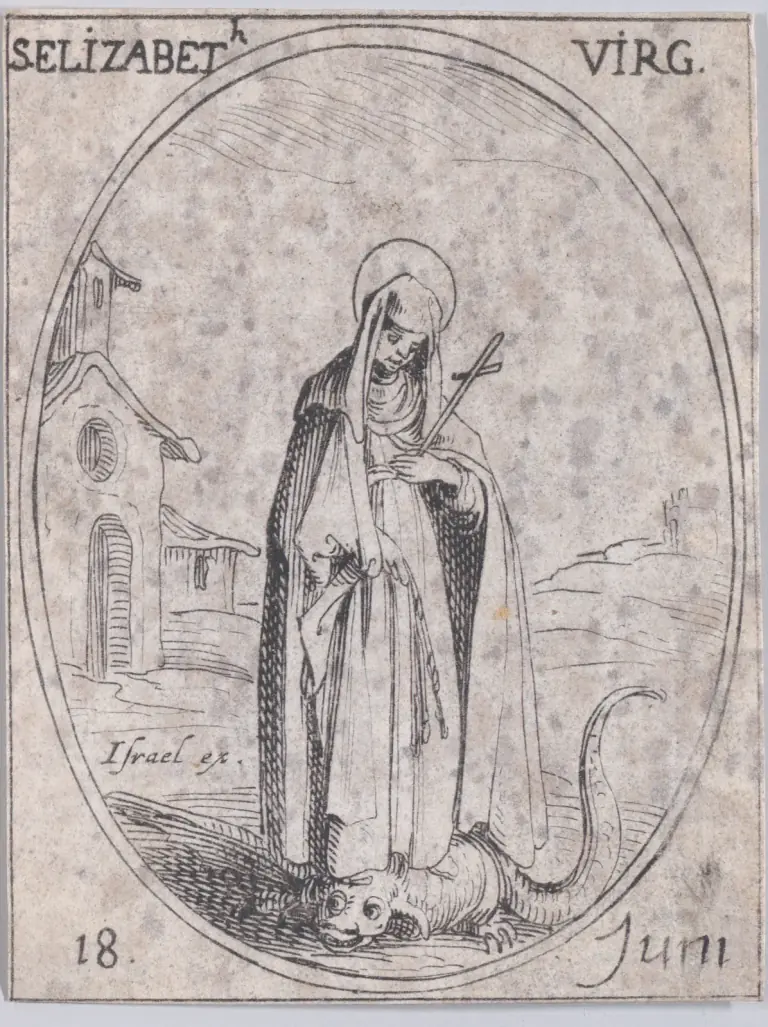
- Religious life
- Benedictine nun of the double monastery of Schönau, professed 1147; superior of the nuns from 1157 12
Saint Elizabeth of Schönau was a Benedictine nun in the Rhineland who, from 1152 until her death about twelve years later, had visions that her brother Egbert wrote down and published under her name. 12 In the Middle Ages she was better known than her friend Hildegard of Bingen, and her revelations about Saint Ursula shaped that legend for centuries. 25 She was never formally canonized, but the Roman Martyrology has called her a saint since 1584, and keeps her on June 18. 123
A nun of Schönau
Francis Mershman, writing in the Catholic Encyclopedia in 1909, says that Elizabeth was born about 1129 "of an obscure family," and entered the double monastery of Schönau in Nassau at the age of twelve. 1 The Norwegian bishops' saints database (katolsk.no) gives her birth year as 1128. 2 She received the Benedictine habit and made her profession in 1147. 1
Schönau was a double monastery, with monks and nuns under one abbot. 12 In 1157 Elizabeth became superior of the nuns under the abbot Hildelin, an office katolsk.no calls magistra, since the nuns had no abbess of their own. 12 She held it for the last seven years of her life. 2 Her brother Egbert, who joined the community and later became its abbot, was her spiritual adviser and, katolsk.no says, her first biographer. 2
Mershman describes her as "much afflicted with bodily and mental suffering," a strict keeper of the Rule of Saint Benedict and of the customs of her house, and given to mortification. 1 katolsk.no adds that the visions began after a serious illness around 1152, when she was twenty-three, and that she also suffered what it calls diabolical visitations that left her scratched and bruised. 2
The visions
From 1152, Mershman says, Elizabeth "was favoured ... with ecstasies and visions of various kinds." 1 They came mostly on Sundays and feast days, at Mass or the Divine Office, or after she had heard or read the life of a saint. 1 Christ, the Virgin Mary, an angel or the saint of the day would appear and instruct her, or she would see scenes of the Passion, the Resurrection and the Ascension, and of the Old and New Testaments. 1
She wrote down what she saw on wax tablets. 12 Her abbot told her to tell it all to her brother Egbert, then a priest at Bonn. 12 She hesitated, Mershman writes, "fearing lest she be deceived or be looked upon as a deceiver; but she obeyed." 1 Egbert, who became a monk of Schönau in 1155, put everything into writing, arranged it at leisure, and published it under his sister's name. 12
Her books, and her brother's hand
Three books of visions came of this. 12 Mershman judges that the first, written "in language very simple and in unaffected style," may easily be her own, while the other two, full of theological terms, "show more of the work of Egbert than of Elizabeth." 1 katolsk.no repeats the judgment. 2
A fourth work, the Liber viarum Dei, the Book of the Ways of God, seems to Mershman an imitation of Hildegard's Scivias. 1 It warns every class of society, from married people to monks and bishops, and calls for a struggle against the Cathar heresy. 1 It also declares the antipope Victor IV, whom the emperor Frederick supported against Pope Alexander III, to be God's chosen. 1 katolsk.no notes that Victor was a friend of her brother, and Mershman observes that "all of this appears in Egbert's own writings." 12
On the visions as a whole, Mershman is careful: "The Church has never passed sentence upon them nor even examined them." 1 Elizabeth herself was convinced they came from God, as she wrote to Hildegard, and so was her brother; the abbot Trithemius later thought them genuine, while the eighteenth-century theologian Eusebius Amort thought them her own imagination or the devil's illusions. 1 katolsk.no adds that whatever scholars made of them, her sincerity was never doubted. 2
Saint Ursula and the virgins of Cologne
Her most influential book was the one about Saint Ursula and her companions, the virgins said to have been martyred at Cologne. 12 In the twelfth century, bones of women, children and even men were dug up in a field at Cologne, together with inscriptions that Albert Poncelet, in the encyclopedia's article on Ursula, calls "gross forgeries." 5 Elizabeth, in her visions, was told the names of many of Ursula's companions. 25
Mershman calls the result "full of fantastic exaggerations and anachronisms," and says it "has become the foundation of the subsequent Ursula legends." 1 Poncelet lists it among the "fantastic legends" that grew from the finds, legends he says are "now unhesitatingly rejected by everyone." 5 katolsk.no is gentler with Elizabeth, saying the later embroidery of Ursula's story cannot be blamed on her. 2
Hildegard
Elizabeth was a friend and correspondent of Saint Hildegard of Bingen. 12 katolsk.no says Hildegard came to Schönau to visit her, and that fifteen authentic letters of Elizabeth survive, one of them to Hildegard, telling of the ecstasies God had granted her. 2 It adds that in the Middle Ages Elizabeth was much better known than Hildegard, whom Benedict XVI would canonize and name a Doctor of the Church. 2
Death, relics and her title
Elizabeth died at Schönau on June 18, in 1165 according to Mershman and in 1164, at thirty-five, according to katolsk.no. 12 She was buried in the abbey church of Saint Florin. 1 The monastery was dissolved in 1803. 2 katolsk.no says her relics were desecrated by Swedish soldiers in 1632, and only her head was saved; it is venerated in the parish church at Schönau, the former abbey church. 2
She was never canonized. Mershman explains that "when her writings were published the name of saint was added. She was never formally canonized, but in 1584 her name was entered in the Roman Martyrology and has remained there." 1 katolsk.no says the same, dates the entry to the reign of Gregory XIII, and adds that she was never formally beatified either. 2
What is Saint Elizabeth of Schönau the patron saint of?
Saint Elizabeth of Schönau's feast day
Saint Elizabeth of Schönau's feast day is June 18, the day she died. 12 The Roman Martyrology, as the Italian bishops print it, enters her on that day: at Schönau in the Rhineland, Saint Elizabeth, virgin, distinguished for her observance of the monastic life. 3 katolsk.no prints the Latin of the entry as it was made in 1584: "Schonaugiae, in Germania, sanctae Elisabeth virginis, ob monasticae vitae observantiam Celebris." 2 The 1897 English edition has the same entry, "celebrated for her observance of monastic discipline," under June 18. 4
katolsk.no adds that her office was taken into the proper of the diocese of Limburg in 1854, and that Limburg keeps her feast on June 19. 2
Praying with Saint Elizabeth of Schönau
Elizabeth was ill much of her short life, and her visions came to her in the ordinary round of a monastery: at Mass, at the Office, after the reading of a saint's life. 1 She did not want to tell anyone about them, because she was afraid of being deceived and of being taken for a deceiver, and she told them because she was asked to. 1
What the sources say about her writings is not simple. Her brother shaped most of them, some of what they say about the Church's quarrels of the day is his, and the book about Ursula fed a legend the Church's own scholars reject. 15 The Church has never ruled on whether the visions were from God. 1
The Martyrology does not remember her for the visions. It remembers her, then and now, for keeping the monastic life well. 34
Saint Elizabeth of Schönau, pray for us.
Sources
- 1.Francis Mershman, "St. Elizabeth of Schönau," The Catholic Encyclopedia, vol. 5 (New York: Robert Appleton Company, 1909).
- 2."Den hellige Elisabeth av Schönau (1128-1164)," Den katolske kirke (katolsk.no), Catholic Diocese of Oslo (in Norwegian).
- 3.Roman Martyrology, entry for June 18, "Santa Elisabetta di Schönau, vergine," Santo del giorno, Conferenza Episcopale Italiana (in Italian).
- 4.The Roman Martyrology, June 18 (Baltimore: John Murphy Company, 1897).
- 5.Albert Poncelet, "St. Ursula and the Eleven Thousand Virgins," The Catholic Encyclopedia, vol. 15 (New York: Robert Appleton Company, 1912).
Saints to turn to next
Others in this collection who are turned to for some of the same things.
- Saint Aldegundc. 630 or c. 639 - 684Suffering and illnessDiscernmentPrayer
- Saint Bernardo TolomeiMay 10, 1272 - August 20, 1348DiscernmentPrayerSuffering and illness
- Saint Carmen RendilesAugust 11, 1903 - May 9, 1977PrayerDiscernmentSuffering and illness
- Saint Clare of Montefalcoc. 1268 - August 1308PrayerSuffering and illnessDiscernment