Saint Dominic
c. 1170 - August 6, 1221
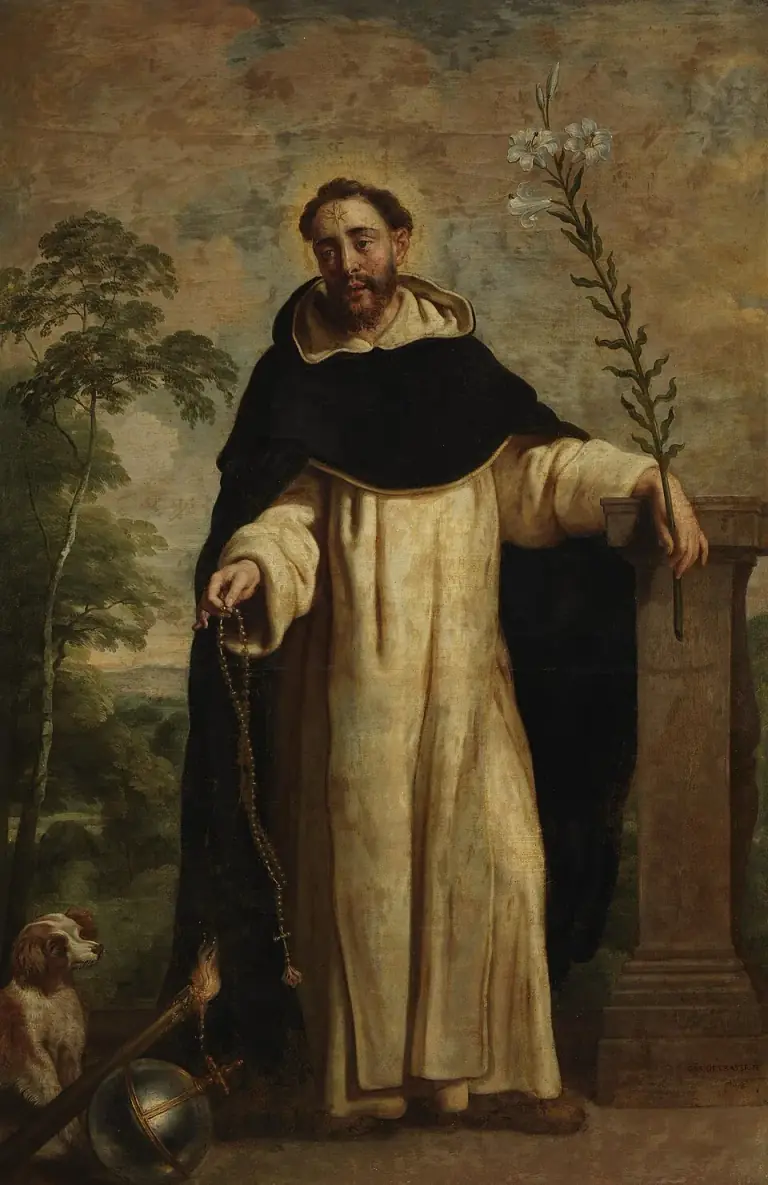
- Patron saint of
- Astronomers and the Dominican Republic 3
- Founded
- The Order of Preachers, from a house at Toulouse in 1215 3
- Motto of the Order
- Contemplata tradere - "to pass on the fruits of contemplation" 3
Saint Dominic worked out why the Church was losing southern France, and the answer was embarrassing: the heretics lived poorly and the Catholic preachers sent against them arrived with horses, servants and rooms at the best inns. 3 He started walking instead. The Order of Preachers came out of ten years of that, and his own encyclopedia is careful to say that two of the most famous things attributed to him - the Rosary and the Inquisition - are not established. 2
The student who sold his books
Dominic was born at Caleruega in Old Castile around 1170, into a noble family, and was educated at a famous school in Palencia with the support of a priest uncle. 13 Benedict XVI singles out one story from those years: books were extremely valuable in the twelfth century, and Dominic sold his to feed victims of a famine. 1
Ordained a priest, he was made a canon of the cathedral chapter at Osma, where the bishop was trying to revive the common apostolic life described in Acts. 13 Benedict is interested in what Dominic did not make of the appointment - not "a personal privilege or as the beginning of a brilliant ecclesiastical career but, rather, as a service to carry out with dedication and humility" - and turns it into a question for the Church now: "Are not a career and power temptations from which not even those who have a role of guidance and governance in the Church are exempt?" 1
The trip that changed everything
Franciscan Media begins its account with a conditional: "If he hadn't taken a trip with his bishop, Saint Dominic would probably have remained within the structure of contemplative life; after the trip, he spent the rest of his life being a contemplative in active apostolic work." 3
The Bishop of Osma, Didacus, took Dominic north with him on diplomatic errands for the King of Castile, and Dominic came back having seen two things he could not unsee: whole populations on the northern edge of Europe who had never been evangelized, and a religious schism in the south of France that was pulling people away from the faith. 1 Those two became the work of his life.
Why the preaching was failing
The Albigensians, or Cathari, "the pure ones," held that there were two principles in the world, one good and one evil, and that all matter belonged to the evil one. So they denied the Incarnation and the sacraments, in which, as Benedict puts it, "the Lord 'touches' us through matter," and they denied the resurrection of the body. They abstained from procreation and took a minimum of food and drink. 13
Their inner circle lived what looked to ordinary people like a heroic life of purity and austerity, and they were pointed critics of the wealth of the clergy. 13 Dominic was commissioned to join the preaching campaign against them and saw at once why it was not working. Franciscan Media puts the diagnosis flatly: "the ordinary people admired and followed the ascetical heroes of the Albigenses. Understandably, they were not impressed by the Catholic preachers who traveled with horse and retinues, stayed at the best inns and had servants." 3
So Dominic and three Cistercians set out on foot, poor, and preached that way for ten years. He had considerable success with ordinary people and none with their leaders. 3 Benedict notes that he carried it out "with the example of his own poor and austere existence, Gospel preaching and public discussions" - meeting the Cathars on their own ground rather than out-arguing them from a distance. 1
The Order of Preachers
The men who joined him gradually became a community, and in 1215 Dominic founded a religious house at Toulouse - the beginning of the Order of Preachers. 3 In obedience to Innocent III and Honorius III he took the ancient Rule of Saint Augustine and adapted it to a life that sent men out to preach on the road and brought them back to convents for study, prayer and community. 1
By the end of 1219 he was writing from Rome to all the convents announcing the order's first general chapter, to be held at Bologna at Pentecost, and Honorius III had by then conferred on him the title of Master General, which until that point he had held only by tacit consent. 2
The ideal he left them is two words: contemplata tradere, "to pass on the fruits of contemplation," or, as Franciscan Media renders the other half of his rule of life, "to speak only of God or with God." 3 Benedict adds the two dreams his sons carried out after him - the mission to those who had never heard of Jesus, and the mission to the cities, "especially the university cities where the new intellectual trends were a challenge to the faith of the cultured." 1
The best short portrait of him comes from the man who succeeded him at the head of the order. Blessed Jordan of Saxony wrote a prayer that Benedict XVI quotes as a complete likeness: "Your strong love burned with heavenly fire and God-like zeal. With all the fervour of an impetuous heart and with an avowal of perfect poverty, you spent your whole self in the cause of the Apostolic life." 1 Benedict picks out one trait from it as fundamental - that Dominic "always spoke with God and of God," and that in the lives of the saints love of the Lord and love of neighbor, the glory of God and the salvation of souls, never come apart. 1
Two things people say that the encyclopedia will not
The Rosary is the first. Dominic is painted holding one, and the tradition is that the devotion was revealed to him by Our Lady. The 1909 encyclopedia handles this with visible care. Writing about the crusaders' victory at Muret, it says Simon de Montfort dedicated a chapel "it is said" to Our Lady of the Rosary, and concludes: "It would appear, therefore, that the devotion of the Rosary, which tradition says was revealed to Saint Dominic, had come into general use about this time." 2 Tradition says. The article does not.
The second is heavier. The claim that Dominic founded the Inquisition and was its first Inquisitor is, the encyclopedia says, "much controverted" - and it offers a date against it: the Inquisition "was in operation in 1198, or seven years before the saint took part in the apostolate in Languedoc, and while he was still an obscure canon regular at Osma." 2 Whatever is true about the Dominicans later, the institution did not begin with him and was already running while he was a cathedral canon in Spain.
Both are here because a reader who has heard either one should be able to find out what an authoritative Catholic source actually says, rather than a version shaped for or against him.
What is Saint Dominic the patron saint of?
Franciscan Media lists Saint Dominic as the patron saint of astronomers and of the Dominican Republic. 3 Neither is explained by the source and neither is explained here. The astronomers may come from the star that painters put on his forehead - it is in the portrait on this page - but that is a guess and it is offered as one.
Saint Dominic's feast day
Praying with Saint Dominic
His famous insight was not theological. He watched a campaign fail and worked out that the problem was the retinue: people were not going to be argued into the faith by men who were visibly more comfortable than the heretics. 3 The remedy cost him ten years on foot and it still did not convince the leadership. 3 Anyone who has to make a case that their own circumstances undermine will recognize the fix and the price of it.
He sold his books in a famine. 1 For a student in the twelfth century that is closer to selling a house than to a donation, and it happened before he was anybody, with nobody watching.
The order he left runs on two words - pass on what you have contemplated. 3 Not speak, and not withdraw. Franciscan Media makes the point that this is not a specialist vocation: "The effective combining of contemplation and activity is the vocation of truck driver Smith as well as theologian Aquinas." 3
Benedict XVI reads him as a standing question to anyone with a position in the Church. Dominic took a cathedral canonry that could have started a career and treated it as a job to do humbly instead, and the pope turns that on his own listeners: "We do not seek power, prestige or esteem for ourselves.... We know how in civil society and often also in the Church things suffer because many people on whom responsibility has been conferred work for themselves rather than for the community." 1
And he is one of the saints most often described by people who are arguing about him. The Rosary the encyclopedia assigns to tradition; the Inquisition it dates to seven years before he arrived. 2 What is left when both are set aside is a Spanish canon who noticed why the preaching was not working and changed how he traveled.
Saint Dominic, pray for us.
Sources
Saints to turn to next
Others in this collection who are turned to for some of the same things.
- Saint Abercius of HieropolisSecond century; died at seventy-two or laterPrayerStudy and teaching
- Saint Aelred of Rievaulx1109 - January 12, 1166 (or 1167)PrayerStudy and teaching
- Saint Ambrosec. 340 - April 4, 397PrayerStudy and teaching
- Saint Anselm of Canterbury1033 or 1034 - April 21, 1109Study and teachingPrayer