Saint David of Wales
Sixth century - died March 1, 589 or 601
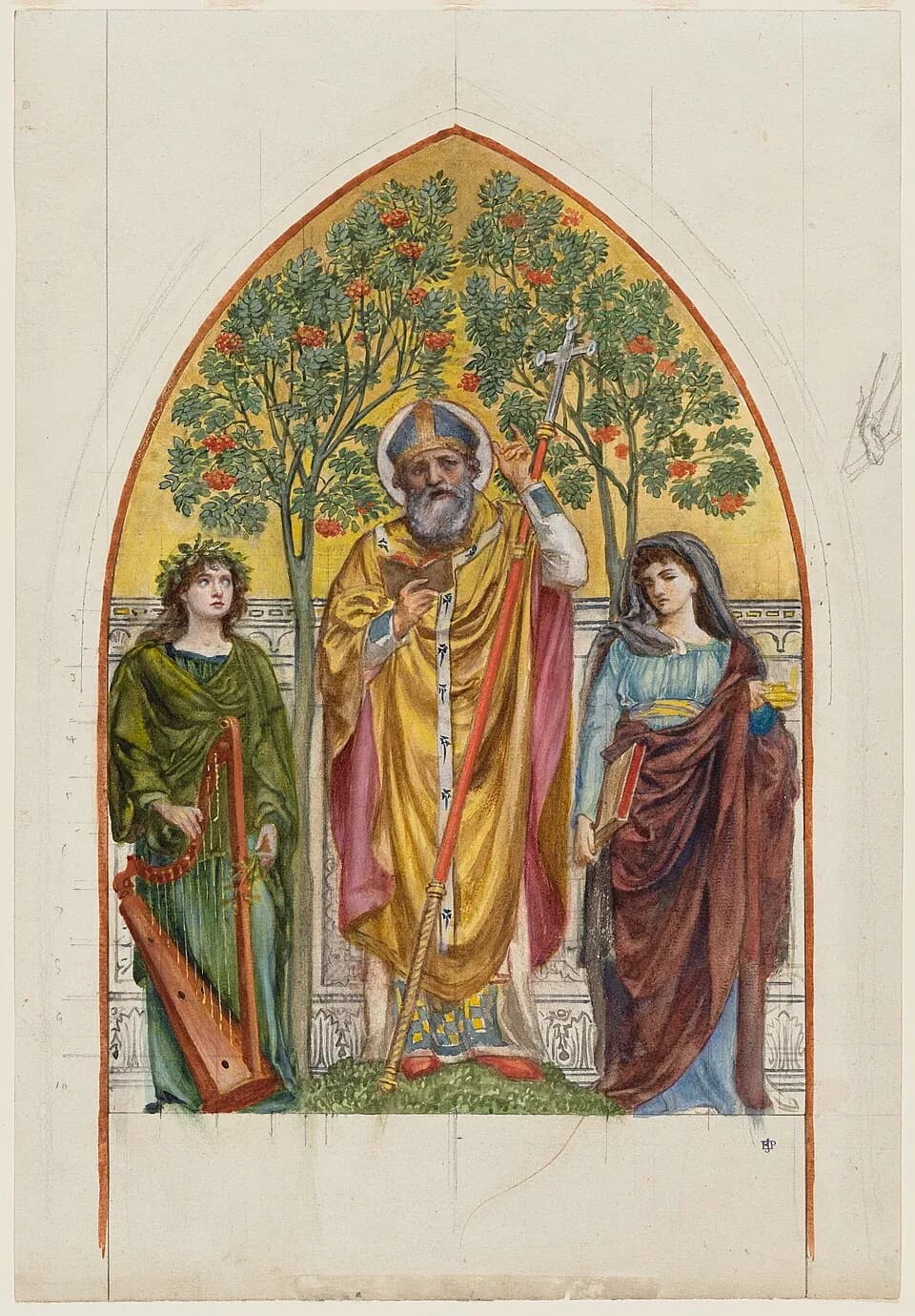
- Born
- Date unknown; a tradition the 1913 Catholic Encyclopedia calls "not improbable" places it at Henvynyw in Cardiganshire 1
- Died
- 601 according to the Annales Cambriae, which the 1913 Catholic Encyclopedia follows 1; March 1, 589 according to Franciscan Media 3; probably the end of the sixth century according to the Liturgy Office 4
- Canonized
- By Pope Callistus II in 1120 1
Saint David, Dewi Sant in Welsh, was a sixth-century monk and bishop of Menevia, the place in the far west of Wales that now bears his name, and he is the patron saint of Wales. 134 Almost everything else told about him comes from a Life written some five hundred years after his death, which the 1913 Catholic Encyclopedia calls "entirely unreliable." 1 His feast is March 1. 134
What is actually known
The Liturgy Office of the Bishops' Conference of England and Wales puts it plainly: "Very little is known about the life of David (Dewi Sant); even the year of his death is uncertain." 4 Leslie Toke, who wrote the encyclopedia's article in 1908, sets out the short list of what can claim to be history and then stops. 1
The earliest mention of him is in a tenth-century manuscript of the Annales Cambriae, which gives his death in 601. 1 A tradition that he was born at Henvynyw, or Vetus-Menevia, in Cardiganshire is "not improbable." 1 He was prominent at the Synod of Brevi, at Llanddewi Brefi in Cardiganshire, and shortly afterward, in 569, presided over another synod at a place called Lucus Victoriae. 1 He was bishop of Menevia, the old Roman port of Menapia in Pembrokeshire, then the chief point of departure for Ireland and later known as St. David's. 1 Pope Callistus II canonized him in 1120. 1 "This is all that is known to history about the patron of Wales," Toke writes. 1
Franciscan Media adds that he became a priest, worked as a missionary and founded many monasteries, among them his principal abbey in the southwest of Wales. 3 The Liturgy Office says ten monasteries are attributed to him, "most notably that of Mynyw or Menevia in Dyfed." 4
Bread, vegetables and water
What the sources agree on most readily is the strictness of his monasteries. The Liturgy Office says the communities "led very strict lives in accordance with the practices of the Egyptian hermits," the desert monks of the early Church. 4 Franciscan Media describes monks who worked in silence and tilled the soil without the help of animals, on a diet limited to bread, vegetables and water, and it sets all of this directly after the sentence "Many stories and legends sprang up about David and his Welsh monks." 3
Franciscan Media also has him rising to lead the Church of the region. At a synod around 550, it says, his eloquence so impressed the others there that he was elected primate, and the episcopal see was moved to Mynyw, where his monastery stood; he governed his diocese into old age. 3 The encyclopedia is more cautious about the title. It calls him bishop of Menevia, "probably not Archbishop." 1
The Life by Rhygyfarch
The first biography of him that survives was written near the end of the eleventh century, about five hundred years after his death, by Rhygyfarch, a son of the bishop of St. David's at the time. 1 The encyclopedia calls it "chiefly a tissue of inventions intended to support the claim of the Welsh episcopate to be independent of Canterbury," and says that Giraldus Cambrensis, William of Malmesbury, Geoffrey of Monmouth and later writers "all simply copy and enlarge upon the work of Rhygyfarch." 1
From that Life come the details found in most popular accounts. It makes him the son of Sant, a prince of Cardiganshire, and of Nonna, and has his birth foretold to Saint Patrick by an angel thirty years before. 1 It sends him to study under Saint Illtyd and then for ten years under Saint Paulinus, has him found or restore twelve monasteries including Glastonbury, Bath and Leominster, and takes him on pilgrimage to Jerusalem with Saint Teilo and Saint Padarn. 1 It has him live to 147. 1 The encyclopedia points out that the twelve monasteries, the temptation of his monks and an attempt to poison him "all suggest an imitation of the life of St. Benedict," and that wilder stories, such as a messenger who crossed from Ireland in a night on the back of a sea monster, "are commonplaces of Celtic hagiography." 1
Its conclusion is that "It is impossible to discover in this story how much, if any, is true." 1 Rhygyfarch doubtless gathered local traditions, Toke allows, but how much of them had a historical foundation "is no longer possible to decide." 1 The Liturgy Office reflects the same caution when it says only that the ten monasteries are "attributed" to him. 4
The Life also adds to the uncertainty over his dates. Geoffrey of Monmouth and the writers after him placed his death around 544, but the encyclopedia says their view rests only on the late Lives and sees "no good reason for setting aside the definite statement of the 'Annales Cambriae'," that is, 601. 1 Franciscan Media gives his death as March 1, 589. 3
The hill at Brefi, the dove and the leek
He is usually shown standing on a little hill with a dove on his shoulder. 13 The picture comes from a story about the Synod of Brefi. In Rhygyfarch's version, as the encyclopedia summarizes it, he was persuaded with difficulty to attend and then preached "so loudly, from the hill that miraculously rose under him, that all could hear him." 1 Franciscan Media tells it as a legend: once while he was preaching, a dove came down to his shoulder and the earth rose to lift him high above the people so that he could be heard. 3
The leek has a story of its own. "From time immemorial," the encyclopedia says, the Welsh have worn a leek on St. David's Day, in memory of a battle against the Saxons in which "it is said" they wore leeks in their hats, on his advice, to tell themselves apart from their enemies. 1 The encyclopedia records the custom and leaves the battle as hearsay.
Do the little things
The best-known words attributed to him are his last, spoken to his monks. Pope Benedict XVI quoted them during his visit to Britain in 2010, when he blessed a mosaic of the saint at Westminster Cathedral: "Be joyful, keep the faith, and do the little things." 2 Franciscan Media gives a longer form: "Be joyful, brothers and sisters. Keep your faith, and do the little things that you have seen and heard with me." 3
The Pope called David "one of the great saints of the sixth century, that golden age of saints and missionaries in these isles," and so "a founder of the Christian culture which lies at the root of modern Europe." 2 His preaching, he said, "was simple yet profound." 2 Of the dying words he said: "It is the little things that reveal our love for the one who loved us first (cf. 1 Jn 4:19) and that bind people into a community of faith, love and service." 2
What is Saint David the patron saint of?
Saint David is the patron saint of Wales. 134 The 1913 Catholic Encyclopedia calls him "patron of Wales," and Benedict XVI called him "the patron saint of the Welsh people." 12 The Liturgy Office traces how that came about. He was first venerated in South Wales; his cult followed his monks to Ireland, Brittany, Cornwall and England; and his shrine at St. David's became a place of pilgrimage in the twelfth century, "from which time he has been honoured as the patron of Wales." 4 Franciscan Media counts more than fifty churches in South Wales dedicated to him before the Reformation. 3
Popular lists sometimes give him other patronages. None of the sources consulted for this page does, and none is repeated here.
Saint David's feast day
His feast is March 1. 134 The Liturgy Office of England and Wales lists it as "St David, bishop, patron of Wales," kept as a solemnity in Wales and as a feast in England. 5 Franciscan Media gives March 1 as the day of his death. 3 It is the day on which, according to the encyclopedia, the Welsh have long worn the leek. 1
Praying with Saint David
There is very little about David that can be checked, and the sources say so. What survives with any confidence is a death recorded in a chronicle, two synods, a see on the western coast and a canonization in 1120. 1 Around those few facts later writers built a long life full of wonders, some of which, in the encyclopedia's words, "has obviously been invented for controversial purposes." 1 A reader looking for him has to make do with the outline.
The outline is a monastic one. The communities associated with him are remembered for silence, hard work in the fields, and bread, vegetables and water, in the manner of the desert hermits. 34 Some of that may belong to the stories rather than the history, and the sources do not claim to know which.
The words his monks are said to have kept from his deathbed are plain ones. Benedict XVI said that it is the little things that "reveal our love for the one who loved us first" and that "bind people into a community of faith, love and service." 2 Franciscan Media's version asks the brothers and sisters to keep doing what they had "seen and heard" with him, which points back to a shared life more than to anything he said. 3
His cult traveled with his monks to Ireland, Brittany, Cornwall and England, and in the twelfth century his shrine at St. David's became a place of pilgrimage. 4 Benedict XVI, unable to visit Wales in 2010, blessed a mosaic of him in London instead and prayed that his message would "continue to resound in Wales today." 2
Saint David of Wales, pray for us.
Sources
- 1.Leslie Toke, "St. David," The Catholic Encyclopedia, Vol. 4 (New York: Robert Appleton Company, 1908).
- 2.Pope Benedict XVI, Salute to the Faithful of Wales, Westminster Cathedral, London, September 18, 2010.
- 3."Saint David of Wales," Saint of the Day, Franciscan Media.
- 4.Liturgy Office of the Catholic Bishops' Conference of England and Wales, "National Calendar for Wales."
- 5.Liturgy Office of the Catholic Bishops' Conference of England and Wales, "March - Sanctoral Calendar."
Saints to turn to next
Others in this collection who are turned to for some of the same things.
- Saint André BessetteAugust 9, 1845 - January 6, 1937Work and vocationPoverty and simplicity
- Saint BarnabasFirst centuryWork and vocationPoverty and simplicity
- Saint Benedict the Moor1524 or 1526 - April 4, 1589Work and vocationPoverty and simplicity
- Saint Brigid of Kildare451 or 452 - February 1, 525Work and vocationPoverty and simplicity