Saint Damasus I
c. 304 - December 11, 384
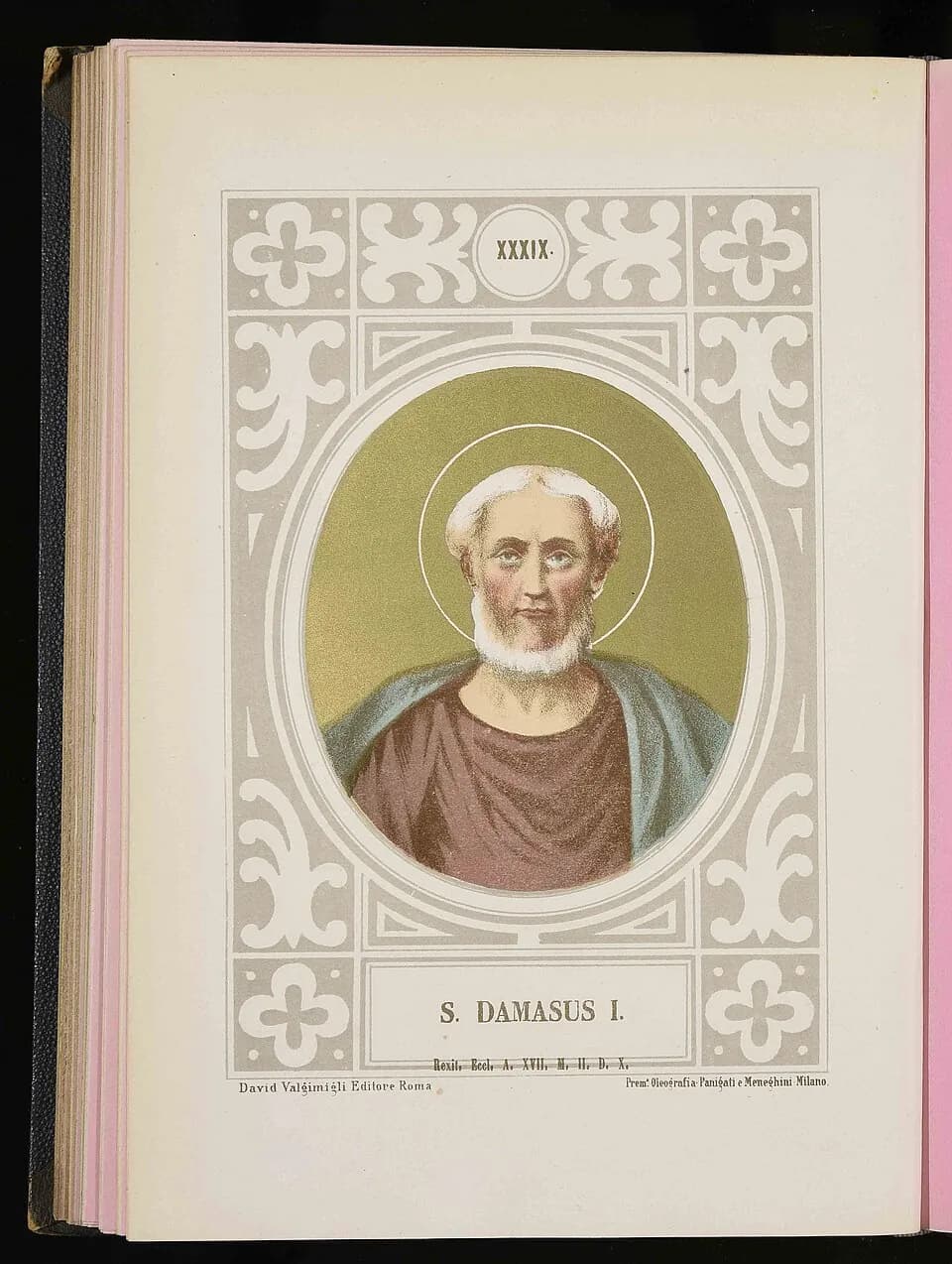
- Born
- About 304, apparently at Rome, to a father probably from Spain 1; Franciscan Media gives 304 and makes his father a Roman priest 2
- Pope
- Elected October 366 1
- Known for
- Setting Saint Jerome to work on a new Latin translation of the Bible 14, and restoring the tombs of the Roman martyrs 56
- Buried
- In a small church he built on the Via Ardeatina, with his mother and sister, according to the Liber Pontificalis 1
- Patron saint of
- No patronage is named by any source consulted
Saint Damasus I was the pope who asked Saint Jerome for a new Latin Bible, and the result was the Vulgate. 124 He also went looking for the graves of the Roman martyrs in the catacombs, restored them, and carved verses of his own over them, some of which can still be read. 156 He came to the papacy in 366 through an election his rivals contested with violence, and he was dogged by it for most of the eighteen years that followed. 12
A deacon of San Lorenzo
Thomas Shahan, writing in the Catholic Encyclopedia in 1908, says Damasus was born about 304 and "seems to have been born at Rome." 1 His father, Antonius, was probably a Spaniard. 1 Franciscan Media gives the year as 304 and says his father was a Roman priest "possibly of Spanish extraction." 2
Both sources tie his early life to the church of the martyr Lawrence. Shahan says it is certain he grew up in its service. 1 Franciscan Media has him starting as a deacon in his father's church and serving as a priest in what later became the basilica of San Lorenzo, and says he served Pope Liberius and followed him into exile. 2
A disputed election
When Liberius died, Damasus was elected in October 366, "by a large majority" according to the encyclopedia. 1 A minority would not accept him. They chose another deacon, Ursinus, had him consecrated irregularly, and, in Shahan's words, "resorted to much violence and bloodshed in order to seat him in the Chair of Peter." 1 Franciscan Media describes the same dispute as having "resulted in violent battles in two basilicas, scandalizing the bishops of Italy," and does not say which side began it. 2
Shahan adds a caution about the evidence. Many of the details survive in a petition to the civil authorities by two presbyters hostile to Damasus, which he calls "highly prejudiced," and he points also to the pagan historian Ammianus Marcellinus. 1 The page reports the violence because both sources do; it does not try to settle who bore the guilt for it.
The emperor Valentinian recognized Damasus and in 367 banished Ursinus to Cologne. 1 He was later allowed as far as Milan but kept away from Rome. 1 His party did not let the matter go. In 378 Damasus was accused before the imperial court, of adultery according to the encyclopedia, of "a grave crime - probably sexual" according to Franciscan Media. 12 The emperor Gratian cleared him, and a Roman synod of forty-four bishops did the same and excommunicated his accusers. 1
Not every bishop was on his side. Franciscan Media records that when Damasus called a synod for his birthday and asked the Italian bishops to approve his actions, their reply was curt: "We assembled for a birthday, not to condemn a man unheard." 2
Pope in a contested century
Much of his reign was spent on doctrine.Roman synods in 368 and 369 condemned the Apollinarian and Macedonian heresies, and he sent legates to the Council of Constantinople in 381. 1 A Roman synod of 374 proclaimed what the encyclopedia calls "an important canon of the New Testament." 1 Relations with the East were harder. Basil of Caesarea appealed to him for help against the Arians, and Shahan says the pope "cherished some degree of suspicion" of him. 1 Franciscan Media puts the trouble down to a misunderstanding over Trinitarian terminology and judges that he was "only moderately successful" with it. 2
In 380 the emperor Theodosius I proclaimed as the religion of the Roman state the faith Saint Peter had preached to the Romans. 1 Franciscan Media adds that Latin became the principal language of the liturgy under his reforms. 2 Damasus held that the authority of the Roman Church rested not on the decrees of councils but on the words of Christ in Matthew 16:18. 1
Franciscan Media says his own way of life was simple next to that of other Roman churchmen. 2 The encyclopedia describes the other side of that: clergy drawn by the new splendor of the office into the pursuit of rich widows and orphans, until in 370 Valentinian addressed an edict to the pope forbidding it. Damasus had the law strictly enforced. 1
Jerome and the Vulgate
In 382 Jerome came to Rome, and Damasus engaged him as secretary and counselor. 4 Benedict XVI says the pope encouraged him, "for pastoral and cultural reasons, to embark on a new Latin translation of the Biblical texts." 4 The encyclopedia says it was Damasus who induced Jerome to undertake the revision of the older Latin versions. 1 Franciscan Media follows the line forward to the Council of Trent, which twelve centuries later declared the Vulgate "authentic in public readings, disputations, preaching." 2
Jerome thought highly of him. Franciscan Media quotes him calling Damasus "an incomparable person, learned in the Scriptures." 2 Jerome also says that Damasus wrote on virginity in prose and verse, though the encyclopedia notes that nothing of it survives. 1 After the pope died, Jerome left Rome, in 385. 4
The tombs of the martyrs
The Pontifical Commission for Sacred Archaeology dates the first restoration of them to him: in the second half of the fourth century Damasus "began the search for the tombs of the martyrs," had them restored, and had praises engraved for "these first champions of the faith." 6 John Paul II described the same work in 2002, saying Damasus sought out the tombs and "embellished them with splendid metric epigraphs in memory of the acts of these first witnesses to the faith." 5
The verses were his own, and the lettering was his friend Furius Dionysius Filocalus's, cut in a distinctive script the encyclopedia calls the Damasan letters. 1 Benedict XVI notes that Damasus had an inscription carved on the grave of the boy martyr Tarcisius, and that it gives his death as 257. 7 John Paul II quoted in full the epigraph for Saint Saturninus, which opens: "Citizen now of Christ, formerly of Carthage." 5
He also built. At the basilica of Saint Sebastian on the Appian Way he set up a marble monument marking the place where, in 258, the bodies of Peter and Paul had been moved for a time. 1 At the Vatican he built a baptistery and drained the ground around the tombs near Peter's, so the bodies buried there would not be damaged by standing water. 1 He restored his own church, now San Lorenzo in Damaso, and provided a home for the archives of the Roman Church. 1
Death and burial
Damasus died on December 11, 384. 12 The Liber Pontificalis says he was buried with his mother and sister in a small church he had built on the Via Ardeatina, between the catacombs of Callistus and Domitilla. 1 Its ruins were found in 1902 and 1903, and with them his mother's epitaph. 1 It gave her name, Laurentia, and said she had lived sixty years of widowhood in the service of God and died in her eighty-ninth year, having seen the fourth generation of her descendants. 1
What is Saint Damasus the patron saint of?
None of the sources consulted for this page names a patronage for him. 12 That is recorded here as it stands rather than filled in. The work he is remembered for in Rome is the care of the martyrs' graves, which is why John Paul II and the Pontifical Commission for Sacred Archaeology both still speak of him. 56
Saint Damasus's feast day
Praying with Saint Damasus
His election was fought over with violence, and the bishops of Italy declined to endorse him at a synod he had called. 12 Franciscan Media writes that his struggles are "a reminder that Jesus never promised his Rock protection from hurricane winds." 2 His life does not make that history tidier. It shows a man who went on governing the Church through it for eighteen years.
Much of what he did was done for other people's memory. He searched the catacombs for the graves of the martyrs, repaired them, and wrote verses to say who lay there and what they had suffered. 56 The year the boy martyr Tarcisius died is given by the stone Damasus had carved over his grave. 7 Praying with him can be as plain as remembering by name the people who handed the faith on.
He also took on a scholar known for his learning and his asceticism, and encouraged him toward a new Latin translation of the Bible. 14 The Vulgate is the larger legacy, and it began with that request.
Franciscan Media names two qualities it sees in him: alertness to the promptings of the Spirit, and service. 2 His mother, by her epitaph, spent sixty years of widowhood in the service of God. 1 He was buried beside her, near the martyrs he had spent his reign honoring. 1
Saint Damasus I, pray for us.
Sources
- 1.Thomas Shahan, "Pope St. Damasus I," The Catholic Encyclopedia, vol. 4. New York: Robert Appleton Company, 1908. New Advent.
- 2."Saint Damasus I," Saint of the Day, Franciscan Media.
- 3."St. Damasus I, Pope," Saint of the Day for 11 December, Vatican News.
- 4.Pope Benedict XVI, General Audience of 7 November 2007: Saint Jerome. The Holy See.
- 5.Pope John Paul II, Message to the President of the Pontifical Commission for Sacred Archaeology, 13 February 2002. The Holy See.
- 6."The Christian Catacombs," Pontifical Commission for Sacred Archaeology. The Holy See.
- 7.Pope Benedict XVI, General Audience of 4 August 2010: Saint Tarcisius. The Holy See.
Saints to turn to next
Others in this collection who are turned to for some of the same things.