Saint Crescentia Höss
October 20, 1682 - April 5, 1744
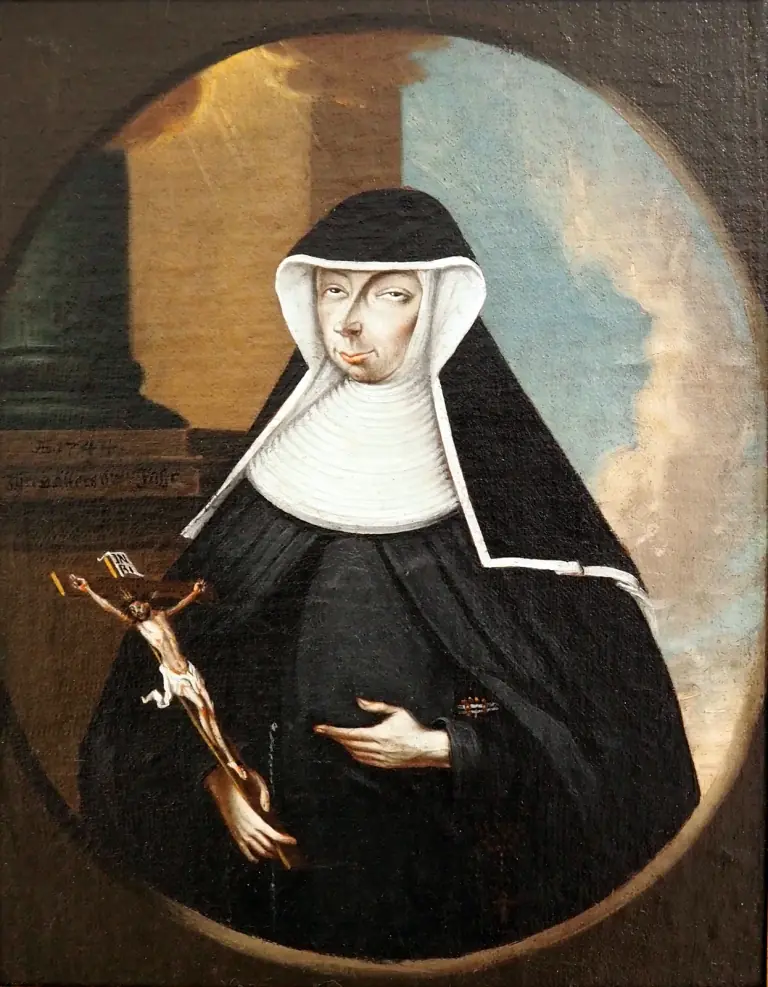
- Beatified
- By Leo XIII, October 7, 1900 3
Saint Crescentia Höss was a poor weaver's daughter from Kaufbeuren in Bavaria who wanted nothing but to enter the little Franciscan convent in her town, was turned away because she had no dowry, and once inside was made to suffer for years by the superior who had not wanted her. 13 She outlived it to become novice mistress and superior, and an adviser whom, John Paul II said, "princes and empresses, priests and religious, abbots and bishops" came to consult. 12 Her feast is April 5. 34
A weaver's daughter in Kaufbeuren
She was born Anna Höss at Kaufbeuren, in the diocese of Augsburg, on October 20, 1682, the daughter of Matthias Höss and Lucia Hoermann. 13 The Holy See's biography makes her the seventh of their eight children; the Norwegian bishops' database makes her the sixth. 13 Her father was a poor wool weaver. Her mother, katolsk.no says, knew a good deal about healing and spent herself day and night on the sick of the town. 3 Catholics were a minority in Kaufbeuren then, outnumbered four to one by Protestants. 3
John Paul II remembered that "God gave her a beautiful voice," and that even as a girl she sang solo parts, "not to display herself but to sing and to play for Christ the King." 2 According to katolsk.no she made a private vow of chastity at six or seven, and went often to pray alone in the chapel of the Franciscan tertiaries in the town, where one day she seemed to hear a voice from the crucifix: "This shall be your home." 3
Refused, then admitted
The convent was poor and a weaver's daughter had no dowry, so the superior refused her. 3 The Holy See's account says only that she was admitted in 1703 "in spite of family difficulties and the superior's reluctance." 1 katolsk.no tells how it came about. The town's Protestant mayor, who had been impressed by the girl, persuaded the sisters to take her in return for his help in getting rid of a rowdy tavern that had been troubling them. 3 She was received on June 16, 1703, at twenty-one, took the name Maria Crescentia, and was professed in 1704. 13
The superior did not hide her resentment. katolsk.no describes years of it: the hardest and dirtiest work despite her poor health, no cell of her own even after profession, a corner of an older sister's floor to sleep on, leftovers at table and cast-off clothes. 3 Most of the community joined in. Some younger sisters tried to protest on her behalf, and she would not support them. 3
Stranger trials came too. Her sisters, katolsk.no says, saw her troubled by mysterious physical assaults from the devil, and began to treat her as a witch, crossing themselves when they met her. 3 The same source tells of the superior ordering her to draw water from the convent well with a broken sieve, and of the sieve holding the water. 3
John Paul II named what had happened in a word his hearers in 2001 would recognize. "Mobbing" took place in her time, he said. "She endured the intrigues of her own community, without ever doubting her own vocation. The long period of suffering allowed her to grow in the virtue of patience." 2
Porter, novice mistress, counselor
It ended when the superior was replaced. 3 From 1709 to 1741 the community was governed by superiors "who were favourably disposed to her," the Holy See writes, and she held the convent's most important offices in turn: porter, novice mistress and, at last, superior. 1 katolsk.no says she kept the door for sixteen years and became known there for her kindness to the poor, and for reconciling families and neighbors who had long lived at odds. 3
The dates of her years with the novices differ. The Holy See gives 1726 to 1741. 1 katolsk.no has her appointed in 1716 and keeping the office for twenty-five years. 3
Her name spread. "To her convent came many visitors," John Paul II said, "both simple men and women, princes and empresses, priests and religious, abbots and bishops." He called her "a kind of midwife" who "helped those seeking counsel to bring forth the truth in their hearts." 2 The Holy See points to her "numerous letters" as evidence of how many people she advised. 1 katolsk.no names the emperor Charles VI and the empress Maria Theresa among those who asked her counsel. 3
Superior
In 1741 the community elected her superior. She tried to refuse and was made to accept. 13 The Holy See calls her, for her three years in office, the house's "second foundress." 1 She told her sisters to keep silence and recollection and to read spiritual books, the Gospels above all; "the teacher of their religious life had to be Jesus on the Cross." 1
She was careful whom she admitted, and she said why: "God wants the convent rich in virtue, not in temporal goods." 1 The Holy See lists the points of her renewal: unlimited trust in providence, readiness in the common life, love of silence, devotion to the crucified Christ, to the Eucharist and to the Mother of God. 1 katolsk.no says she was kind to her sisters as superior and strict in testing the novices. 3 For John Paul II, "to direct meant spiritually to serve. She was generous with the poor, motherly with her sisters, and kind to all who needed a kind word." 2
She had suffered from severe toothaches and headaches all her life, and they grew worse. 3 By February 1744 she was dangerously ill, and her last agony was painful. 3 She died on Easter in 1744: late on the evening of Easter Sunday, April 5, katolsk.no says, at sixty-one. 13 Her body lies beneath the high altar of the convent church in Kaufbeuren, still much visited. 13
Leo XIII beatified her on October 7, 1900. 3 John Paul II canonized her in Saint Peter's Square on November 25, 2001, together with Joseph Marello, Paula Montal and Leonie Aviat. 23
What is Saint Crescentia Höss the patron saint of?
Saint Crescentia Höss's feast day
Saint Crescentia's feast day is April 5, the day she died. The current Roman Martyrology, as the Italian bishops publish it, enters her on that day at Kaufbeuren on the Wertach, as a virgin of the Third Order of Saint Francis who strove to pass on to others the love of the Holy Spirit with which she burned. 4 The Norwegian bishops' database also keeps her on April 5. 3
Praying with Saint Crescentia
The hard part of her story comes from inside a convent. She was not persecuted by unbelievers; she was ill-treated by the women she had begged to join, and the Pope who canonized her did not soften it. 23
She refused to let younger sisters fight her battles. 3 The sources do not say the treatment stopped because she won anyone over. It stopped when the superior was replaced. 3
Years later, when she held the office herself, she used it for service, and she told her sisters that the teacher of their life was Jesus on the Cross. 12 Visitors came to her door from every rank, and she was remembered, in the end, as kind to all of them. 23
Saint Crescentia Höss, pray for us.
Sources
- 1."Maria Crescentia Höss (1682-1744): biography," Office for the Liturgical Celebrations of the Supreme Pontiff, canonization of November 25, 2001, The Holy See.
- 2.John Paul II, Homily for the canonization of Joseph Marello, Paula Montal Fornés, Leonie Frances de Sales Aviat and Maria Crescenzia Höss, November 25, 2001, The Holy See.
- 3."Den hellige Crescentia Höss (1682-1744)," Den katolske kirke, the saints database of the Catholic Church in Norway, katolsk.no (in Norwegian).
- 4.Roman Martyrology, entries for April 5, Santo del giorno, Conferenza Episcopale Italiana (in Italian).
Saints to turn to next
Others in this collection who are turned to for some of the same things.
- Saint Aldegundc. 630 or c. 639 - 684Suffering and illnessDiscernmentPrayer
- Saint Bernardo TolomeiMay 10, 1272 - August 20, 1348DiscernmentPrayerSuffering and illness
- Saint Carmen RendilesAugust 11, 1903 - May 9, 1977PrayerDiscernmentSuffering and illness
- Saint Clare of Montefalcoc. 1268 - August 1308PrayerSuffering and illnessDiscernment