Saint Cornelius
Birth unknown - June 253
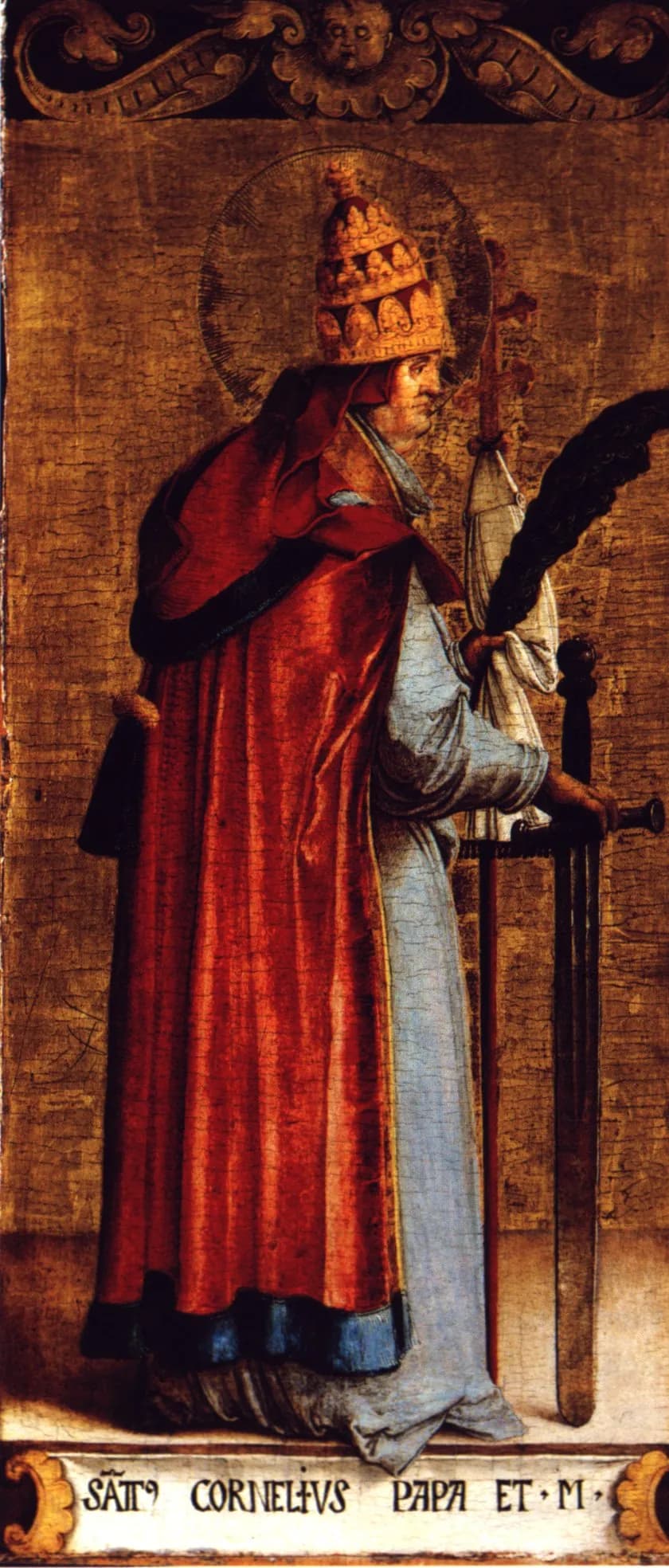
- Born
- Unknown
- Bishop of Rome
- From early 251, after the see had been empty since the martyrdom of Fabian on 20 January 250 110
- Length of pontificate
- Two years, three months and ten days by the Liberian catalogue 1; "about three years" according to Eusebius 9
- Buried
- In a catacomb beside the papal crypt, under a Latin inscription: CORNELIUS MARTYR 1
Saint Cornelius was bishop of Rome for a little over two years, from 251 to 253, and was elected to an office he did not want at a moment when holding it could get him killed. 12 Within weeks a Roman priest, Novatian, had himself consecrated as a rival bishop, and the question between them was what the Church could do for Christians who had denied the faith under persecution. 110 Cornelius held that they could be brought back through penance, and a Roman synod of sixty bishops agreed with him. 18 His defender throughout was Cyprian of Carthage, whose letters are the main record of his pontificate. 12 He died in exile in 253, and the two are kept together on September 16. 11011
Elected while the chair was dangerous
The emperor Decius put Pope Fabian to death on 20 January 250. 1 Franciscan Media counts fourteen months without a pope, during which a college of priests governed the Roman church. 10 Around the beginning of March 251 the persecution slackened, because Decius was away dealing with two rivals for his throne, and sixteen bishops were able to meet in Rome. 12 They elected Cornelius.
The fullest account of the election comes from Cyprian, writing to a wavering African bishop named Antonianus. Cornelius had been "promoted through all the ecclesiastical offices," he says, and neither asked for the episcopate nor wanted it: "he himself suffered compulsion, so as to be forced to receive the episcopal office." 2 He was chosen "by the testimony of almost all the clergy, by the suffrage of the people who were then present," when "the place of Peter" was vacant. 2
What Cyprian admires most is the timing. Cornelius took his seat while the emperor "would much more patiently and tolerantly hear that a rival prince was raised up against himself than that a priest of God was established at Rome." 2 Had he not, Cyprian asks, already earned a place "among the glorious confessors and martyrs," having sat so long awaiting the sword or the cross or the fire? 2
Novatian
A few weeks later Novatian, a Roman priest and a learned philosopher, made himself a rival bishop, and in Chapman's words "the whole Christian world was convulsed by the schism at Rome." 1 Novatian sent an envoy to Carthage, and he was refused communion. 5 Cyprian did not simply take Cornelius's word, though. With accusations circulating, he waited for letters from the bishops present at the ordination, and refused to let the charges be read aloud in his assembly. 3 Once the testimony came, his support secured Cornelius the hundred bishops of Africa, and Dionysius of Alexandria brought the East round within a few months. 13
Cornelius gave his own account of his rival in letters to Fabius, bishop of Antioch, who seems to have wavered. 1 Eusebius, who calls Novatian "Novatus," preserved extracts, and Chapman warns that they set out his faults "with considerable bitterness." 18 In Cornelius's telling, a man who had sworn "terrible oaths in nowise to seek the bishopric" got himself consecrated by three country bishops brought to Rome on a pretext and made drunk. 8 During the persecution, he adds, Novatian had refused to leave his room to help the brethren. 8 Worst of all, he held each communicant's hands at the Eucharist until the man swore: "I will never return to Cornelius." 8
The same letter gives a rare count of the third-century Roman church: forty-six priests, seven deacons, seven subdeacons, forty-two acolytes, fifty-two exorcists, readers and doorkeepers, and "over fifteen hundred widows and persons in distress," all supported by the community. 81
What the Church could forgive
The quarrel was about the lapsed, the Christians who had sacrificed to the gods or bought certificates saying they had. Franciscan Media describes Novatian's position as a denial that the Church had any power to reconcile apostates, or those guilty of murder, adultery, fornication or second marriage. 10
Cornelius called a synod of sixty bishops at Rome. It declared Novatian and his followers strangers to the Church, and directed that the fallen be healed "with the medicines of repentance." 810 At Carthage, Cyprian's council had reached a similar middle course, and Cornelius, in Cyprian's words, "concurred in the same opinion as we had held." 12 A later letter of Cyprian's records one consequence they settled together: a bishop who had lapsed could be admitted to penance but not restored to the priesthood. 7
He also acted on it. When a man named Trophimus, who had led a large part of a congregation away, came back confessing his error, Cornelius received him and the people who returned with him, but only to communion as a layman. Cyprian had to explain that to Antonianus, who had heard that Trophimus was given back a priest's place. 2 Rumors circulated that Cornelius himself had bought a certificate; Cyprian replied that the bishops had looked into it and found him "blemished with no stain." 2
The confessors come back
One of the two letters by Cornelius that survive in Cyprian's correspondence tells how the Roman confessors who had sided with Novatian returned. 14 Maximus, a priest, and Urbanus and Sidonius had suffered for the faith, and Cornelius wrote that Novatian had used them as a cloak for his ambition. 48 Cornelius did not take them back on a message. He had them questioned by the priests, called the presbytery together with five bishops, and only then brought them before the people. 4
What he describes next is the scene of a crowd: "There was one voice from all, giving thanks to God; all were expressing the joy of their heart by tears, embracing them as if they had this day been set free from the penalty of the dungeon." 4 Maximus was given back his place as a priest. 4 Chapman notes that Cornelius wrote in the colloquial Latin of the day, not in the classical style of the former orator Cyprian or the philosopher Novatian. 1
The friendship was not always easy. Franciscan Media says it was strained for a time when one of Cyprian's rivals made accusations, and then cleared up. 10 Cyprian's own letter shows him "considerably surprised" that Cornelius had been "in some degree disturbed by the threats" of the party of Fortunatus and Felicissimus, who had come to Rome. 5
Exile at Centumcellae
At the beginning of 252 persecution broke out again without warning, and Cornelius was banished to Centumcellae, the modern Civitavecchia. 110 This time, Chapman says, there were no defections at Rome. 1 Cyprian wrote to congratulate him: Cornelius had "stood forth as a leader of confession to the brethren," and "the whole Roman Church has confessed." 6 Many who had lapsed the first time, he added, stood firm in this one. 6
Cornelius died in June 253, and how is not certain. 1 The Liberian catalogue says "ibi cum gloriâ dormicionem accepit," which Chapman thinks may mean the rigors of exile killed him, "though later accounts say that he was beheaded." 1 Franciscan Media says he died of the hardships of exile. 10 Cyprian repeatedly calls him a martyr: "a peaceable and righteous priest, and moreover honoured by the condescension of the Lord with martyrdom." 17 Eusebius gives him "about three years" in office, Franciscan Media two, and the Liberian catalogue, which Chapman trusts, two years, three months and ten days. 9101 He was buried in a catacomb next to the crypt of the popes, and his epitaph is in Latin where those of Fabian and his successor Lucius are in Greek. 1
What is Saint Cornelius the patron saint of?
Saint Cornelius's feast day
His feast is September 16, kept together with Saint Cyprian. 1011 Franciscan Media lists him for that day, and the Vatican News calendar for September 16 gives "Sts. Cornelius, Pope and Cyprian, Bishop, Martyr." 1011
Chapman's 1908 article gives a different date: "His feast is kept with that of St. Cyprian on 14 September, possibly the day of his translation from Centumcellæ to the catacombs." 1 He explains the pairing as well. Jerome said the two men suffered on the same day in different years, a "careless statement" in Chapman's view that "has been generally followed." 1 And a fourth-century Roman calendar shows that Cyprian's feast was kept at Rome at the tomb of Cornelius, in the cemetery of Callistus. 1
Praying with Saint Cornelius
Cyprian's case for Cornelius rests on a single act: he accepted. He did not want the office, and he took it while an emperor was killing bishops. 12 Cyprian counts that, by itself, as a kind of confession. 2
The argument he then had to settle was about people who had failed. Novatian's answer was that the Church could not take them back; Cornelius's was that it could, through penance, and he applied it with some care. Trophimus came back as a layman, not a priest, and the confessors who had followed Novatian were questioned before they were embraced. 24 His own account of the day they returned is mostly about the crowd in tears. 4
He was also accused of having bought his way out of sacrifice, and at one point was shaken enough by threats that Cyprian wrote to steady him. 25 What he wrote about Novatian is bitter, and Chapman says so. 1 The sources do not make him serene.
When persecution came back, the Roman church confessed with him, and Cyprian could write that he had led it. 16 The same letter, sent to him in exile, asks that each keep praying for the other, "that if any one of us, by the swiftness of divine condescension, shall go hence the first, our love may continue in the presence of the Lord." 6 Cornelius died first. Cyprian suffered in a later year, and the Church keeps them on one day. 111
Saint Cornelius, pray for us.
Sources
- 1.John Chapman, "Pope Cornelius," The Catholic Encyclopedia, Vol. 4 (New York: Robert Appleton Company, 1908).
- 2.Cyprian of Carthage, Epistle 51, "To Antonianus About Cornelius and Novatian," trans. Robert Ernest Wallis, Ante-Nicene Fathers, Vol. 5 (Buffalo, NY: Christian Literature Publishing Co., 1886), via New Advent.
- 3.Cyprian of Carthage, Epistle 41, to Cornelius, trans. Robert Ernest Wallis, Ante-Nicene Fathers, Vol. 5 (Buffalo, NY: Christian Literature Publishing Co., 1886), via New Advent.
- 4.Cornelius of Rome, Epistle 45 in the correspondence of Cyprian, to Cyprian, trans. Robert Ernest Wallis, Ante-Nicene Fathers, Vol. 5 (Buffalo, NY: Christian Literature Publishing Co., 1886), via New Advent.
- 5.Cyprian of Carthage, Epistle 54, "To Cornelius, Concerning Fortunatus and Felicissimus," trans. Robert Ernest Wallis, Ante-Nicene Fathers, Vol. 5 (Buffalo, NY: Christian Literature Publishing Co., 1886), via New Advent.
- 6.Cyprian of Carthage, Epistle 56, "To Cornelius in Exile, Concerning His Confession," trans. Robert Ernest Wallis, Ante-Nicene Fathers, Vol. 5 (Buffalo, NY: Christian Literature Publishing Co., 1886), via New Advent.
- 7.Cyprian of Carthage, Epistle 67, to the clergy and people of Spain, trans. Robert Ernest Wallis, Ante-Nicene Fathers, Vol. 5 (Buffalo, NY: Christian Literature Publishing Co., 1886), via New Advent.
- 8.Eusebius of Caesarea, Church History, Book VI, Chapter 43, quoting Cornelius to Fabius of Antioch, trans. Arthur Cushman McGiffert, Nicene and Post-Nicene Fathers, Second Series, Vol. 1 (1890), via New Advent.
- 9.Eusebius of Caesarea, Church History, Book VII, Chapter 2, trans. Arthur Cushman McGiffert, Nicene and Post-Nicene Fathers, Second Series, Vol. 1 (1890), via New Advent.
- 10."Saint Cornelius," Saint of the Day, Franciscan Media.
- 11."16 September," Saint of the Day, Vatican News.
Saints to turn to next
Others in this collection who are turned to for some of the same things.