Saint Cleophas
First century
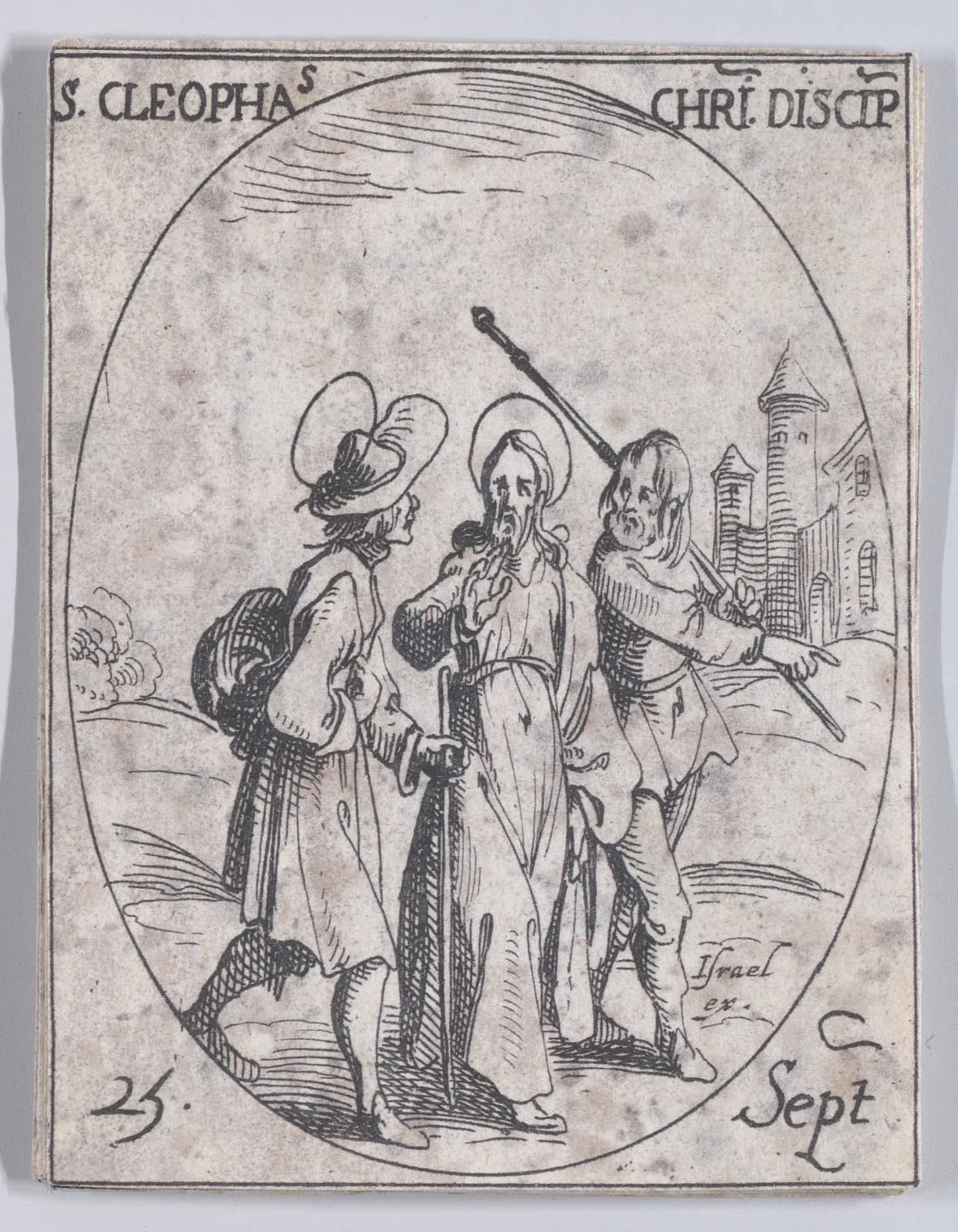
- Gospel
- Luke 24:13-35 1
- Possibly the same as
- Clopas of John 19:25, whose wife Mary stood by the cross; the question is open 24
- Reliable data
- "We have no reliable data concerning him," says the 1908 Catholic Encyclopedia 2
Saint Cleophas is the disciple who, on the evening of the first Easter, was walking with a companion to a village called Emmaus when the risen Jesus joined them on the road. 1 Luke names him, gives him one speech, and tells how the two recognized Jesus "in the breaking of the bread." 1 Beyond that one chapter, as the 1908 Catholic Encyclopedia says, "We have no reliable data concerning him." 2
The road to Emmaus
Luke sets the story on the day of the resurrection. Two of the disciples were going to a village seven miles from Jerusalem called Emmaus, "conversing about all the things that had occurred," when Jesus himself drew near and walked with them, "but their eyes were prevented from recognizing him." 1 He asked what they were discussing, and they stopped, "looking downcast." 1
Only one of the two is named. "One of them, named Cleopas, said to him in reply, 'Are you the only visitor to Jerusalem who does not know of the things that have taken place there in these days?'" 1 The two told him about Jesus of Nazareth, "a prophet mighty in deed and word," handed over and crucified. 1 Then comes the line Benedict XVI singled out: "But we were hoping that he would be the one to redeem Israel." 18 The Pope remarked that the verb in the past tense "tells all: we believed, we followed, we hoped..., but now everything is over." 8
They told him too about the women who had found the tomb empty and seen angels, and about the others who had gone and found it so, "but him they did not see." 1 The stranger answered, "Oh, how foolish you are! How slow of heart to believe all that the prophets spoke!" and, beginning with Moses and all the prophets, interpreted to them what referred to him in all the scriptures. 1
Recognized in the breaking of the bread
At the village he made as if to go on, and they urged him, "Stay with us, for it is nearly evening and the day is almost over." 1 At table he took bread, said the blessing, broke it and gave it to them. "With that their eyes were opened and they recognized him, but he vanished from their sight." 1 They said to each other, "Were not our hearts burning [within us] while he spoke to us on the way and opened the scriptures to us?" 1
They went straight back to Jerusalem that night, found the Eleven, and heard that the Lord had appeared to Simon. Then "the two recounted what had taken place on the way and how he was made known to them in the breaking of the bread." 1 The current Roman Martyrology draws its entry from this chapter: Cleophas is the disciple whose heart burned as Christ explained the Scriptures on the road, and who recognized the Lord at Emmaus in the breaking of bread. 5
Benedict XVI saw in the account "the structure of Holy Mass": first listening to the word in the Scriptures, then the Eucharist. 8 He also took the unidentified village as a figure for every place, so that "the road that leads there is the road every Christian, every person, takes." 8
Where Emmaus was
Nobody now knows for certain. The note in the New American Bible says Luke's "seven miles" is literally sixty stades, that some manuscripts read 160, and that "the exact location of Emmaus is disputed." 1 Benedict XVI said the locality "has not been identified with certainty." 8
The oldest identification is with Nicopolis, the town now called 'Amwas, about eighteen miles from Jerusalem. 3 Siméon Vailhé, writing on Emmaus in the 1909 Catholic Encyclopedia, says this was the tradition of the Church of Jerusalem, attested in the fourth century by Eusebius, Titus of Bostra and Jerome. 3 Jerome, describing Paula's pilgrimage, says she came "to Nicopolis, once called Emmaus, where the Lord became known in the breaking of bread; an action by which He dedicated the house of Cleopas as a church." 6 Vailhé himself thought the tradition ill founded: most manuscripts give sixty stadia, and 160 would mean about six hours' walk, too far for disciples who were back in Jerusalem the same evening. 3
Cleopas and Clopas
In the Catholic English versions of his day, Romain Butin explains in the 1908 Catholic Encyclopedia, Cleophas was the name of two people whose names differ in Greek. 2 One is Cleopas, a short form of Cleopatros, the disciple of Emmaus; the other is Clopas, named in John 19:25, where "Mary the wife of Clopas" stands by the cross. 2 Some have taken Clopas to be the Aramaic Alphaeus, father of the apostle James; Butin sets out the linguistic objections, allows that even different names may have been borne by one man, and calls the question of the identity of Alphaeus and Clopas "still open." 2
There is an old tradition about Clopas. Eusebius records from the second-century writer Hegesippus that Clopas was a brother of Joseph, and that his son Symeon became the second bishop of Jerusalem after James. 7 Hegesippus says Symeon was accused of being a descendant of David and a Christian, and "suffered martyrdom, at the age of one hundred and twenty years, while Trajan was emperor and Atticus governor." 7 Eusebius connects him with the Gospel through "Mary, the wife of Clopas, who was the father of Symeon." 7 katolsk.no gathers these threads into a family: Clopas, his wife Mary, and their sons among the "brothers of the Lord." 4 It then warns that it is not at all certain that the Cleopas who walked to Emmaus is this Clopas. 4
katolsk.no also reports traditions about the Emmaus disciple himself: that Jerome and Eusebius held he was born at Emmaus, and that he is said to have been killed in the same house where he had recognized the risen Lord. 4 It notes that he has been counted from early times among the seventy-two disciples, and stands fourth on the Eastern list of the Seventy. 4
What is Saint Cleophas the patron saint of?
None of the sources consulted names a patronage for Saint Cleophas. He is remembered for a single journey, and the Martyrology's entry for him is a summary of it. 5
Saint Cleophas's feast day
Saint Cleophas's feast day is September 25. 45 Butin noted in 1908 that "his name is entered in the martyrology on the 25th of September," and the current Roman Martyrology keeps him on that day as a disciple of the Lord. 25 The Emmaus story itself was the Gospel of the Third Sunday of Easter when Benedict XVI preached on it in 2008. 8
Praying with Saint Cleophas
Cleophas is remembered at the lowest point of his discipleship. When Luke introduces him he is leaving Jerusalem, downcast, talking about a hope in the past tense. 18 He has heard the women's report and does not know what to make of it. 1
He does not recognize Jesus, and nothing in the story blames him for that; Luke says their eyes were prevented. 1 What he does is talk honestly with a stranger about his disappointment, listen to the Scriptures explained, and ask the stranger to stay. 1 The recognition comes at a table, over bread. 1
Then he sets out at once, the same evening, and walks the seven miles back to tell the others. 1 Benedict XVI hoped that every Christian community might rediscover "the grace of the transforming encounter with the Risen Lord." 8
Saint Cleophas, pray for us.
Sources
- 1.Luke 24, with notes. New American Bible, Revised Edition, United States Conference of Catholic Bishops.
- 2.Romain Butin, "Cleophas," The Catholic Encyclopedia, Vol. 4 (New York: Robert Appleton Company, 1908).
- 3.Siméon Vailhé, "Emmaus," The Catholic Encyclopedia, Vol. 5 (New York: Robert Appleton Company, 1909).
- 4."Den hellige Kleofas (1. årh)," Den katolske kirke (katolsk.no), Catholic Diocese of Oslo (in Norwegian).
- 5.Roman Martyrology, entry for September 25, "San Cleofa, discepolo del Signore," as printed in "Santo del giorno," Conferenza Episcopale Italiana (in Italian).
- 6.Jerome, Letter 108, to Eustochium, ch. 8, trans. W. H. Fremantle, Nicene and Post-Nicene Fathers, Second Series, Vol. 6 (1893).
- 7.Eusebius, Church History, Book III, chs. 11 and 32, trans. Arthur Cushman McGiffert, Nicene and Post-Nicene Fathers, Second Series, Vol. 1 (1890).
- 8.Benedict XVI, Regina Caeli address, Third Sunday of Easter, April 6, 2008.
Saints to turn to next
Others in this collection who are turned to for some of the same things.