Saint Claude of Besançon
c. 606 - June 6, c. 699 (other dates are given)
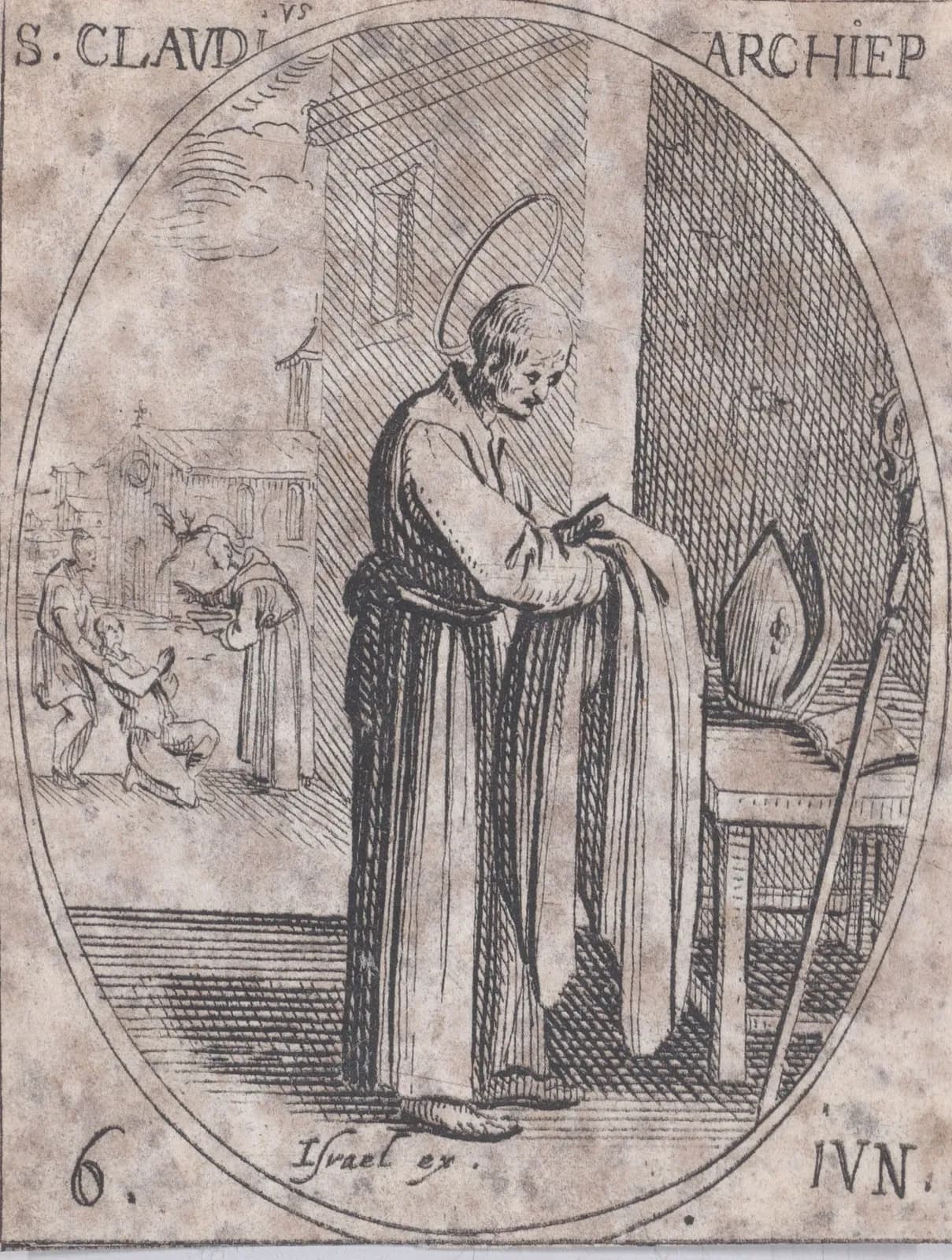
- Also called
- Claudius; Claude of Condat; Claude the Wonderworker 1
- Born
- About 606, at Bracon near Salins, in the Jura 1
- Canon of Besançon
- From 627, under Archbishop Donatus 1
Saint Claude was a priest of Besançon who became the twelfth abbot of Condat, a monastery in the Jura mountains, and is said to have been bishop of Besançon for some years before going back to his monks. 14 So little about him is certain that the Roman Martyrology says only that he is believed to have been bishop and abbot. 2 His tomb, though, became one of the great pilgrimages of France, and the town that grew up around it is called Saint-Claude. 13
An uncertain life
Georges Goyau, writing in the 1912 Catholic Encyclopedia, puts it bluntly: "The Life of St. Claudius, Abbot of Condat, has been the subject of much controversy." 3 The dates show why. The Norwegian bishops' saints database (katolsk.no) has him born about 606 and dying about 699. 1 Goyau reports the view of Dom Benoit, the historian of the abbey, that he lived in the seventh century, was bishop of Besançon before he was abbot, ruled the abbey for fifty-five years, and died in 694. 3 Gabriel Meier, in the encyclopedia's article on Saint Eugendus, says he resigned the see of Besançon in 687 and died in 696. 4 katolsk.no adds that the Bollandists dated his death to 581, and Butler to 693 or 696. 1
Part of the confusion, katolsk.no says, comes from an earlier Claudius of Besançon, of the same family, who lived more than a century before him, attended the councils of Epaone in 517 and Lyon in 529, and is not venerated as a saint. 1 Because the later Claude was known for many miracles, some historians called him Claude the Wonderworker to tell the two apart. 1
A priest of Besançon
The traditional account, as katolsk.no gives it, has him born at Bracon near Salins, in the Jura, to a local nobleman of Gallo-Roman stock, of the family of the Claudii. 1 One of his biographers, Laurentius Surius, says he had private tutors as a boy and spent long hours reading devout books, above all the lives of the saints. 1 He was trained as a soldier and served on the frontier, but at about twenty gave up a worldly career to become a priest. 1
In 627 Archbishop Donatus of Besançon made him a canon of his church. 1 Donatus had written a rule for his canons, and Claude kept it carefully, living very simply and often fasting and keeping vigil. 1 He was ordained and served among the clergy of Besançon for at least twelve years. 1
Abbot of Condat
Condat was by then two centuries old. Goyau says the hermits Romanus and Lupicinus withdrew into "the desert Condat" between 425 and 430 and founded a monastery there, and that other monasteries grew from it. 3 Its fourth abbot, Eugendus, rebuilt it in stone, and the town that formed around his tomb was called Saint-Oyand after him. 4
Here the traditions divide. katolsk.no says one has Claude remain a secular priest until he became bishop, while the other has him enter Condat as a monk. 1 In that second account the eleventh abbot, an old man named Injuriosus, was so struck by Claude that he proposed to step aside for him, and Claude refused to take the office while Injuriosus lived. 1 After the old abbot's death he was elected, at thirty-four, in 641 or 642. 1
katolsk.no says the abbey flourished under him. He restored its buildings, had new reliquaries made, and fed the poor and the pilgrims of the district. 1 He introduced the Rule of Saint Benedict; Goyau confirms that Condat, which began under a rule of its own drawn up between 510 and 515, later took Benedict's. 13 King Clovis II supported the abbey, persuaded by his wife, Saint Bathild, and granted Claude an annual income. 1
Bishop, and back to the monastery
katolsk.no, Goyau and Meier all make Claude bishop of Besançon and have him give the office up, though they do not agree on when. 134 katolsk.no says he kept the government of Condat while he was bishop, and that when he saw discipline slackening there he resigned in 692, after seven years as archbishop, at an age it gives as eighty-six. 1 Meier dates the resignation to 687. 4
katolsk.no tells his death in detail. When he was well over ninety he fell ill, and three days later called his monks together, urged them a last time to love God and despise worldly things, and asked them to bear his death with patience. 1 He gave each of them the kiss of peace and spent the night in prayer. On his last day he received Communion in the church, went back to his cell, and asked to be buried without pomp. 1 It was the fifth day of his illness, at three in the afternoon. He sat in the chair where he usually read and prayed, lifted his hands and eyes toward heaven, and died. 1
katolsk.no dates it to June 6, about 699, in the fourth year of King Childebert III. 1 He was buried, as he had asked, without ceremony, in the abbey church of Saint Eugendus. 1
The tomb at Saint-Claude
katolsk.no says people of the region believed that demons lived in the dark valleys of the Jura, and Claude was often called on for protection. 1 His body was hidden during the Saracen raids and found again in 1160; Goyau says Saint Peter of Tarentaise visited it in 1172, and that it was "solemnly carried all through Burgundy before being brought back to Condat." 3 katolsk.no says it was found intact, and that it was put in a silver shrine in 1243. 1
The pilgrims came in such numbers that, in Meier's words, "since the thirteenth century, the name Saint-Claude came more and more into use" for the town and abbey, and has replaced the old ones. 4 Goyau lists some of them: the dukes of Burgundy Philip the Bold, Philip the Good and Charles the Rash; King Louis XI in 1456 and 1482; and, in 1500, Anne of Brittany, queen of Louis XII, who came "in thanksgiving for the birth of her daughter Claudia." 3 katolsk.no says that daughter, later queen of France as the wife of Francis I, was named after him. 1
In 1742 Benedict XIV secularized the abbey and made it the seat of a new diocese of Saint-Claude. 3 Half a century later the Revolution reached it: "In March, 1794, the body of St. Claudius was burnt by order of the revolutionary authorities." 3
What is Saint Claude the patron saint of?
katolsk.no calls Saint Claude the patron saint of toy dealers, and notes that the trade still thrives in the town of Saint-Claude. 1 Goyau writes that the people of Franche-Comté took him as their second regional patron, alongside Saint Andrew, the first patron of the Burgundians. 3 The diocese of Saint-Claude was placed under his protection. 1 He is shown as an abbot or in a bishop's vestments, often with a staff in his hand or a crown beside him. 1
Saint Claude's feast day
Saint Claude's feast day is June 6, the traditional day of his death. 12 The current Roman Martyrology keeps him on that day, remembering him on the Jura massif as one held to have been bishop and abbot of the monastery of Condat. 2 katolsk.no notes that Rabanus Maurus already named him in his ninth-century martyrology. 1
Praying with Saint Claude
The sources cannot agree on the order of his offices or the century of his death, and the Martyrology itself speaks of him with care. 123 What survives clearly is a man who kept a rule, first as a canon and then as an abbot, and who would not take an old abbot's place while the old man was alive. 1
He was given the highest office in his region and, by the traditional account, put it down to go back and look after his monks. 1 The Callot print shows exactly that: an old man folding away a vestment beside a miter he no longer wears.
His death, as katolsk.no tells it, was a monk's: the brethren gathered, the kiss of peace, a night of prayer, Communion, and a request to be buried plainly. 1 The centuries afterward made him famous anyway. Dukes, a king and a queen came to his tomb, and a town took his name. 34
Then his body was burned. 3 His name is still on the town and on the diocese, which was placed under his protection. 13
Saint Claude of Besançon, pray for us.
Sources
- 1."Den hellige Claudius av Besançon (~606-~699)," Den katolske kirke (katolsk.no), Catholic Diocese of Oslo (in Norwegian).
- 2.Roman Martyrology, entry for June 6, "San Claudio, vescovo e abate," as printed in "Santo del giorno," Conferenza Episcopale Italiana (in Italian).
- 3.Georges Goyau, "Saint-Claude," The Catholic Encyclopedia, Vol. 13 (New York: Robert Appleton Company, 1912).
- 4.Gabriel Meier, "St. Eugendus," The Catholic Encyclopedia, Vol. 5 (New York: Robert Appleton Company, 1909).
Saints to turn to next
Others in this collection who are turned to for some of the same things.