Saint Canute IV of Denmark
c. 1043 - 1086
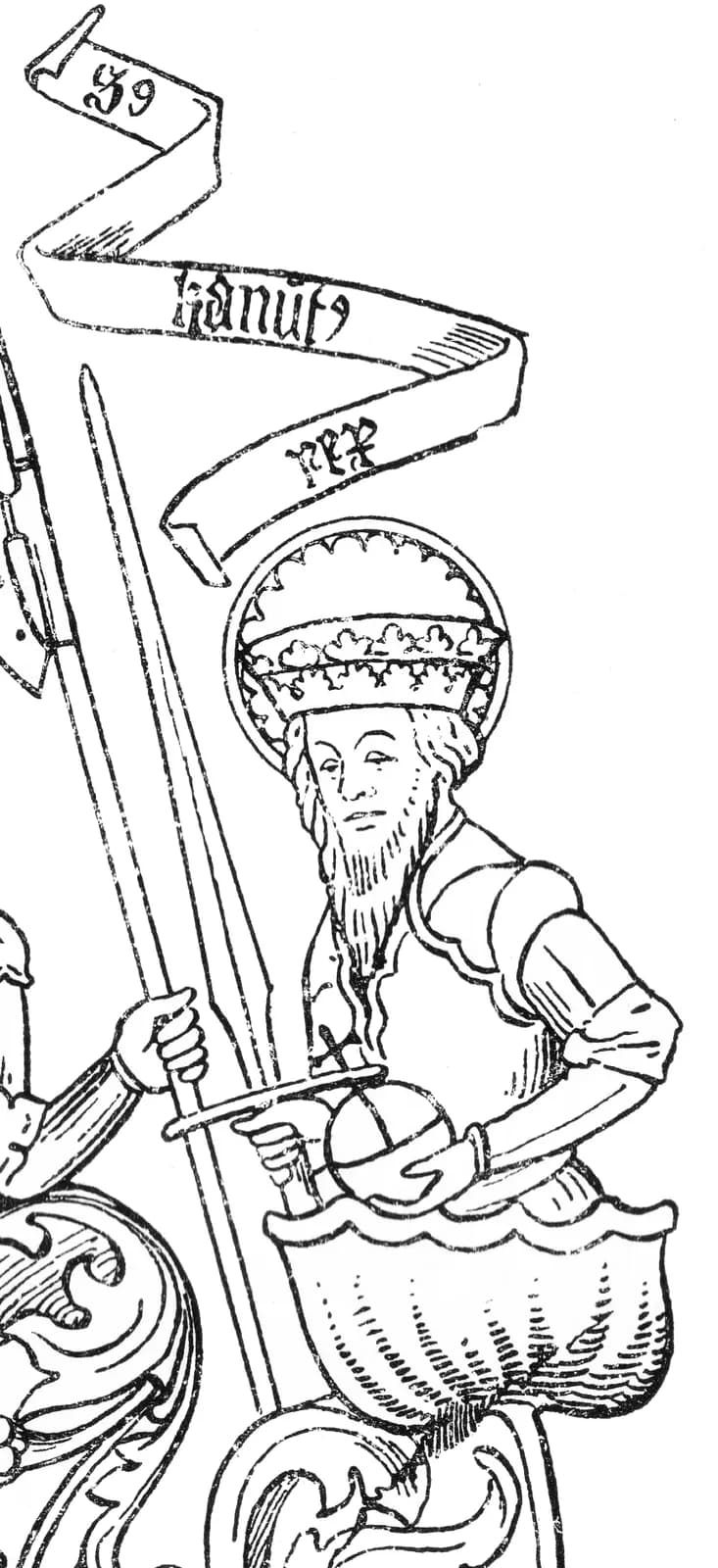
- Died
- July 10, 1086, killed with his brother Benedict and seventeen companions in St. Alban's Church, Odense 13
- Relics
- The crypt of St. Canute's Cathedral, Odense 1
- Patron saint of
- Denmark, as its national saint, and the Danish Canute guilds 1
Saint Canute IV was king of Denmark from 1080 until July 10, 1086, when a rebellion of his own subjects trapped him in a wooden church at Odense and killed him before the altar with his brother and seventeen of his men. 13 He was Denmark's first martyr, and his bones still lie in the cathedral built close to the spot. 1 The Roman Martyrology remembers him as a king burning with zeal who founded the Churches of Lund and Odense. 2 The Catholic Church in Norway, telling his life, is just as clear about why his people hated him. 1
A son of Sweyn Estridsen
Canute was born around 1043, though the date is not secure; the 1908 Catholic Encyclopedia says only that it is "uncertain." 13 His father was King Sweyn II Estridsen of Denmark. Sweyn had no son by either of his queens and some twenty children by other women, thirteen of them sons, and five of those sons became king in turn. 1 The encyclopedia makes Canute "the third of the thirteen natural sons"; the Norwegian biography makes him the second eldest. 13 He is not to be confused with his great-uncle Canute the Great, king of England and Denmark, or with his nephew, Saint Canute Lavard. 1
Sweyn had him well taught, in religion and in everything else. 1 As a prince he led campaigns against the pagan Wends and in the Baltic, and he sailed to England more than once to challenge William the Conqueror, whose rule there he regarded as a usurpation. 1 In 1075 he was one of the leaders of a Danish fleet of two hundred ships that reached York before the English rising it had come to support was crushed. 1
When his father died in 1076 the crown went to his brother Harald, and Canute withdrew to Norway. He came back on Harald's death in 1080 and was elected king. 13 He married Edel of Flanders, whom the encyclopedia calls Eltha, daughter of Count Robert; the Norwegian biography makes her the count's sister. 13 Their son was Charles the Good, later count of Flanders, who like his father would be murdered in a church by rebels. 1
King and Church
The encyclopedia calls him "a strong ruler" and says that "the happiness of his people and the interests of the Church were the objects he had most at heart." 3 It credits him with bringing Courland and Livonia, in what is now Latvia, to the faith. 3 The Norwegian biography says he brought them under his rule and introduced Christianity there. 1
He strengthened the Church in a country where paganism had been pushed back but Christianity had not yet taken hold. 1 He was the first Danish king to improve the legal standing of the Church and the economic independence of its clergy, with large grants of land to the cathedral at Lund and gifts to the churches of Roskilde and Odense. 1 To Roskilde he gave his own crown, and it became the burial church of the Danish kings. 13 To Odense he brought the relics of Saint Alban from England. 1 His laws protected women, freed slaves and foreigners, and his legend singles out two: that the Church should have its tithes, and that foreigners should count as fellow citizens. 1
He was by all accounts devout. The Norwegian biography reports that he fasted every Friday and scourged himself in his room, and the encyclopedia says that "his austerity was equalled by his assiduity in prayer." 13
Why the Danes rose against him
His piety did not make him popular. The Norwegian biography describes a king who meant to use the Church to build a royal power independent of the nobles and the farmers, and who in the process ignored old laws and customs. 1 He claimed common land, wreck goods and the property of foreigners who died without heirs. 1 He sent collectors to take tithes that the law did not provide for. 1 He hanged Egil, his own chosen governor of Bornholm, with most of his household for piracy, and the other great men took note. 13
Then came England. In 1085 he gathered a fleet of more than a thousand ships in the Limfjord to restore the empire of Canute the Great, and William the Conqueror took the threat seriously enough to hire mercenaries and strip the coastal towns of supplies. 1 The fleet never sailed. The encyclopedia blames "the treachery of his brother Olaf." 3 The Norwegian biography thinks Canute held back himself, because the investiture conflict between the emperor and the pope had reached Denmark's southern border. 1 His men waited unpaid through the summer, and many went home to their harvests. When he let the fleet go and then had his officers fine the men who had left without permission, the north of Jutland rose. 1
The encyclopedia gives the cause in one phrase: "the cruelties of certain tax-collectors." 3
St. Alban's Church, Odense
The rebels took Canute's brother Olaf as their leader, and the king was driven from place to place until he reached the royal estate at Odense on the island of Funen. 1 The encyclopedia says simply that he "retired to the island of Funen." 3 When even that was threatened he took refuge with his brother Benedict in the wooden church of St. Alban, the town's first parish church. 1 The right of sanctuary was not respected. 1
While loyal men held the door, the king confessed, received Communion, sat down before the altar and sang psalms. 1 The rebels smashed the windows and hacked holes in the walls. A stone struck him near the eye, and he went on singing with the blood running down his face. Finally a spear thrown through the choir window killed him on the altar step. 1 The encyclopedia says only that "after due preparation for death, the king, his brother Benedict, and seventeen others were surrounded and slain." 3 The Martyrology says he was killed by rebels. 2
Ælnoth, an English priest at St. Alban's who wrote his life about twenty years later, has him pierced in the side by a lance, like Christ. 1 When forensic scientists from the University of Southern Denmark examined the bones in 2008, they found no such wound. The injury they did find, a crack at the base of the spine, came from a heavy blow from the front, and there were no defensive marks on the forearms, which fits the tradition that he faced his killers without fighting. 1
Denmark's first martyr
His brother Olaf became king and was called Olaf Hunger, for a famine followed that lasted eight years, and people read it as God's judgment on the murder. 1 When another brother, Eric, became king in 1095, he brought Benedictine monks from Evesham in England to Odense, and the English monks promoted Canute as their own saint. 1 That year his relics were laid in the crypt of a new stone church. 1 In 1099 Eric obtained permission from Pope Paschal II for a public cult, and the solemn enshrinement followed on April 19, 1100; elsewhere the same biography dates it 1101. 1
The Norwegian biography is candid about what came next. Canute, it says, seems to have been so hated in Denmark that he was honored only later, as the result of a deliberate policy by King Eric and the Odense monks, and the evidence of his cult is official rather than popular. 1 Pilgrims nonetheless kept coming to Odense throughout the Middle Ages. 1 His shrine was walled up after the Reformation, rediscovered in 1582, and is still in the crypt of St. Canute's Cathedral, where the skeletons of Canute and Benedict can be seen in glass coffins. 1
What is Saint Canute the patron saint of?
Saint Canute's feast day
Saint Canute's feast day is July 10, the day he died. The Roman Martyrology enters him on that day, and the Norwegian biography gives it as his memorial. 12 In 1908 the Catholic Encyclopedia put it differently: "His feast is 19 January, translation, 10 July." 3 January 19, katolsk.no explains, was the day he was kept at Evesham, the mother house of the Odense monks, and it passed into English calendars. 1 The Norwegian calendar also marked January 13, and Odense keeps April 19, the day of his enshrinement. 1 Since the calendar reform of 1969, katolsk.no adds, he has been honored only in local calendars, such as those of the North and the German dioceses of Hamburg and Osnabrück. 1
Praying with Saint Canute
He is a hard saint to tidy up. The same king who scourged himself on Fridays and gave his crown to a cathedral also claimed the commons, taxed without law and kept an army waiting all summer for a war against England. 1 The rebels who killed him had grievances, and the source that tells his life most fully says so. 1 To pray with him honestly is to keep both halves in view.
What the last hour shows is narrower and plainer. He had run out of places to go. He had his confession heard, received Communion and sat down before the altar to sing while stones came through the windows. 1 Whatever he had been as a king, he did not die as a warrior. The bones, read by modern science, seem to agree with one of the old accounts on that point: no wounds on his arms, no sign that he fought. 1
And his memory was made, in part, by other people for their own ends. A brother who needed a royal saint and English monks who needed a patron built his cult. 1 That is true of other saints too, and it did not stop pilgrims from coming to Odense all through the Middle Ages. 1
Saint Canute IV of Denmark, pray for us.
Sources
- 1.Per Einar Odden, "Den hellige Knut av Danmark (~1043-1086)," Den katolske kirke (the Catholic Church in Norway), katolsk.no (in Norwegian).
- 2.Roman Martyrology, entry for July 10, "San Canuto, martire," as printed in "Santo del giorno," Conferenza Episcopale Italiana (in Italian).
- 3.Patrick W.F. Ryan, "St. Canute IV," The Catholic Encyclopedia, Vol. 3 (New York: Robert Appleton Company, 1908).
Saints to turn to next
Others in this collection who are turned to for some of the same things.