Saint Callistus I
Birth unknown - c. 222 or 223
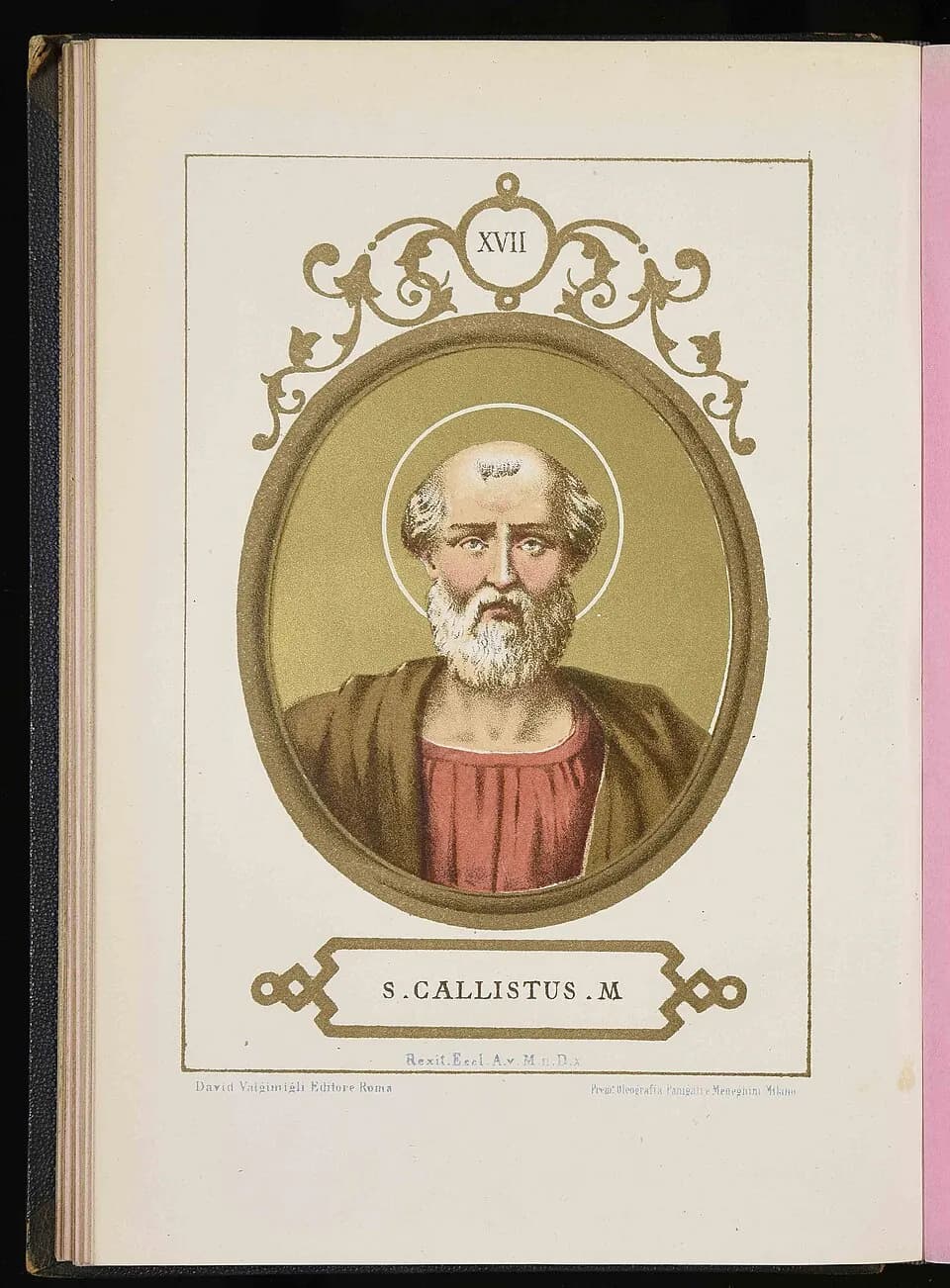
- Also written
- Callixtus or Calixtus, the spelling of most Latin writers 1
- Born
- Unknown
- Early life
- A slave in the household of Carpophorus, a Christian in the emperor's service, according to Hippolytus 12
- Before he was pope
- Deacon under Pope Zephyrinus, who put him in charge of the Church's cemetery on the Appian Way 35
- Bishop of Rome
- 218 to 222 in the Holy See's list of popes 4; 217 to 222 according to the Pontifical Commission for Sacred Archaeology 3; acceded 218 or 219 and served five years according to the sources Chapman weighs 1
- Buried
- In the cemetery of Calepodius on the Via Aurelia, not in the catacomb named for him; relics moved to Santa Maria in Trastevere in the ninth century 1
Saint Callistus I was bishop of Rome for about five years in the early third century, and before that he had been a slave, a failed banker and a convict in the mines of Sardinia. 12 As a deacon he ran the Church's cemetery on the Appian Way, which has carried his name ever since and became the burial place of the third-century popes. 13 Nearly all of this is known from Hippolytus, a learned Roman rival who wrote it down to destroy his reputation. 12 As pope he readmitted repentant adulterers to Communion and was denounced for it by Hippolytus and Tertullian, and the 1908 Catholic Encyclopedia concludes that the Church "sides with Callistus." 1 His feast is October 14. 178
A life told by an enemy
The account comes from the ninth book of the Refutation of All Heresies, also called the Philosophumena, which John Chapman, writing in the Catholic Encyclopedia, attributes to Hippolytus, "no doubt." 1 Hippolytus says he explains the life of Callistus so that "the heresy attempted to be established by him may be easily known, and may perchance be regarded as silly." 2 He calls him "a man cunning in wickedness, and subtle where deceit was concerned," driven by "restless ambition to mount the episcopal throne." 2
Chapman calls Hippolytus and Tertullian the pope's "bitter enemies" and says their calumnies "are probably based on facts." 1 Following the nineteenth-century scholars Döllinger and De Rossi, he accepts much of the story and rejects the reading. 1 The story below is Hippolytus's, with Chapman's answer alongside.
The slave, the bank and the harbor
Callistus was a household servant of Carpophorus, "a man of the faith belonging to the household of Caesar." 2 Entrusted with his master's money, Callistus opened a bank in the Piscina Publica, where widows and other Christians deposited savings in Carpophorus's name. 2 Hippolytus says Callistus "made away with all" of it. 2 Chapman answers that Hippolytus "does not say that Callistus by his own fault lost the money." 1
When Carpophorus asked for an account, Callistus fled to a ship at Portus. 2 Seeing his master approach in a boat, Callistus threw himself into the sea, and sailors pulled him out "unwilling to come." 2 Hippolytus treats this as an attempt at suicide; Chapman thinks he "evidently jumped from the vessel rather to escape." 12 Carpophorus put him in the pistrinum, the hand mill used to punish slaves, which, Chapman remarks, "does not speak well for the master's character." 12
Other Christians asked for his release, saying Callistus claimed money was owed to him. 2 Freed and unable to repay, he went on a Sabbath to a synagogue and caused a disturbance, and was beaten and dragged before Fuscianus, the prefect of the city. 2 Hippolytus says he was looking for a way to die. 2 Chapman calls that "absurd" and reads it as an attempt to collect from Jewish debtors "at some risk to himself." 1
Sardinia and the cemetery
Carpophorus told the prefect that Callistus "is not a Christian, but seeks occasion of death." 2 Fuscianus did not believe him, had Callistus scourged and sent him to the mines of Sardinia. 2 Chapman calls the master's statement "scandalous and untrue," and points out that by Hippolytus's own telling Callistus was condemned as a Christian and so suffered as a confessor. 1
Some time later Marcia, the mistress of the emperor Commodus, asked Pope Victor for the names of the Christians in Sardinia so she could have them freed. 12 Victor left Callistus off the list. 2 When the release came, Callistus "dropping on his knees, and weeping," begged the elderly eunuch carrying the order to include him, and the governor let him go. 2 Victor, Hippolytus says, was "very much grieved" but "a compassionate man," and sent him to live at Antium on a monthly allowance. 2 Chapman notes that the pension hardly suggests Victor regretted the release. 1
Victor's successor, Zephyrinus, brought him back and, in Hippolytus's words, "appointed him over the cemetery." 2 The Holy See's Pontifical Commission for Sacred Archaeology dates the origin of the Roman catacombs to that decision: Zephyrinus "entrusted to the deacon Callixtus" the cemetery on the Appian Way, "where the most important pontiffs of the third century would be buried." 3 The Salesians who now receive its pilgrims call it the official cemetery of the third-century Roman church, where some half a million Christians were buried, sixteen popes among them. 5 Chapman stresses that it belonged to the Church and was not a private catacomb, and "it has ever since borne Callistus's name." 1 Benedict XVI, speaking in 2010 of the young martyr Tarcisius, recalled that he was buried in the Catacombs of St Calixtus. 6
The edict on penance
Hippolytus says Callistus won Zephyrinus over with presents; Chapman answers that he "could hardly have raised himself so high without considerable talents." 12 Julius Africanus, as Chapman reports, dates his election to 218 or 219. 1 The Holy See's list gives his pontificate as 218 to 222, and the Pontifical Commission for Sacred Archaeology as 217 to 222. 34
His best-known act was a decree allowing those who had committed adultery and fornication to be given Communion after penance. 1 Tertullian, by then a Montanist, mocked it: "the bishop of bishops, which means the Pontifex Maximus, proclaims: I remit the crimes of adultery and fornication to those who have done penance." 1 Tertullian's own protest, that the pope was claiming the power of binding and loosing given to Peter, shows Chapman what the decree rested on. 1
Hippolytus had a longer list. Callistus, he wrote, "first invented the device of conniving with men in regard of their indulgence in sensual pleasures"; held that a bishop should not be deposed even for a mortal sin; let men who had married more than once remain clergy; and allowed women of rank to take slaves as husbands. 12 To defend himself Callistus cited the parable of the wheat and the tares and compared the Church to Noah's ark, which held "dogs, and wolves, and ravens, and all things clean and unclean." 2 Chapman answers them one by one, arguing on the last that Callistus was rightly distinguishing the Church's law of marriage from Roman civil law. 1 He concludes that "the Catholic church sides with Callistus against the schismatic Hippolytus and the heretic Tertullian." 1
Hippolytus also accused Callistus of a modified Sabellianism, and admits that Callistus called him and his followers "Ditheists." 12 Hippolytus records that Callistus excommunicated Sabellius, and Chapman, noting that Zephyrinus and Callistus condemned both Sabellius and the opposite error of Hippolytus, finds this "enough to suggest that Callistus held the Catholic Faith." 12 He adds that nothing is said against his character after his election, nor against its validity. 1
Death and burial
Callistus died about 223. 1 His Acts are spurious, Chapman says, but he is the earliest pope listed in the fourth-century Depositio Martyrum, "good evidence that he was really a martyr, although he lived in a time of peace" under the emperor Alexander Severus. 1 How he died is not recorded in any reliable source. A well in the church of St. Callistus in Trastevere is the one "into which legend says his body was thrown." 1
The Historia Augusta, as Chapman reports it, records that tavern keepers claimed a plot where he had built an oratory, and the emperor ruled that the worship of any god was better than a tavern. 1 He was not buried in his own catacomb but in the cemetery of Calepodius on the Via Aurelia, and in the ninth century his relics were moved to Santa Maria in Trastevere. 1
What is Saint Callistus I the patron saint of?
Saint Callistus I's feast day
His feast is October 14. 178 Chapman traces the date to the fourth-century Depositio Martyrum, which records his anniversary at the third milestone of the Via Aurelia, and to the martyrologies after it, "on which day his feast is still kept." 1 The Vatican News calendar for October 14 lists "St. Callistus I, Pope and Martyr," and the United States Conference of Catholic Bishops gives the day's readings for the optional memorial of Saint Callistus I, Pope and Martyr. 78
Praying with Saint Callistus I
The story of Callistus reaches us through someone determined to make it look as bad as possible, and the facts Hippolytus chose still include a man who was a slave, lost other people's money, was beaten, and was sent to the mines. 12 Chapman thinks the worst readings are wrong. 1 He does not claim the money was never lost or the treadmill never happened.
He came back from Sardinia without being on the list of the ones meant to come back, because he knelt and begged. 2 The pope who had left him off then gave him an allowance and somewhere to live, and the next pope gave him the Church's dead to care for. 12 The cemetery he kept became the resting place of some half a million Christians. 5
As bishop he decided that people who had committed grave sins could be brought back to Communion through penance, and Hippolytus and Tertullian both attacked him for it, Hippolytus accusing him of conniving at sin. 12 His own reported answer was the parable of the wheat and the tares, and an ark with clean and unclean animals in it. 2 Chapman judges that the Church sided with him, while noting that Hippolytus and Tertullian thought they were defending older practice. 1
Little of his own voice survives: the edict is known from the man who mocked it, and the life from the man who hated him. 12 What is left is his anniversary, entered under October 14 in a fourth-century Roman list of martyrs, which is the evidence Chapman relies on that Rome remembered him as one. 1
Saint Callistus I, pray for us.
Sources
- 1.John Chapman, "Pope Callistus I," The Catholic Encyclopedia, Vol. 3 (New York: Robert Appleton Company, 1908).
- 2.Hippolytus, Refutation of All Heresies, Book IX, chapters 2-7, trans. J. H. MacMahon, Ante-Nicene Fathers, Vol. 5 (Buffalo, NY: Christian Literature Publishing Co., 1886), via New Advent.
- 3.Pontifical Commission for Sacred Archaeology, "The Christian Catacombs," The Holy See.
- 4."Callistus I," Supreme Pontiffs, The Holy See.
- 5."The Catacombs of St. Callixtus in Rome," Catacombe di San Callisto, Salesians of Don Bosco.
- 6.Benedict XVI, General Audience on Saint Tarcisius, August 4, 2010.
- 7."14 October," Saint of the Day, Vatican News.
- 8."Optional Memorial of Saint Callistus I, Pope and Martyr," Daily Readings, United States Conference of Catholic Bishops.
Saints to turn to next
Others in this collection who are turned to for some of the same things.