Saint Caius
Died 296
- Born
- A Dalmatian, son of Gaius and a relative of the emperor Diocletian, says the Liber Pontificalis; katolsk.no doubts both; date unknown 34
- Pope
- December 17, 283, to April 22, 296, by the Liberian catalog; Eusebius gives about fifteen years 12
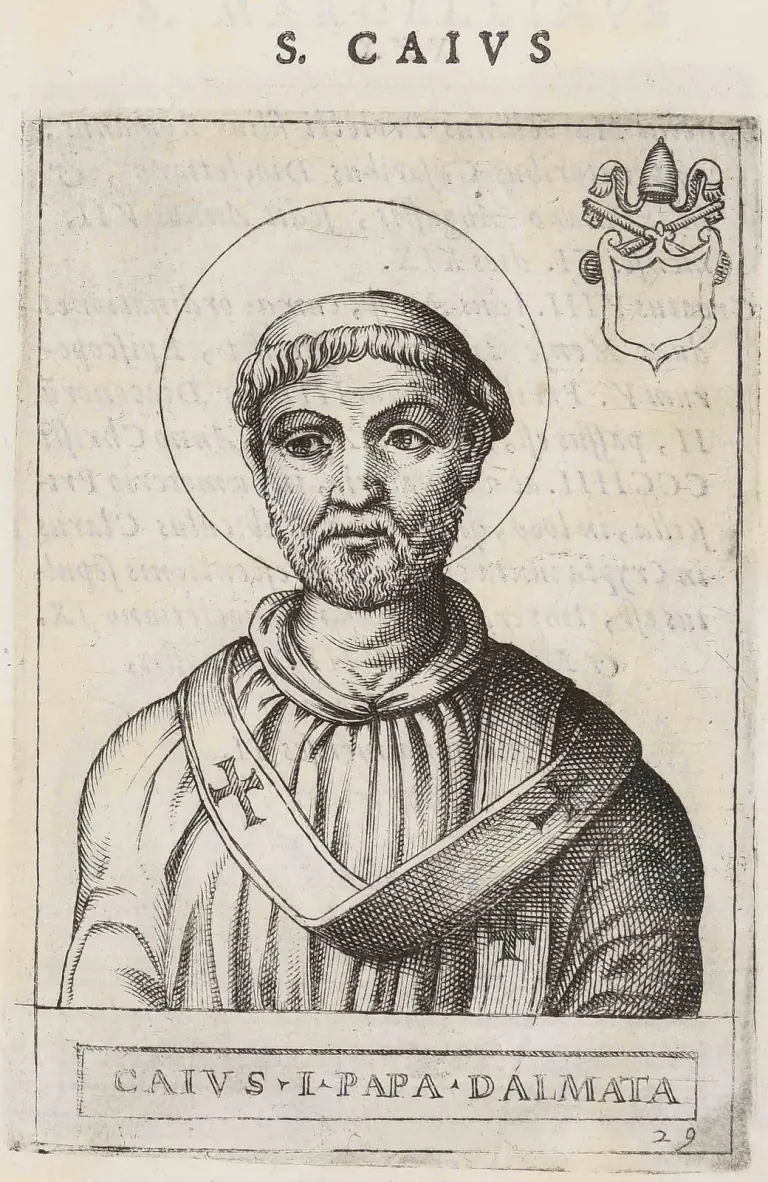
Saint Caius, also called Gaius, was bishop of Rome for about twelve years, from December 283 to April 296, in the last long peace the Church knew before Diocletian's persecution. 14 The Catholic Encyclopedia says flatly that "nothing whatever is known of his life," and that he lies in the catacomb of Callistus on the Appian Way, where the broken stone of his epitaph was found in the nineteenth century. 134 Later legend made him the uncle of the martyr Susanna and a martyr himself. 347 His feast is April 22. 6
A pope in the years of peace
Eusebius of Caesarea, his contemporary, gives Caius a single sentence. Eutychian, he says, held the see of Rome less than ten months and "left the position to Caius, who lived in our day. He held it about fifteen years, and was in turn succeeded by Marcellinus, who was overtaken by the persecution." 2
John Chapman, in the Catholic Encyclopedia, takes the dates from the Liberian catalog, a list of popes compiled in Rome in the fourth century: twelve years, four months and seven days, from December 17, 283, to April 22, 296. 1 Eusebius is wrong to give him fifteen, Chapman says. 1 The Liber Pontificalis, the early book of papal lives, has the same two dates but counts eleven years, four months and nine days; another version of the text says twelve days. 3
Chapman adds that Caius "lived in the time of peace before the last great persecution." 1 The Norwegian bishops' saints database (katolsk.no) agrees that his pontificate fell in a time of peace and consolidation for the Roman Church, and observes that Diocletian, at the start of his reign, was far from hostile to Christians. 4 It suggests why so little survives: the Church's archives were probably destroyed when Diocletian later set out to destroy every Christian writing. 4
What the Liber Pontificalis says
The Liber Pontificalis begins its entry: "Gaius, by nationality a Dalmatian, of the family of Dioclitian, the emperor, son of Gaius." 3 Butler repeats the claim, attributing it to "the ancient pontificals." 5 katolsk.no calls it rather doubtful and traces it to the sixth-century legend of Saint Susanna, which made Caius her uncle. 4
The book credits him with a rule that anyone worthy to be bishop must rise through every rank in turn: doorkeeper, reader, exorcist, acolyte, subdeacon, deacon, priest, and only then bishop. 3 It says that he divided the districts of Rome among the deacons, and that he held four ordinations in December, making twenty-five priests, eight deacons and five bishops for various places. 3 katolsk.no adds that the Liber Pontificalis dates to his time the Roman practice of keeping a record of the days on which clergy were ordained. 4
The ranks themselves are older than Caius. Loomis, in a note to her translation, points out that Pope Cornelius had listed them some thirty years earlier, when he counted in the Roman Church "forty-six priests, seven deacons, seven subdeacons, forty-two acolytes, fifty-two exorcists, readers and doorkeepers." 3 katolsk.no also records that the catacombs were greatly extended in these years. 4
The crypts and the martyrdom
The rest of the Liber Pontificalis entry tells three stories at once. It says that Caius "fled from the persecution of Diocletian into the crypts," and then, in different manuscripts, that he died there a confessor, or that he was crowned with martyrdom there after eight years. 3 A third sentence has him martyred after eleven years "in company with Gavinius, his brother, on account of the daughter of Gavinius, the priest, whose name was Susanna." 3
None of it fits the dates. Loomis notes that his name is not in the early martyrologies and that the persecution of Diocletian "did not begin until seven years after his death." 3 katolsk.no rejects the flight into the catacombs and the martyrdom as anachronisms, and points out that the Liberian list of martyrs of 354 does not include him. 4 Chapman reads the oldest evidence the same way: the fourth-century Depositio Episcoporum, a calendar of the burials of Roman bishops, enters him as "X kl maii Caii in Callisti," on April 22 in the cemetery of Callistus, among the bishops and "therefore not as a martyr." 1
The later tradition kept the martyrdom. The 1897 English edition of the Roman Martyrology entered "St. Caius, pope, who was crowned with martyrdom, under the emperor Diocletian." 7 Butler has a gentler version: the Church enjoyed a calm when Caius was elected, then a two-year outbreak of persecution after the death of the emperor Carinus, during which Caius encouraged the martyrs and withdrew for a time "to preserve himself for his flock." 5 "His sufferings obtained him the title of martyr," Butler concludes, citing the historian Orsi. 5 The current Martyrology, in the Italian bishops' text, says that he fled the persecution of Diocletian and died a confessor of the faith. 6
In the legends of Sebastian and Susanna
Caius also appears in two of the long Roman martyr legends. In the story of Saint Sebastian he encourages the soldier and his companions before their deaths, as both katolsk.no and Butler relate. 45 The 1897 Martyrology draws on the same cycle: under July 6 it says that Saint Tranquillinus, converted by Sebastian's preaching, was ordained priest "by pope St. Caius," and under October 25 that the priest Protus and the deacon Januarius were sent to Sardinia "by pope St. Caius" and martyred there. 7
The Susanna legend gives him a family. The 1897 Martyrology calls Saint Gabinus, on February 19, "brother of the blessed pope Caius," and Saint Susanna, on August 11, "niece of the blessed Pontiff Caius." 7 Gabriel Meier, retelling the legend in the Catholic Encyclopedia, says that Susanna's house and the house next to it, which belonged to "her uncle, the prefect Caius," became the titular church of Saint Susanna "ad duas domos," at the two houses. 8 katolsk.no explains the connection the other way around: Susanna's cult was attached to an old Roman church called the titulus of Caius, and the legend made the two of them relatives. 4
His tomb in the catacomb of Callistus
The one thing about Caius that can still be touched is his grave. The Liber Pontificalis says he was buried in the cemetery of Callistus on the Via Appia on April 22. 3 Chapman places him "in the chapel of the popes in that cemetery." 1 katolsk.no is more precise: in a chamber outside the old papal crypt, which was probably already full. 4
His epitaph was found there in the nineteenth century. Loomis notes that the tablet "was discovered in fragments and put together by De Rossi," the archaeologist of the catacombs. 3 katolsk.no adds that it is written in Greek letters, and that the first letter of the name is clearly a gamma: Gaius, not Caius. 4
What is Saint Caius the patron saint of?
Saint Caius's feast day
Saint Caius's feast day is April 22. 6 The Roman Martyrology, in the text published by the Italian bishops, enters on that day at Rome, in the cemetery of Callistus on the Appian Way, the burial of Saint Gaius, pope. 6 It is the day the Depositio Episcoporum gives for his burial, and the day the 1897 Martyrology and Butler keep him. 157
Chapman notes that he shares the day with Pope Soter in most martyrologies, though Notker and a few others put Caius on April 19 or 21. 1 katolsk.no says the joint feast of the two popes stood in the Roman calendar until 1969. 4
Praying with Saint Caius
Caius governed the Church of Rome for twelve years and left almost no trace. 1 Eusebius, who was alive while he was pope, could say only that he "lived in our day." 2 What the Liber Pontificalis remembers of him is ordinary work: ordinations in December, deacons given their districts, clergy who were to learn each office before taking the next. 3
The Church that came after him could not leave it at that. Later writers gave him a hiding place in the catacombs, a brother and a niece among the martyrs, and a martyr's death. 347 The current Martyrology keeps the plainest of the Liber Pontificalis's versions: a pope who fled the persecution and died a confessor of the faith. 36
The stone from his grave was found in pieces and fitted together again, and it spells his name with a Greek gamma. 34 The calendar has kept his day since the fourth century. 16
Saint Caius, pray for us.
Sources
- 1.John Chapman, "Caius and Soter, Saints and Popes," The Catholic Encyclopedia, Vol. 3 (New York: Robert Appleton Company, 1908).
- 2.Eusebius, Church History, Book VII, chapter 32, translated by Arthur Cushman McGiffert, Nicene and Post-Nicene Fathers, Second Series, Vol. 1 (Buffalo: Christian Literature Publishing Co., 1890), as hosted by New Advent.
- 3.The Book of the Popes (Liber Pontificalis), Vol. 1, "XXIX. Gaius (283-296)," translated by Louise Ropes Loomis (New York: Columbia University Press, 1916).
- 4."Den hellige pave Caius ( -~296)," compiled and translated by Per Einar Odden, Den katolske kirke (katolsk.no), the Catholic Church in Norway (in Norwegian).
- 5.Alban Butler, "St. Caius, Pope," April 22, in The Lives of the Fathers, Martyrs, and Other Principal Saints, Vol. 4 (Derby: Richardson and Son, 1842), via the Internet Archive.
- 6.Roman Martyrology, entry for April 22, "San Gaio, papa," Santo del giorno, Conferenza Episcopale Italiana (in Italian).
- 7.The Roman Martyrology, April 22, February 19, July 6, August 11 and October 25 (Baltimore: John Murphy Company, 1897), Internet Archive.
- 8.Gabriel Meier, "Sts. Tiburtius and Susanna," The Catholic Encyclopedia, Vol. 14 (New York: Robert Appleton Company, 1912).
Saints to turn to next
Others in this collection who are turned to for some of the same things.