Saint Burchard of Würzburg
Born between 683 and 700; died 754 or 755
- Also called
- Burkard, Burkhard 2
- Relics
- In the church of St. Burkard, Würzburg 2
- Patron saint of
- The city of Würzburg; invoked for joint pain, rheumatism, back pain and kidney stones 2
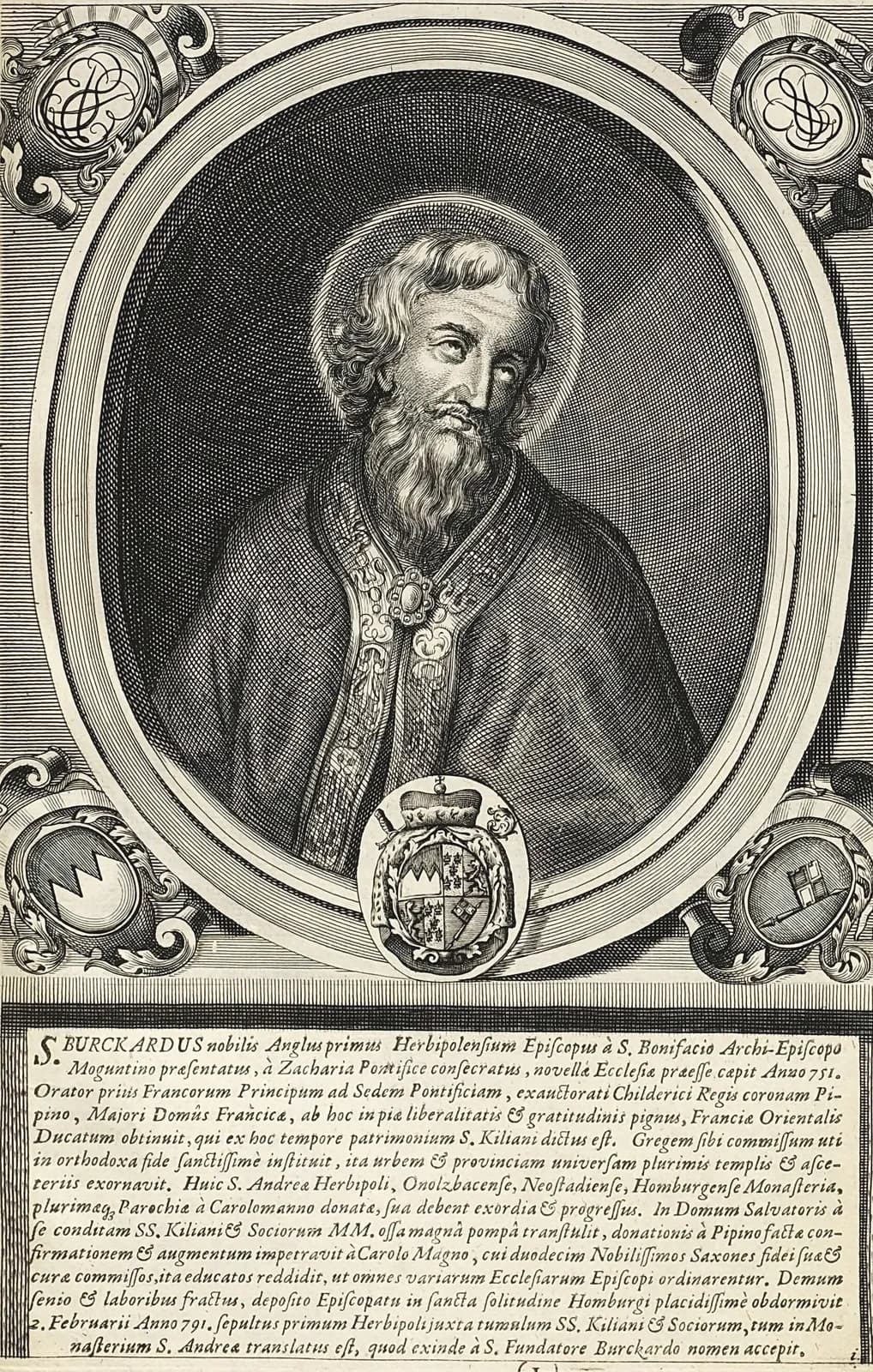
Saint Burchard was an Anglo-Saxon monk who followed Saint Boniface to Germany and became the first bishop of Würzburg. 12 He organized a new diocese in Franconia, raised the Irish martyr Kilian to the altars as its patron, and went to Rome for Pepin the Short on the question of who should be king of the Franks. 12 His feast is kept on October 14, the day his bones were moved into the monastery that still carries his name. 12
An Anglo-Saxon follower of Boniface
Very little about his early life is certain. The Diocese of Würzburg, on its saints portal, says two medieval Lives tell his story, one from about 855 and one from about 1140, and that both are so full of legend that few dates and facts can be relied on. 2 Johann Peter Kirsch, writing in the 1908 Catholic Encyclopedia, calls the earlier one an "unreliable account of ninth and tenth centuries." 1
All accounts agree that he was English. 123 Kirsch says he was born of Anglo-Saxon parents, and that after their deaths he left home for Germany, "being drawn to this life by the great reputation of his countryman, St. Boniface, to whom he offered himself as an assistant." 1 Since Boniface was already an archbishop, Kirsch reasons, Burchard's mission work in Germany must have begun after 732. 1
The diocese gives a fuller and partly different picture. It calls him a Benedictine monk from southwestern England, probably of good family, born between 683 and 700, and says he was ordained priest at thirty, probably by Boniface, and probably crossed to the continent with him in 718. 2 It adds that recent research places him between 720 and 740 near another countryman, Willibrord, in Frisia, and that he may have worked before 737 at Berceto in Lombardy, where he is still venerated. 2 After Willibrord's death in 739 he appears in Boniface's inner circle in Thuringia and Franconia, and around 740 or 741 he founded the monastery of Neustadt am Main on a former Carolingian hunting estate and became its first abbot. 2
First bishop of Würzburg
When Boniface organized the Church in the old Thuringian territories, he set up three sees: Würzburg for Franconia, Büraburg for Hesse and Erfurt for Thuringia. 2 Only Würzburg lasted. 2 The sources differ on the year Burchard was consecrated its bishop. Kirsch says probably 741, because on October 22, 741, Burchard and Witta of Buraburg took part as bishops in the consecration of Saint Willibald as bishop of Eichstätt. 1 The Catholic Encyclopedia's article on the diocese also gives 741. 4 The diocese itself says 742. 2 In a letter to Boniface of April 1, 743, Pope Zachary confirmed the new diocese. 12
The diocese describes a bishop building from very little. The Franks, it says, had been drifting back toward paganism despite Kilian's mission a half century before, and the minimum asked of every Catholic was baptism, knowledge of the Our Father and the Creed, and rest on Sunday. 2 Burchard first lived at Neustadt, then made the church of Our Lady on the Marienberg his cathedral. 2 The encyclopedia says he lived at the fortress there, which he had received from the last duke in exchange for another castle, and that he built the first cathedral church. 4
Around 750 he founded the monastery of St. Andrew at the foot of the Marienberg, peopled it with Benedictine monks and made it the seat of the cathedral clergy. 24 The diocese also names the women's communities of his time: Kitzingen and Kleinochsenfurt under Saint Thecla, Tauberbischofsheim under Saint Lioba, and Karlburg, where Burchard installed Blessed Immina as abbess. 2
Kilian, Colman and Totnan
The act with the longest reach was his care for the martyrs of Würzburg. The diocese says the bones of the Irish missionaries Kilian, Colman and Totnan had been hidden beneath a horse stable. 2 Burchard raised them in 743 and moved them to the Marienberg church; after mysterious lights appeared, he returned them three years later to the place of their martyrdom, and on July 8, 752, he raised the three to the honors of patrons of the diocese. 2 The diocese notes that some sources give 752 as the date of the first raising. 2 The encyclopedia says simply that he buried the bodies of Kilian and his companions in the cathedral he built. 4 In the diocese's words, this made the grave of the apostles of Franconia the center and source of life of the diocese. 2
Synods and a mission for Pepin
Burchard was also a bishop of the Frankish realm. Kirsch places him at the first German synod in April 742; the diocese dates that council, the Concilium Germanicum, to 743, and says it was called to restore the law of God and the order of the Church after years of decay. 12 In 747 he signed, with Boniface and other bishops, a declaration of obedience to the pope, and in 748 he carried it to Rome. 2 Kirsch says he went to Rome in the spring of 748 to report on the Church in Franconia and to put several questions for decision. 1
His best-known mission came next. Kirsch writes that Burchard "was held in high esteem by Pepin the Short," and that in 749, when Pepin sent an embassy to ask Pope Zachary "who should be King of the Franks," he put Burchard and Abbot Fulrad of St. Denis at its head. 1 The diocese dates the journey to 750 or 751, and explains what was at stake: the last Merovingian kings had become shadow kings, and the embassy cleared the way for Pepin to take the crown. 2 Pepin in turn endowed the diocese with the tithe and granted it immunity. 2 The encyclopedia dates the immunity to 752 or 753. 4
Two deaths
There are two traditions about his death. 2 The older Life says he died in Würzburg on February 2, 755. 2 The younger Life, by Abbot Ekkehard of Aura, says he resigned his offices, walked down the Main with six monks, and died in a cave in the castle hill of Homburg am Main. 2 The diocese says this version was taken up by many later writers but almost certainly belongs to legend. 2 Kirsch says he died "most probably in 754," and that he died before Boniface. 1
His successor, Megingaud, brought the body to Würzburg and buried it beside the Franconian apostles. 2 In 788 the bones were moved into the new cathedral of the Savior that Burchard had begun. 2 On October 14, 986, says the diocese, Bishop Hugo translated them into the monastery of St. Andrew, and Burchard was declared a saint; church and monastery have carried his name ever since. 2 Kirsch places the translation in Hugo's reign, 984 to 990, on October 14. 1 The grave was rediscovered in 1955, and the relics now rest in a shrine by the Würzburg goldsmith Theo Sebald on a side altar of St. Burkard. 2
What is Saint Burchard the patron saint of?
The Diocese of Würzburg calls Saint Burchard the patron of the city of Würzburg, and a helper against joint pain, rheumatism, back pain, and kidney stones and gravel. 2 He is usually shown as a bishop with miter, staff, book and coat of arms, and sometimes with a host, a model of a church, or a sword, as on the Old Main Bridge in Würzburg. 2 Homburg, where legend places his death, still honors him with a grotto chapel and an annual October procession to it. 2
Saint Burchard's feast day
Saint Burchard's feast day is October 14. 12 Kirsch explains that the date is the day Bishop Hugo had his remains dug up and solemnly reburied, and that "this day has remained the feast-day of the saint." 1 In medieval Würzburg it was kept as a solemnity, and people baked a ring-shaped bread for it, the Burkardusweck. 2 The Roman Martyrology enters him instead on February 2, at Würzburg, as the bishop from England whom Saint Boniface ordained first bishop of the city. 3
Praying with Saint Burchard
Burchard's work was the unglamorous kind. He did not convert a people; the Franks had heard the Gospel half a century before him, and were slipping away from it. 2 He gave them churches, monasteries, a cathedral clergy and a short list of what a Christian needed to know, and he left a diocese that outlasted the two founded beside it. 2
He also gave a local Church its memory. The martyrs of Würzburg had been buried in disgrace, and he brought them out and made their grave the center of the diocese. 24
His own end is uncertain. One Life has him die at his post, another has him lay down his office and walk away to die in a cave with six companions. 2 The sources cannot settle which is true, and the diocese thinks the cave is legend. 2 Either way, the people of Homburg still walk to the grotto every October. 2
Saint Burchard of Würzburg, pray for us.
Sources
- 1.Johann Peter Kirsch, "St. Burchard of Würzburg," The Catholic Encyclopedia, Vol. 3 (New York: Robert Appleton Company, 1908).
- 2.Anja Legge and Jerzy Staus, "Hl. Burkard," Heilige und Selige im Bistum Würzburg, Diocese of Würzburg (in German).
- 3.Roman Martyrology, entry for February 2, "San Burcardo, vescovo," as printed in "Santo del giorno," Conferenza Episcopale Italiana (in Italian).
- 4.Joseph Lins, "Diocese of Würzburg," The Catholic Encyclopedia, Vol. 15 (New York: Robert Appleton Company, 1912).
Saints to turn to next
Others in this collection who are turned to for some of the same things.