Saint Braulio of Zaragoza
c. 590 - c. 651
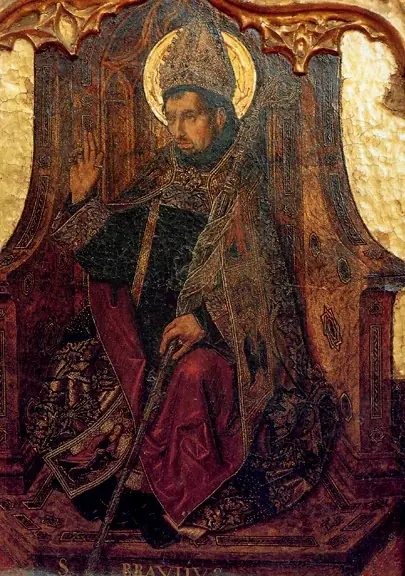
- Died
- At Zaragoza about 651, say the Catholic Encyclopedia, katolsk.no and Santi e Beati 123; in 646, says Butler 4
- Patron of
- Aragon, says katolsk.no 2
Saint Braulio was bishop of Zaragoza in Visigothic Spain from 631 until his death about 651, and the closest friend and disciple of Saint Isidore of Seville. 123 It was Braulio who pressed Isidore to write his great encyclopedia, the Etymologies, and Braulio who divided it into the twenty books we know. 1 His feast is March 18. 6
A family of the Church
Braulio came from a rich and noble Hispano-Roman family; Santi e Beati adds that it had Germanic blood as well. 23 He was born about 590, according to katolsk.no and Santi e Beati, at Gerona or at Zaragoza, katolsk.no says, since the sources differ; the Catholic Encyclopedia says only that his date of birth is unknown. 123
It was a family that filled the Church. His father, Gregory, became a bishop, almost certainly of Osma, after his children were grown. His elder brother John was abbot of the monastery of Saint Engratia at Zaragoza and became bishop of the city in 619. Another brother, Frunimian, was abbot of the monastery founded by Saint Emilian, and one sister, Pomponia, was an abbess. 23
Braulio grew up in John's care and entered his brother's monastery about 610, at around twenty. 23
Isidore's pupil and friend
About 620 he went to Seville to study in the school of Isidore, the most important in Spain, where young clerics, monks and nobles came from every part of the country. 23 He was soon more friend than pupil. 23 katolsk.no says Isidore used to send him his own writings to correct and revise, and that in 624 Isidore made him a deacon. 2
Their friendship produced the Etymologies. The Catholic Encyclopedia says that the beginning and the completion of Isidore's "Libri Etymologiarum" were due to Braulio's insistence, and that the division and titles of its twenty books are Braulio's work. 1 Santi e Beati, drawing on their surviving letters, says the tired master sent Braulio the draft and charged him with finishing, ordering and publishing it, apparently in 637; katolsk.no says Braulio gave the book its final form after Isidore's death. 23
After Isidore died, Braulio wrote a short notice of his life with a list of his writings, added to Isidore's own book on famous men. 124 Butler calls Braulio "the great assistant of St. Isidore of Seville in settling the discipline of the church of Spain." 4
Bishop of Zaragoza
He came home about 625 and served as archdeacon to his brother John, who ordained him priest and gave him charge of the business of the diocese. 123 When John died in 631, Braulio succeeded him as bishop. 123 Santi e Beati says the times were hard, marked by wars, plague and famine, and that more and more priests, abbots, bishops and princes turned to him for advice. 3
He sat at the councils of Toledo in 633, 636 and 638; katolsk.no notes that for unknown reasons he was not at the council of 646. 123 The council of 638 gave him a delicate task. Pope Honorius I had written reproaching the Spanish bishops. The Catholic Encyclopedia says the charge was negligence in their pastoral duties; Santi e Beati and katolsk.no say it was leniency toward converted Jews who had gone back to Judaism. 123 The council chose Braulio to reply, and the encyclopedia says that in his letter he "cleverly and fearlessly defended the conduct of the Spanish episcopate." Santi e Beati says he managed at once to justify his brother bishops and to honor the successor of Peter. 13
He wrote to kings as well. In one letter he urged King Chindaswinth to make his son Recceswinth co-regent, which katolsk.no says was meant to spare the kingdom the usual turmoil over a succession. 12 After Isidore's death, Santi e Beati says, he was the man to whom the Spanish Church looked. 3
katolsk.no describes a bishop who kept the habits of a monk: coarse clothes, plain food, long hours of prayer by day and night in his cathedral and in the church of Our Lady of the Pillar, and no limit to his generosity to the poor. 2 He disliked flattery, it says, and told those who praised him that public opinion often mistakes a bad man for a good one and a good man for a bad one, and that he knew he was not what they made him out to be. 2 He was remembered as an eloquent preacher; katolsk.no records that people said they saw the Holy Spirit as a dove on his shoulder as he preached. 2
His writings
Santi e Beati calls him the best Spanish writer of his time after Isidore. 3 He wrote a Life of Saint Emilian, the hermit and priest known in Spain as San Millán de la Cogolla, and a hymn in his honor. 1234 The Catholic Encyclopedia says his authorship of the Acts of the martyrs of Zaragoza is usually admitted, though Santi e Beati calls them of doubtful authenticity, and that he may also have written the Passion of Saint Leocadia. 13
His letters were found in the eighteenth century in a manuscript at León and first published in 1775. 123 The Catholic Encyclopedia and katolsk.no count forty-four of them; Santi e Beati says twenty-four, and notes that a modern scholar has doubted some. 123 The encyclopedia calls them a valuable addition to the history of Visigothic Spain. 1 katolsk.no singles out his letters of condolence, which sympathize fully with the grief of the bereaved and then point past it to the joy of heaven, and his letters on monastic life, which oppose forcing a superior on a community and are severe with an abbot who takes his charge too lightly. 2
Blindness and death
Toward the end of his life his sight failed, and, the Catholic Encyclopedia says, he "complained bitterly" of it. 12 Santi e Beati says that by about 650 he was almost blind and worn out by work and penance. 3 katolsk.no says that when he knew he was dying he spent his last day reciting the psalms. 2
He died about 651, according to the Catholic Encyclopedia, katolsk.no and Santi e Beati. 123 Butler gives 646, "in the twentieth year of his episcopacy." 4 katolsk.no says his first biography was written by Saint Ildephonsus of Toledo. 2
He was buried in the church of Our Lady of the Pillar. The Catholic Encyclopedia says his tomb was discovered in 1290. 1 katolsk.no tells it differently: his relics, by the entrance of the church, were found about 1120 by Bishop Pedro de Librana of Zaragoza and placed under the high altar. 2
What is Saint Braulio the patron saint of?
Saint Braulio's feast day
Saint Braulio's feast day is March 18. The current Roman Martyrology, as the Italian bishops print it, enters him on that day: at Zaragoza in Spain, Saint Braulio, bishop, who helped his great friend Saint Isidore renew church discipline throughout Spain and was his worthy successor in eloquence and learning. 6
The older Roman date was March 26. The Catholic Encyclopedia says that his feast was kept in Spain on March 18 while the Roman Martyrology had it on the 26th; katolsk.no says the same and adds a feast of his translation on July 19; Butler places him on March 26, and the 1897 English Martyrology enters him there. 1245
Praying with Saint Braulio
Much of what Braulio did was done for someone else's book. He pushed Isidore to write it, took the unfinished draft from a tired man, and gave it its divisions and titles. 13 The book went out under Isidore's name.
He was a bishop in hard years, the man the councils chose when a letter to the pope had to be written with care, and the man others wrote to for advice. 13 The letters that survive show him consoling the bereaved and taking abbots to task. 2
The end was not easy. A scholar lost his sight and, the encyclopedia says plainly, complained bitterly about it. 1 katolsk.no says he spent his last day with the psalms. 2
The sources keep both, the complaint and the psalms, and neither cancels the other. 12 He had once told the people who praised him that he knew he was not what they made him out to be. 2
Saint Braulio of Zaragoza, pray for us.
Sources
- 1.Nicholas Weber, "St. Braulio," The Catholic Encyclopedia, Vol. 2 (New York: Robert Appleton Company, 1907).
- 2."Den hellige Braulius av Zaragoza (~590-651)," Den katolske kirke (katolsk.no), Catholic Church in Norway (in Norwegian).
- 3."San Braulio, Vescovo," Santi, beati e testimoni (santiebeati.it) (in Italian).
- 4.Alban Butler, "St. Braulio, Bishop of Saragossa, C.," March 26, in The Lives of the Fathers, Martyrs, and Other Principal Saints, Vol. I (New York, 1895), Project Gutenberg eBook #20450.
- 5.The Roman Martyrology, March 26 (Baltimore: John Murphy & Co., 1897).
- 6.Roman Martyrology, entries for March 18, Santo del giorno, Conferenza Episcopale Italiana (in Italian).
Saints to turn to next
Others in this collection who are turned to for some of the same things.
- Saint Aelred of Rievaulx1109 - January 12, 1166 (or 1167)Work and vocationStudy and teaching
- Saint Albert the Greatc. 1206 - November 15, 1280Study and teachingWork and vocation
- Saint Alexander Sauli1533 or 1534 - October 11, 1592Work and vocationStudy and teaching
- Saint Angela MericiMarch 21, 1474 - January 27, 1540Study and teachingWork and vocation