Saint Boniface IV
Died May 8, 615
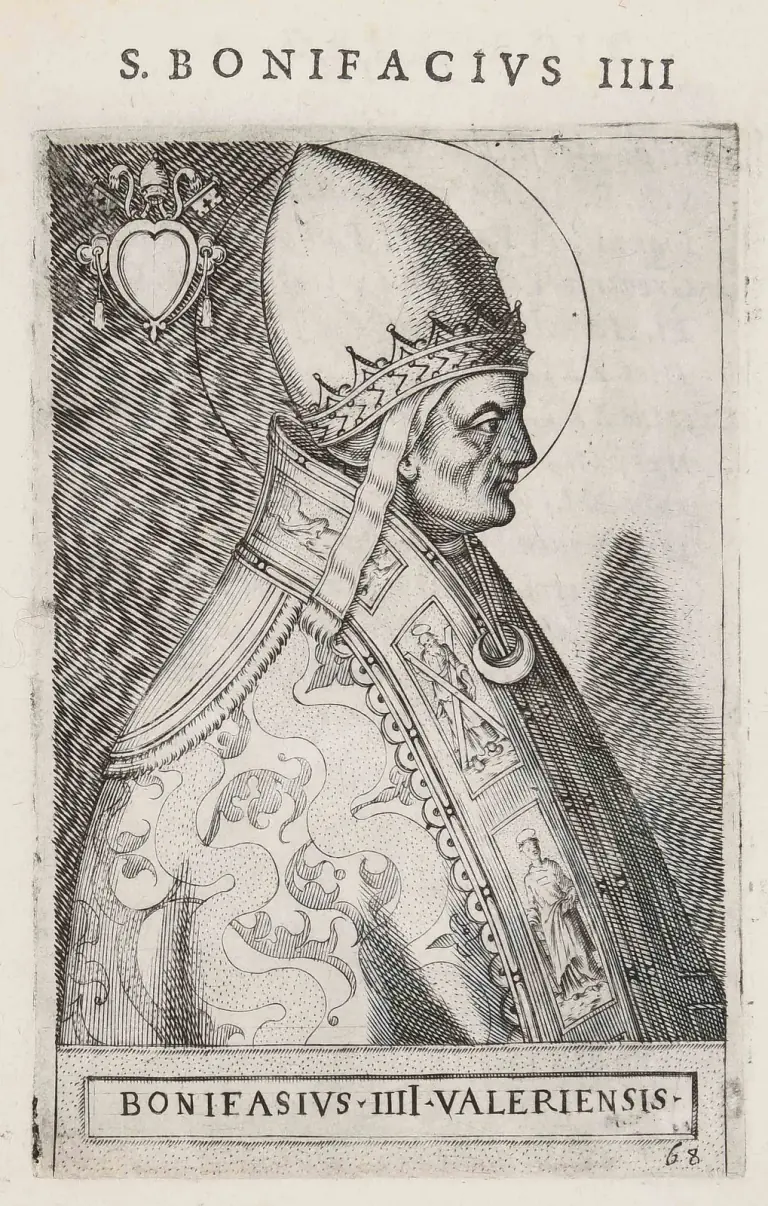
- Born
- In the country of the Marsi, in the province of Valeria, east of Rome; son of a physician named John; date unknown 128
- Pope
- August 25 (or September 15), 608, to May 8 (or May 25), 615; the 67th pope in the Holy See's list 128
Saint Boniface IV was pope from 608 to 615, a deacon who had served Gregory the Great and who obtained the Pantheon from the emperor Phocas and consecrated the old temple as a church of the Virgin Mary and all the martyrs. 146 It was the first time a pagan temple in Rome had been made a place of Christian worship. 12 His feast in the current Roman Martyrology is May 8; older calendars kept him on May 25. 135
A deacon of Gregory's
Horace Mann, who wrote the fullest English account of these popes, opens his chapter with a warning: "Though Boniface IV. reigned for over six years, he is little more than a name to us." 2 Little is recorded of what he did, and almost nothing that shows his character. 2
The Liber Pontificalis, as Mann and the Catholic Encyclopedia both report it, makes him the son of a physician named John, from the country of the Marsi in the province of Valeria, the mountain region east of Rome along the Via Valeria. 12 Under Gregory the Great he was a deacon of the Roman Church and its dispensator, the first official in the running of the Church's estates, which Mann calls the pope's "right-hand man." 12
Gregory himself seems to mention him. In the Dialogues, finished at the end of 593, he tells of a priest named Stephen in the province of Valeria, "nigh of kindred to my deacon Bonifacius," who came home from a journey and called carelessly to his servant, "Come, sir devil, and pull off my hose." His garters at once began to come undone, and Stephen, terrified, had to cry out that he had been speaking to his servant. 27 A letter of Gregory's from the same time speaks of "my most beloved son Boniface, the deacon." 2 Mann concludes that the deacon in both places is the future pope. 2
A long vacancy
Boniface III was buried in November 607, the year he was consecrated, and the see stayed empty for more than nine months by the Catholic Encyclopedia's count, more than ten by Mann's. 12 Mann supposes the emperor was slow to confirm the election. 2
Boniface IV was consecrated bishop of Rome on August 25, 608, according to Duchesne, or on September 15 according to Jaffe; both sources give both dates, and the Holy See's list of popes uses August 25. 128
The Pantheon
The act he is remembered for is the Pantheon. The temple had been built by Agrippa and dedicated to Jupiter the Avenger, to Venus and to Mars. 12 The pagan temples of Rome had been closed since the end of the fourth century, and Mann says it would have fallen into ruin with the rest if Boniface had not obtained leave from Phocas to make it a church. 2
Bede tells it plainly: Boniface "obtained for the Church of Christ from the Emperor Phocas the gift of the temple at Rome called by the ancients Pantheon, as representing all the gods; wherein he, having purified it from all defilement, dedicated a church to the holy Mother of God, and to all Christ's martyrs, to the end that, the company of devils being expelled, the blessed company of the saints might have therein a perpetual memorial." 4 Paul the Deacon, writing in the eighth century, has the same purpose in fewer words: where "the worship, not of all the gods, but of all the devils" had been performed, "there at last there should be a memorial of all the saints." 6
The Catholic Encyclopedia dates the consecration to May 13, 609, with a question mark, and so does Mann, who takes the day from an early Roman calendar and from Ado. 12 The 1897 English edition of the Roman Martyrology keeps the dedication of "the church of St. Mary of the Martyrs" on May 13. 5 It was said, according to the encyclopedia, that twenty-eight cartloads of the bones of martyrs were brought from the catacombs and placed in a porphyry basin under the high altar. 1 The building took the name Santa Maria Rotonda from its shape. 12
From the dedication came a feast. The 1897 Martyrology, under November 1, says that Boniface IV, after dedicating the Pantheon, ordained a festival in honor of the Virgin Mary and the martyrs to be kept solemnly every year in Rome, and that Gregory IV later fixed it on that day for the whole Church. 5 Sellar, Bede's translator, adds that the feast was probably kept at first on May 13. 4
The consecration saved the building, though not all of it. Paul the Deacon records that the emperor Constans, visiting Rome in 663, stripped the bronze tiles from the roof of "the church of the blessed Mary which at one time was called the Pantheon" and shipped them to Constantinople. 6
Mellitus and the English Church
Bede is also the source for the next thing known of him. Mellitus, the first bishop of London, came to Rome "to confer with the Apostolic Pope Boniface about the necessary affairs of the English Church." 4 The pope had called a synod of the bishops of Italy "to prescribe rules for the life and peace of the monks," and Mellitus sat in it on February 27 of the eighth year of Phocas, which Sellar reckons as 610. 4 Mann says Bede's words are all that is known of the council's work; the decree usually printed under its name is generally held to be spurious. 12
Mellitus carried the council's decrees home, with letters from Boniface to Laurentius, archbishop of Canterbury, to the clergy, and to King Ethelbert and the English people. 14 A letter to Ethelbert survives in William of Malmesbury, and the sources part over it. The Catholic Encyclopedia reports that Hefele thought it spurious, Haddan and Stubbs questionable, and Jaffe genuine. 1 Mann accepts it: in it Boniface grants the king's request that monks living in full observance be settled in the monastery Laurentius governed, and Mann notes that it is the first papal letter dated by the year of the Incarnation. 2
A letter from Columban
Some time between 612 and 615 the Irish abbot Columban, then settled at Bobbio in the Lombard kingdom, wrote Boniface a long letter about the Three Chapters, the writings condemned at the Council of Constantinople in 553, which some bishops in the Lombard kingdom still defended. 12 The Catholic Encyclopedia and Mann both say King Agilulf asked him to write, and Mann cites Columban's own words: a Lombard king had asked a slow-witted Irish foreigner to write. 12 Foulke, Paul the Deacon's translator, says instead that Queen Theudelinda used Columban to defend the schismatics' cause. 6
The encyclopedia calls the letter "remarkable at once for its expressions of exaggerated deference and its tone of excessive sharpness." 1 Columban addressed the pope as "the most beautiful Head of all the Churches of Europe," told him that he was charged with heresy, and urged him to "call a council to free yourself from the charges made against you." 2 In the same letter he declared his faith in the Roman see: "For I believe that the pillar of the Church is ever firm in Rome." 2
What Boniface answered is not known. 2 The encyclopedia says the letter "seems not to have disturbed in the least" Columban's relation with the Holy See. 1 Mann adds that a second letter of Columban's, if its editor is right to address it to Boniface IV, shows the two on good terms; Columban wrote it on the Church's feasts and the date of Easter "under the compulsion of your commanding charity," and ended, "I believe, O venerable Pope, that obedience with faith is of more worth than human genius." 2
Gaul, famine and a monastery
Theoderic II, king of Burgundy, wrote to Boniface asking the pallium for Florian, the new archbishop of Arles. 2 In letters Mann dates to August 23, 613, the pope praised the king's care for his churches, commended to him the poor of the Roman Church's estates in Gaul, and sent the pallium, urging Florian above all to fight simony. 2
The Liber Pontificalis says that in his time there were "famines, pestilences, and inundations," and Mann supposes these took up the pope's attention until his death. 12 It also says he turned his own house into a monastery and endowed it. 12 In this he followed Gregory, and his epitaph said so: in life, work and conduct, it ran, he always followed the counsels and example of Gregory, his master. 2 Mann adds that Boniface carried out Gregory's practice of placing monks in important posts, and that his successor, Deusdedit, appears to have undone it. 2 The current Roman Martyrology remembers him as a pope who did much for the monastic life. 3
Death and burial
Boniface died in 615 in monastic retirement, the encyclopedia says; he had made his own house a monastery. 1 The day is May 8 by Duchesne's reckoning, which the Holy See's list follows, and May 25 by Jaffe's. 128
He was buried in the portico of St. Peter's. 12 His body was moved three times: in the tenth or eleventh century, at the end of the thirteenth under Boniface VIII, and into the new St. Peter's on October 21, 1603. 12 Mann says the inscription placed on the tomb under Boniface VIII could still be read in the crypt of St. Peter's in his day. 2
What is Saint Boniface IV the patron saint of?
Saint Boniface IV's feast day
Saint Boniface IV's feast day is May 8. The Roman Martyrology, as the Italian bishops print it, enters him on that date: at Rome, at St. Peter's, Saint Boniface IV, pope, who turned the temple of the Pantheon, obtained from the emperor Phocas, into a church and dedicated it to God in honor of the Blessed Mary and all the martyrs, and who did much for the monastic life. 3
Older books have a different day. The 1897 English edition of the Martyrology has "At Rome, of pope St. Boniface IV., who dedicated the Pantheon to the honor of blessed Mary of the Martyrs" under May 25, and both the Catholic Encyclopedia and Mann say he is commemorated on that date. 125 May 25 is the day of his death in Jaffe's reckoning; May 8 is the day in Duchesne's. 12
Praying with Saint Boniface IV
Most of Boniface's life went unrecorded. What survives is a career spent in someone else's service: deacon and steward to Gregory, then pope for more than six years in a Rome of famine, plague and floods. 12 His epitaph praised him for following his master. 2
The one act everyone remembers was a work of rescue. A temple no one used was going to ruin, and he asked for it, cleaned it out and gave it to the Virgin Mary and the martyrs, so that, in Bede's words, "the blessed company of the saints might have therein a perpetual memorial." 24 The feast of All Saints has one of its roots there. 45
He was also on the receiving end of a sharp letter from a saint, which told him he was suspected of heresy and should prove otherwise. 12 No answer survives, and nothing suggests he broke with Columban; a second letter, if it was to him, has Columban writing "under the compulsion of your commanding charity." 12
He ended his life, the encyclopedia says, in monastic retirement, having made his own house a monastery, as Gregory had done before him. 12
Saint Boniface IV, pray for us.
Sources
- 1.Thomas Oestereich, "Pope St. Boniface IV," The Catholic Encyclopedia, vol. 2 (New York: Robert Appleton Company, 1907).
- 2.Horace K. Mann, The Lives of the Popes in the Early Middle Ages, vol. I, part 1 (London: Kegan Paul, Trench, Trubner; St. Louis: B. Herder, 1914 printing; first published 1902), "St. Boniface IV," pp. 268-279, and "Deusdedit," p. 280.
- 3.Roman Martyrology, entry for May 8, "San Bonifacio IV, papa," Santo del giorno, Conferenza Episcopale Italiana (in Italian).
- 4.Bede, Ecclesiastical History of England, Book II, chapter 4, translated by A.M. Sellar, with notes (London: George Bell and Sons, 1907), as published by Project Gutenberg.
- 5.The Roman Martyrology, May 13, May 25 and November 1 (Baltimore: John Murphy Company, 1897).
- 6.Paul the Deacon, History of the Langobards, Book IV, chapter 36, and Book V, chapter 11, translated with notes by William Dudley Foulke (Philadelphia: Department of History, University of Pennsylvania, 1907).
- 7.Saint Gregory the Great, Dialogues, Book III, chapter 20, in the English edition of 1911, as transcribed by Roger Pearse.
- 8."Boniface IV," The Supreme Pontiffs, The Holy See.
Saints to turn to next
Others in this collection who are turned to for some of the same things.