Saint Beatrice da Silva
c. 1424 - c. 1490
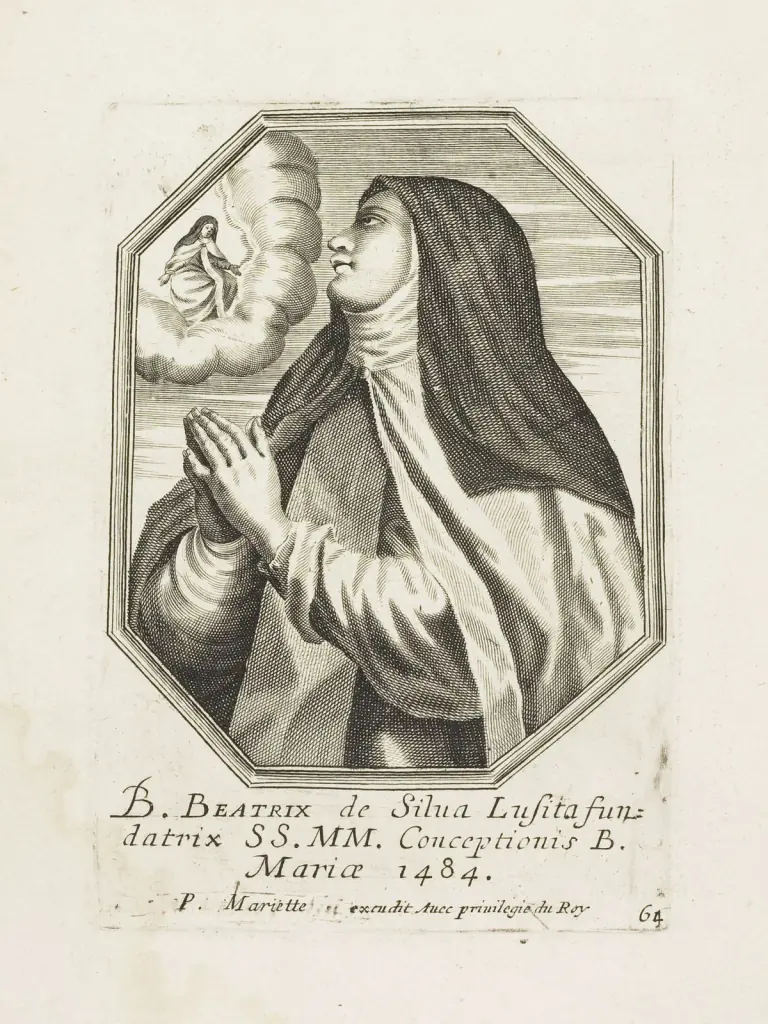
- Born
- At Ceuta, in 1426 or 1424, according to Paul VI; at Campo Maior in Portugal, according to the Conceptionist nuns of Ágreda 134
Saint Beatrice da Silva was a Portuguese noblewoman who came to Castile in 1447 as a lady of the new queen, left the court, and lived for some thirty years in a Dominican convent at Toledo with her face veiled. 14 In 1484 she moved with a few companions into a house given by Isabella the Catholic, and in 1489 Pope Innocent VIII approved the order she founded in honor of the Immaculate Conception, the Conceptionist nuns. 12 Her feast is August 17. 45
A life seen through a veil
Paul VI began his homily at her canonization by admitting how little could be said. As her extraordinarily beautiful face had stayed veiled for long years of her life, he said, so too many lines of her biography had reached the Church only by reflection, as in a mirror. 1 No word of hers survives in her own syllables, no writing in her hand, no portrait of her face, and not even a final rule for the family she founded. 1
Was her life a legend, then? "No, no," he answered. Her civil records and her work as foundress of a religious family that still flourished left no doubt that she had lived. 1 What follows is what the sources report, with the places where they differ marked.
Ceuta, Campo Maior and the court of Castile
Paul VI, speaking in Portuguese, said she was born at Ceuta on the North African coast, then held by the Portuguese crown, very probably in 1426, though some biographers say 1424. 1 Catholic.net also gives Ceuta, about 1424. 3 The Conceptionist nuns of Ágreda, following Sister Juana de San Miguel of the first community, say she was born at Campo Maior, a small town in Portugal. 4
Her father, Ruy Gomes da Silva, had fought in the taking of Ceuta in 1415, and the captain of the city, Pedro de Meneses, gave him his daughter Isabel in marriage. 1 They had eleven children, by Paul VI's count and the Ágreda nuns'; Catholic.net says twelve. 134 One of them was Blessed Amadeus da Silva, who entered the Franciscans in Italy and began a reformed branch of the Friars Minor known after him. 14 About 1433 the father was made governor of Campo Maior, and Beatrice grew up there. 1
In 1447 Isabel of Portugal married John II, King of Castile, and took Beatrice with her to the Castilian court; she had just turned twenty, Paul VI said. 1 The 1910 Catholic Encyclopedia says that her great beauty "aroused the jealousy of the queen," and that "she escaped with difficulty." 2 Paul VI was more careful: she left the court, he said, because her beauty drew the admiration of the nobles, or perhaps because the queen feared a dangerous rival. 1
The chest
Two sources tell a story that Paul VI did not repeat. Catholic.net says that the queen, believing she had seen a look pass between her husband and Beatrice, had her locked in a chest, where she stayed three days and nights without food or water, praying. 3 The Conceptionist nuns of Ágreda tell it the same way and add that the Virgin Mary appeared to her there, dressed in a white habit and a blue mantle with the child Jesus in her arms, and asked her to found an order in honor of her Immaculate Conception. 4 Beatrice, they say, promised her virginity, and came out of the chest after three days as if nothing had happened. 4
Catholic.net says she was freed when a relative noticed her absence and had her searched for. 3 Both sources connect the white habit and blue mantle of the Conceptionists to what she saw in the dark. 34 The encyclopedia records only that "the foundress determined on the habit, which was white, with a white scapular and blue mantle." 2
Thirty years at Santo Domingo el Real
She went to Toledo and entered the Dominican monastery of Santo Domingo el Real, though not as a nun of the order. 123 Paul VI and the Ágreda nuns say she stayed about thirty years; the encyclopedia says forty. 124
Paul VI quoted her first biographer on why she covered her face: remembering the beauty she had received from God, she decided that no man and no woman would see it as long as she lived. 1 The Ágreda nuns say she wore a white veil over it for the rest of her life, as penance and as a sign of total consecration to God. 4 Paul VI asked whether that was an exaggeration, and answered that the saints are always a provocation to habits we think wise only because they are comfortable. 1
The Order of the Immaculate Conception
In 1484 she left the monastery with a few companions for a house in Toledo called the Palaces of Galiana, given to her by Queen Isabella the Catholic. 14 Catholic.net notes that this Isabella was the daughter of the queen who had once turned against her, and that she visited Beatrice and took an interest in her plan. 3 On April 30, 1489, at the request of Beatrice and of the queen, Innocent VIII authorized the new monastery and approved the principal rules to be kept in it. 1 The encyclopedia says the sisters then adopted the Cistercian rule and bound themselves to recite daily the Office of the Immaculate Conception. 2
She died before regular life under the papal permission could begin, Paul VI said, and the Ágreda nuns say the same. 14 New Advent's editorial note dates her death to 1490; Catholic.net to August 1492. 23 The institute survived its foundress, received its own rule in 1511, and spread through Spain, Italy and France. 12 Its first foundation in Mexico dates from 1540, and in 1976, Paul VI said, it had about 3,000 nuns in some 150 monasteries. 1
The Ágreda nuns write that Pius XI confirmed her immemorial cult in 1926, and that Paul VI canonized her on October 3, 1976. 4 In his homily Paul VI called devotion to Mary Immaculate the secret of her holiness, and noted that her order honored the Immaculate Conception centuries before it was defined as dogma. 1
What is Saint Beatrice da Silva the patron saint of?
Saint Beatrice da Silva's feast day
Saint Beatrice da Silva's feast day is August 17. The current Roman Martyrology, as the Italian bishops print it, enters her on that day at Toledo, as a noblewoman of the queen's court who withdrew for many years among the Dominican nuns and founded an order dedicated to the Conception of the Blessed Virgin Mary. 5 The Conceptionist nuns of Ágreda also give August 17 as her liturgical feast. 4
New Advent's editorial note to the 1910 encyclopedia article gives her feast as September 1. 2
Praying with Saint Beatrice da Silva
Most of what she did was wait. She spent about thirty years in another order's house, veiled, without taking its vows, before the foundation she had in mind could begin. 124 The Ágreda nuns describe that time as patient waiting on a promise. 4
She did not live to see her order keep its rule. 1 She died before the regular life Innocent VIII had permitted could start, and the institute received its own rule twenty years later. 12
Paul VI put the center of her life in one name, Mary, and Mary Immaculate in particular. 1 The order she left behind still recites the Office of the Immaculate Conception that its first sisters bound themselves to. 12
Paul VI also said that we do not have her face or her voice. 1 What survives is a convent rule, a habit of white and blue, and a choice to be unseen. 124
Saint Beatrice da Silva, pray for us.
Sources
- 1.Paul VI, Homily for the canonization of Saint Beatrice da Silva, October 3, 1976 (in Italian, Portuguese and Spanish), vatican.va.
- 2.F. M. Rudge and F. Steele, "Congregation of the Immaculate Conception," The Catholic Encyclopedia, Vol. 7 (New York: Robert Appleton Company, 1910), with New Advent's editorial note, New Advent.
- 3."Santa Beatriz de Silva, fundadora de las concepcionistas," Catholic.net (in Spanish).
- 4."Saint Beatriz de Silva," Monasterio de la Concepción, Franciscan Conceptionist nuns of Ágreda.
- 5.Roman Martyrology, entry for August 17, Santo del giorno, Conferenza Episcopale Italiana (in Italian).
Saints to turn to next
Others in this collection who are turned to for some of the same things.