Saint Babylas
Died about 250
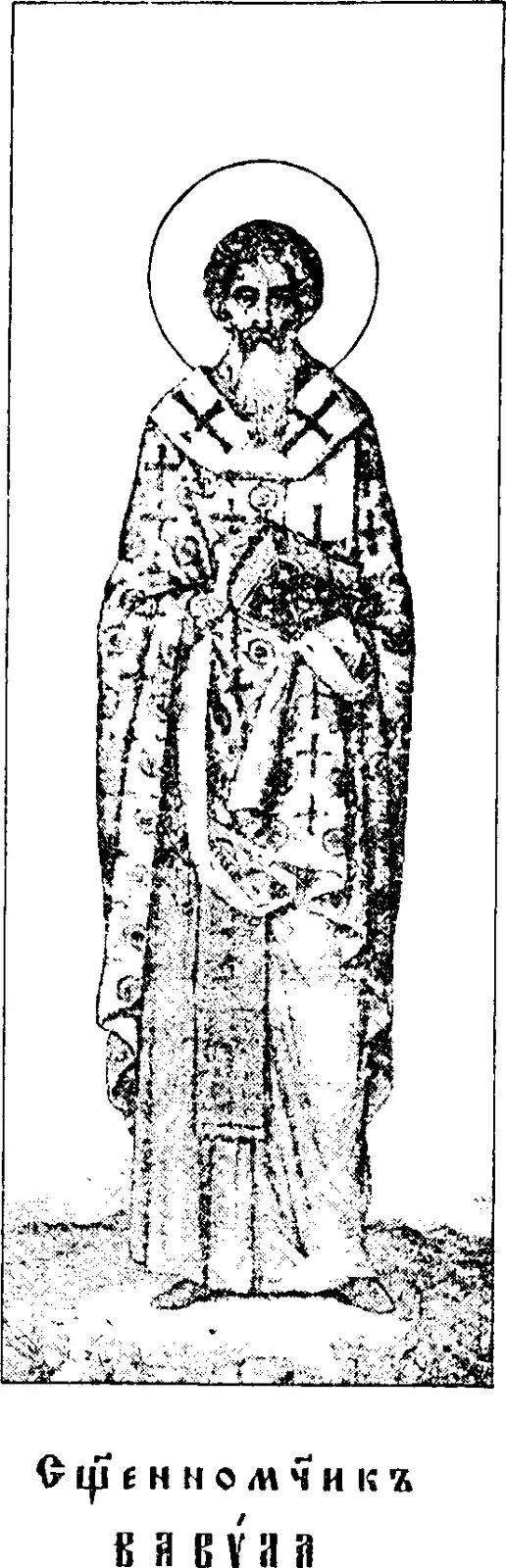
- Known for
- Refusing an emperor entry to the church for a murder; and, after death, the silencing of Apollo at Daphne 1234
- Relics
- Taken to Daphne by Gallus about 351, sent back by Julian in 362; said to have been carried to Cremona in the Middle Ages 1234
- Patronage
- None stated; Butler says he is titular saint of many churches in Italy, France and Spain 3
Saint Babylas was bishop of Antioch in the 240s, and two stories are told of him. 12 One is that he shut the church door against an emperor who had blood on his hands; the other, which John Chrysostom told from the pulpit, is that his bones, lying in a suburban shrine, silenced a famous oracle of Apollo. 123 He died in chains in the persecution of Decius about 250, and his feast is January 24. 25
Bishop of Antioch
Babylas succeeded Zebinus as bishop of Antioch, the twelfth bishop of that city by Kirsch's count, in the reign of Gordian; Butler gives the year as 237. 23 He governed the church for about thirteen years. 3 Butler calls him "the most celebrated of the ancient bishops of Antioch, after St. Ignatius." 3
Almost everything else about his life is uncertain, and the biography published by the Milanese parish of San Babila says so plainly. The one early historian, Eusebius, writing more than half a century later, records only that he died in prison at Antioch after confessing the faith, under Decius, about 250. 4 The ancient martyrologies add that three boys died with him. 4
The emperor at the door
The story comes from Chrysostom, who was born in Antioch and heard what its church remembered. 4 An emperor who had received the son of a barbarian king as a hostage, and promised to treat him as his own, had the boy killed and then came to the Christian assembly to take part in the liturgy. The bishop barred him from the church and drove him out. 4 Chrysostom did not name the emperor. 24
Who was it? The Acts of Babylas name Numerian, though Butler says none of the Acts can be authentic. 23 Kirsch thinks it more probably Philip the Arabian, of whom Eusebius reports that a bishop would not let him into the Easter vigil until he took his place among the penitents. 2 Butler accepts Philip, and repeats the Bollandist Stilting's suggestion that it may instead have been Decius. 3 The Milanese biography gives a third account, from the Chronicon Paschale, in which Philip had murdered a son of his predecessor Gordian; it doubts that too, and concludes that the episode cannot be fully deciphered. 4
In chains
He was arrested in the persecution of Decius, and here too there are two accounts. Eusebius, as Kirsch reports, says he was thrown into prison and died there of his sufferings, and so was venerated as a martyr. 24 Chrysostom, in his early discourse against Julian and the pagans, describes him as condemned to death and executed, apparently by the sword. 4 Butler follows the prison: "at least it seems to have been under Decius that St. Babylas consummated his martyrdom by the hardships of his prison." 3
On one detail the sources agree. Before he died he asked to be buried with his chains. 34 The current Roman Martyrology keeps it: he died bound in iron fetters, and arranged for his body to be buried in them. 5
With him, the Martyrology says, tradition remembers three boys he had taught the faith, Urbanus, Prilidanus and Epolonus. 5 The Syriac tradition, in the Milanese biography, gives them other names and their ages: Barbadus, twelve; Apollonius, nine; and Urbanus, seven. 4
The oracle at Daphne
He was buried in the cemetery outside Antioch. About 351 the Caesar Gallus moved his body to Daphne, a suburb five miles away, and built a church for it beside the great temple of Apollo, whose oracle was famous. 23 The Milanese biography calls it the first translation of relics for which there is sure testimony. 4 Butler, following Chrysostom, says that "the neighborhood of the martyr's relics struck the devil dumb." 3
In 362 the emperor Julian came to Daphne and could get no answer from the god. 24 Chrysostom, preaching at Antioch years later, told the congregation what the oracle had said: "The dead prevent me from uttering, says he, but break open the graves, dig up the bones, move the dead." 1 Julian left every other grave alone and ordered only the martyr moved. "For that these things were an excuse, and pretence and that he feared the blessed Babylas," Chrysostom says, "is manifest from what the emperor did." 1
The Christians carried the coffin back to Antioch in procession, singing the psalms against idols. 3 Then, Chrysostom says, "as soon as the coffin was drawn into the city, a thunderbolt came from above upon the head of his image, and burnt it all up." 1 Julian never put the roof back on the temple. Chrysostom told his listeners that its bare walls still stood, "uttering a voice clearer than a trumpet," and that a visitor seeing the martyr's shrine without its saint and Apollo's temple without its roof would ask why, and learn the whole story. 1
Across the river
In 379 or 380 Bishop Meletius built a martyrium for Babylas across the Orontes from the city, and the relics were moved there for good; Meletius himself was buried beside him in 381. 4 Chrysostom, who had served under Meletius, alludes to it in the homily: the saint "quickly received, a neighbor, and a fellow-lodger, and one of similar life," a bishop who had worked on the building with his own hands in the summer heat. 14
Kirsch says the bones were carried to Cremona in the Middle Ages; Butler says they are "said to be" there, brought from the East in the crusades. 23 His cult reached Milan early, where a church of San Babila is attested from the eleventh century. 4
What is Saint Babylas the patron saint of?
None of the sources consulted for this page names Saint Babylas as the patron saint of anything, and the page does not supply a patronage. Butler notes that he is the titular saint of many churches in Italy, France and Spain. 3
Saint Babylas's feast day
Saint Babylas's feast day is January 24, where the current Roman Martyrology enters his passion at Antioch. 5 Butler and Kirsch both give January 24 as the Latin feast, and the Milanese biography traces the date back to the Syriac Martyrology of 412 and the fifth-century Hieronymian Martyrology, and to Chrysostom himself. 234
The Greek Church keeps him on September 4. 234 In Milan, where his memory is found in missals from the ninth century, he has been kept since the liturgical reform after the Second Vatican Council on January 23, to leave the 24th to Saint Francis de Sales. 4
Praying with Saint Babylas
Chrysostom chose, in the homily, not to tell the story of the bishop at the door. He left that to the older preachers and spoke only of what had happened in his own lifetime, after the martyr was dust. 1 Most of what can be known about Babylas is like that: not what he did, but what was done around his grave.
What is certain is small. He confessed the faith, he was put in chains, and he wanted the chains buried with him. 345 He seems to have thought of them as something worth keeping.
The story of the emperor cannot be pinned down, and the sources say so. 24 What it remembers is a bishop who would not let the most powerful man in the world receive the sacraments with a murder on his conscience until he had done penance like anyone else. 24
Chrysostom ends the homily not with Babylas at all but with the bishop who built his shrine, and who "keeps the image of the martyrs alive, in himself." 1 That is where he looked for the saint: in the people who imitated him.
Saint Babylas, pray for us.
Sources
- 1.John Chrysostom, "On St. Babylas," trans. W. R. W. Stephens, Nicene and Post-Nicene Fathers, First Series, Vol. 9 (Buffalo, 1889), New Advent.
- 2.Johann Peter Kirsch, "St. Babylas," The Catholic Encyclopedia, Vol. 2 (New York: Robert Appleton Company, 1907).
- 3.Alban Butler, "St. Babylas, Bishop of Antioch and Martyr," January 24, in The Lives of the Fathers, Martyrs, and Other Principal Saints, Vol. I (New York, 1895), Project Gutenberg eBook #20450.
- 4."Santi Babila, Urbano, Prilidano ed Epolono, Martiri," biography from the parish of San Babila, Milan, Santi, beati e testimoni (santiebeati.it) (in Italian).
- 5.Roman Martyrology, entries for January 24, Santo del giorno, Conferenza Episcopale Italiana (in Italian).
Saints to turn to next
Others in this collection who are turned to for some of the same things.