Saint Anterus
Died January 3, 236
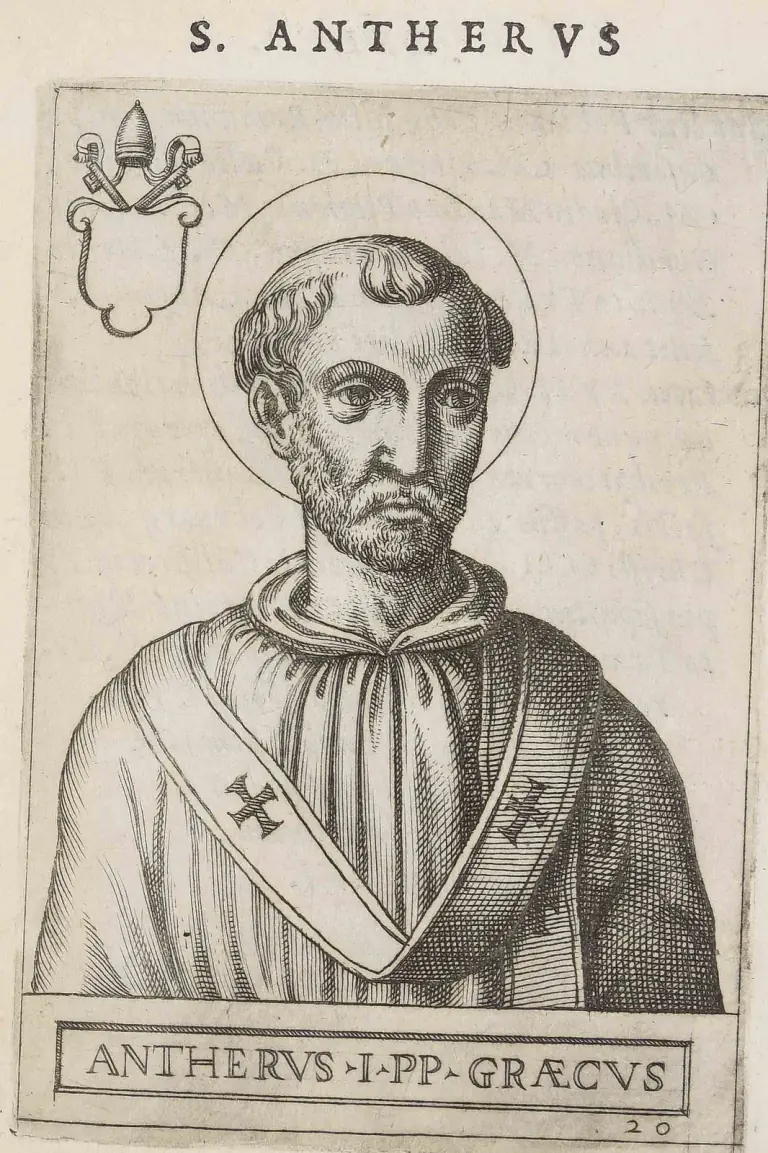
- Pope
- From November 21, 235, to January 3, 236, according to Shahan; a month by Eusebius, one month and twelve days by the Liber Pontificalis 134
- Successor
- Fabian, chosen when a dove settled on his head, as Eusebius tells it 3
- Died
- January 3, 236; a martyr according to the Liber Pontificalis and the 1897 Martyrology, a natural death according to katolsk.no 1458
Saint Anterus was bishop of Rome for about six weeks, from November 235 to January 236, elected while his predecessor Pontian was a prisoner in the mines of Sardinia. 125 Almost nothing is known of what he did, but his gravestone survives: a narrow slab with his name cut in Greek, found in the papal crypt of the catacomb of Callistus in 1854. 16 His feast is January 3. 7
A Greek in the see of Rome
The Liber Pontificalis, the early book of papal lives, gives the whole of his background in one line: "Antheros, by nationality a Greek, son of Romulus." 4 The name itself is Greek, as the Norwegian bishops' saints database (katolsk.no) points out. 5 Nothing is known of his life before he was chosen. 15
Thomas Shahan, writing in the Catholic Encyclopedia in 1907, does not pretend otherwise. "We know for certain only that he reigned some forty days," he says, "and that he was buried in the famous 'papal crypt' of the cemetery of St. Calixtus at Rome." 1 Everything else told of Anterus comes from later sources, and Shahan weighs them accordingly. 1
Pontian in the mines
Anterus became pope because his predecessor could no longer be one. In 235 the new emperor Maximinus the Thracian began a persecution that, as J.P. Kirsch puts it, was "directed chiefly against the heads of the Church." 2 Eusebius says Maximinus hated the household of the murdered emperor Alexander, "which contained many believers," and commanded "that only the rulers of the churches should be put to death." 3
Pope Pontian was one of the first taken. He and Hippolytus, the Roman priest whose schism had divided the Church of Rome through Pontian's years, were banished together to Sardinia. 24 Kirsch calls it "the unhealthy island of Sardinia"; katolsk.no says Pontian was sent to the mines there, to almost certain death. 25 Kirsch adds that shortly before or soon after, Hippolytus was reconciled to the Roman Church, and his schism came to an end. 2
Then Pontian gave up the office. "To make the election of a new pope possible," Kirsch says, he resigned on September 28, 235. 2 katolsk.no gives the same date and reason: so that a successor could take up the leadership as quickly as possible. 5 "Consequently Anteros was elected in his stead," Kirsch writes. 2 The Liber Pontificalis tells it differently, saying that Pontian was beaten with clubs in Sardinia and died on October 30, and that "in his place Antheros was ordained, November 21." 4
Forty days
No two sources quite agree on how long he held the office. Shahan gives November 21, 235, to January 3, 236, "some forty days." 1 Eusebius says simply that "after he had held the office for a month, Fabianus succeeded him." 3 The Liber Pontificalis gives one month and twelve days, Alban Butler's Lives of the Saints one month and ten days, and katolsk.no six weeks. 459 Loomis notes that the Liberian Catalogue, the fourth-century list of Roman bishops, says only that he died after a pontificate of forty days. 4
Of what he did with that time, one act is recorded. The Liber Pontificalis says that he "created one bishop in the city of Fundi, in the Campania, during the month of December." 4 katolsk.no repeats it: he ordained a bishop for Fundi, today's Fondi, in Campania. 5
The acts of the martyrs
The one story attached to his name concerns records. The Liber Pontificalis says that "he collected carefully from the notaries the acts of the martyrs" and "deposited them in the church," and connects this with a priest named Maximus, or Maximinus in another recension, who had been martyred. 4 Shahan summarizes it as the claim that he "caused the Acts of the martyrs to be collected by notaries and deposited in the archives of the Roman Church," and that it cost him his life. 1 Northcote and Brownlow, in their account of the catacombs compiled from the work of Giovanni Battista De Rossi, say he "diligently sought out the Acts of the martyrs in the official records of the Praetor Urbanus," the city magistrate. 6
The historians are cautious. Shahan grants that "this tradition seems old and respectable," but adds that "the best scholars maintain that it is not sufficiently guaranteed by its sole voucher, the 'Liber Pontificalis'," which was compiled long afterward. 1 katolsk.no calls it probably a romantic anachronism. 5 Loomis observes that the compiler of the Liber Pontificalis "seems to have felt a special ardor for the memory of the martyrs," and that he has three early popes, "Clement, Anteros and Fabianus, each make provision for the collection of facts regarding them." 4 Elsewhere she suggests that he may himself have belonged to the body of church notaries whose origins he was eager to dignify. 4
Martyr or not
The Liber Pontificalis says that Anterus "was crowned with martyrdom" in the consulship of Maximinus and Africanus, the year 236. 4 The Roman Martyrology of 1897 enters him as "St. Anterus, pope, who suffered under Julius Maximinus." 8 Butler says he "is styled a martyr by Bede, Ado, and the present Roman Martyrology." 9 Northcote and Brownlow go further and say he was martyred "before the death of his predecessor," still alive in Sardinia. 6
Against that, Loomis notes that his name "does not occur in the lists of martyrs." 4 katolsk.no judges the martyrdom unlikely for the same reason, adding that the Liberian Catalogue says he "fell asleep," the phrase it uses for popes who died a natural death. 5 The current Roman Martyrology records only his burial, and does not give him the title of martyr. 7
The papal crypt
He was buried, the Liber Pontificalis says, "in the cemetery of Calistus on the Via Appia, January 3." 4 The place was a single chamber in that catacomb, set apart for the bishops of Rome in the third century. 6 It was lost for centuries. Northcote and Brownlow describe how, when it was rediscovered in 1854, it was "in a complete state of ruin," filled through its light shaft with earth, broken gravestones and rubbish. 6
Among the fragments recovered from that rubbish were the gravestones of several third-century popes, Anterus and Fabian among them. 6 Shahan describes his as "the narrow oblong slab that closed his tomb," carrying "some broken remnants of the Greek epitaph." 1 katolsk.no reads what survives as his name and the beginning of the word for bishop. 5 Shahan sees in it "an index at once of his origin and of the prevalence of Greek in the Roman Church up to that date." 1 Northcote and Brownlow note how "curt and unceremonious" these papal stones are, a name and a title, and add that no one familiar with early Christian inscriptions doubts that they are the originals. 6 Loomis records that the name of his successor Fabian is cut "close to those of Anteros." 4
Pontian was laid beside him. Fabian later had Pontian's body brought back from Sardinia and buried in the same chapel, on August 13 according to Kirsch. 26 Northcote and Brownlow suggest that Pontian's grave coming after that of Anterus led some early chroniclers to reverse the order of the two popes. 6 katolsk.no calls Anterus the first pope buried in the crypt; Northcote and Brownlow name Zephyrinus as the first recorded, with a broken stone of Urban found there as well. 56 In the fifth century Pope Sixtus III set up a list of the bishops buried in the cemetery, and Anteros is on it, as De Rossi reconstructed it. 6 Pope Damasus left verses in the same chamber: "Here, if you would know, lie heaped together a whole crowd of Saints." 6
After Anterus
His death left the Roman Church to choose again, and Eusebius tells how it did. Fabian, who had come in from the country with others, was in Rome when "all the brethren had assembled to select by vote him who should succeed to the episcopate," and was "in the mind of none." 3 "Suddenly a dove flying down lighted on his head," and the people cried out that he was worthy and placed him on the bishop's seat. 3 According to the Liber Pontificalis, the see stood empty thirteen days after Anterus. 4
What is Saint Anterus the patron saint of?
Saint Anterus's feast day
Saint Anterus's feast day is January 3. 7 The Roman Martyrology, in the text published by the Italian bishops, enters on that day at Rome, in the cemetery of Callistus on the Appian Way, the burial of Saint Anterus, pope, who after the martyr Pontian was bishop for a short time. 7 January 3 is also the day of his burial in the Liber Pontificalis. 4
The older calendar kept the same day. The 1897 Martyrology has him on January 3, as do Butler and katolsk.no. 589
Praying with Saint Anterus
Anterus took the office of a man who had been sent away to die, in a persecution aimed at the very office he was taking. 23 Pontian had stepped aside so that the Church would not be left without a shepherd, and Anterus was the one chosen to take it up, with the persecution still going on. 235
He had six weeks. 15 In that time the one thing recorded of him is that he gave the city of Fundi in Campania a bishop. 4 The story of the notaries may be a later writer's tribute rather than history, as the scholars say. 14 It shows, at least, what the Roman Church came to remember him for: keeping the record of those who had died for the faith. 46
What survives for certain is a broken stone with a Greek name on it, in a room where the bishops of Rome were laid one beside another. 16 Damasus wanted to be buried among them and held back for fear of disturbing them. 6 The Church still keeps the day Anterus was laid there. 7
Saint Anterus, pray for us.
Sources
- 1.Thomas J. Shahan, "Pope St. Anterus," The Catholic Encyclopedia, Vol. 1 (New York: Robert Appleton Company, 1907).
- 2.J.P. Kirsch, "Pope St. Pontian," The Catholic Encyclopedia, Vol. 12 (New York: Robert Appleton Company, 1911).
- 3.Eusebius, Church History, Book VI, chapters 28 and 29, translated by Arthur Cushman McGiffert, Nicene and Post-Nicene Fathers, Second Series, Vol. 1 (Buffalo: Christian Literature Publishing Co., 1890), as hosted by New Advent.
- 4.The Book of the Popes (Liber Pontificalis), Vol. 1, Introduction and "XIX. Pontianus," "XX. Anteros" and "XXI. Fabianus," translated by Louise Ropes Loomis (New York: Columbia University Press, 1916).
- 5."Den hellige pave Anterus ( - 236)," Den katolske kirke (katolsk.no), Catholic Diocese of Oslo (in Norwegian).
- 6.J. Spencer Northcote and W.R. Brownlow, Roma Sotterranea, or An Account of the Roman Catacombs, Especially of the Cemetery of St. Callixtus, Compiled from the Works of Commendatore de Rossi, new edition, Part First: History (London: Longmans, Green, and Co., 1879), pp. 291-314.
- 7.Roman Martyrology, entry for January 3, "Deposizione di Sant'Antero, papa," as printed in "Santo del giorno," Conferenza Episcopale Italiana (in Italian).
- 8.The Roman Martyrology, January 3 (Baltimore: John Murphy Company, 1897).
- 9.Alban Butler, "St. Anterus, Pope," January 3, in The Lives of the Fathers, Martyrs, and Other Principal Saints, Vol. I (New York: P. J. Kenedy, 1895), via Project Gutenberg.
Saints to turn to next
Others in this collection who are turned to for some of the same things.