Saint Anna the Prophetess
First century BC to first century AD
- Life
- Married seven years, then a widow who "departed not from the temple, by fastings and prayers serving night and day" 1
Saint Anna was the aged widow and prophetess who, according to Saint Luke, came into the Temple at the moment the infant Jesus was being presented there, gave thanks to God, and spoke of the child "to all that looked for the redemption of Israel." 1 She is known from three verses of the Gospel and from nothing else. 12 The Roman Martyrology now commemorates her with Simeon on February 3, as the two who greeted Jesus as the Messiah and Savior. 4
Three verses of Luke
Luke introduces her right after Simeon has taken the child in his arms. 1 In the Douay-Rheims translation: "And there was one Anna, a prophetess, the daughter of Phanuel, of the tribe of Aser; she was far advanced in years, and had lived with her husband seven years from her virginity. And she was a widow until fourscore and four years; who departed not from the temple, by fastings and prayers serving night and day. Now she, at the same hour, coming in, confessed to the Lord; and spoke of him to all that looked for the redemption of Israel." 1
Edward Arbez, writing in the 1907 Catholic Encyclopedia, says Luke describes her "carefully." 2 Widowed early, she never remarried and gave her life to the service of God, and because she spent most of her time in the Temple, her presence at the presentation of Jesus is easily understood. 2 Her praise of God, Arbez says, was about Jesus, and its burden was that he was the long-awaited Redeemer. 2
Anna is the form of the name in the Septuagint; Hannah is closer to the Hebrew, which means "graciousness." 2 Jerome, writing to a widow named Furia, found meaning in every name in the verse: "The meaning of the name Anna is grace. Phanuel is in our tongue the face of God. Aser may be translated either as blessedness or as wealth." 7
How old was she?
Luke's words allow two readings, and katolsk.no sets them side by side. 3 On the usual one she was eighty-four years old when she saw the child. 3 On the other, she had been a widow for eighty-four years, which, with marriage at the customary age of fourteen and seven years of marriage, would make her about 105; katolsk.no calls that conceivable but unlikely. 3
The Fathers read the plain way. Jerome says she bore "the burden of widowhood" from her youth "up to the age of fourscore and four years," and Ambrose calls her "a widow of fourscore and four years." 67
A model for widows
Arbez observes that she "answers perfectly" to the portrait of the model widow in Saint Paul's First Letter to Timothy, chapter 5. 2 Two Fathers of the fourth century made the same use of her. 67
Ambrose of Milan, in his treatise Concerning Widows, says simply that "Anna shows what widows ought to be." 6 He describes her as "vigorous in religion, and worn out in body, whose resting-place is the temple, whose conversation is prayer, whose life is fasting," one who "though the body acknowledge old age, yet knows no age in her piety." 6 The seven years of marriage matter to him as well: they show "that the things which are the support of her old age began in the aims of her youth." 6
Jerome, in his letter to Furia on how a widow should live, begins his examples with her: "Do we wish to know what widows ought to be? Let us read the gospel according to Luke." 7 Because she gave herself to fasting and prayer, he says, she "earned spiritual grace, received the title 'daughter of the face of God,'" and shared in the blessedness of her tribe. 7
Anna and Simeon
Luke sets her beside Simeon, and recent popes have preached on the pair together at the feast of the Presentation. 18910 Pope Francis in 2014 called the scene "a meeting between the young and the old": Mary and Joseph with their infant on one side, and on the other "Simeon and Anna, two people who often went to the Temple." 8 He noted that Luke calls her a prophetess, "that is she was inspired by God," and concluded, "these two elders are full of life!" 8
In 2017 Francis returned to them: "Simeon and Anna, in their old age, were capable of a new fruitfulness, and they testify to this in song." 9 Their song, he said, "was born of hope, the hope that sustained them in their old age." 9 Leo XIV, preaching on the same feast in 2026, said the expectation of Israel "finds full expression in two elderly people: Simeon and Anna," and spoke of Anna as the one who "never left the temple." 10
The legend of Mary in the Temple
Later tradition gave Anna a larger part. Arbez mentions, without endorsing it, that "legend knows that she had Mary under her tutelage in the Temple." 2 katolsk.no repeats a full legendary biography: born around 90 BC, married at fourteen, widowed at twenty-one, and at seventy-two put in charge of the Virgin Mary in the Temple from her presentation there at the age of three until her betrothal to Joseph. 3 None of this is in Luke, who says nothing of Anna before or after the one hour he describes, and katolsk.no adds that her later fate is unknown. 13
What is Saint Anna the patron saint of?
Saint Anna's feast day
Saint Anna's feast day is February 3. 34 The current Roman Martyrology, as the Italian bishops print it, commemorates Saints Simeon and Anna together at Jerusalem on that day, the day after the feast of the Presentation of the Lord: an old man, righteous and devout, and a widow and prophetess, who greeted the child as Messiah and Savior. 4 katolsk.no says the date comes from the revised Martyrology of 2001. 3
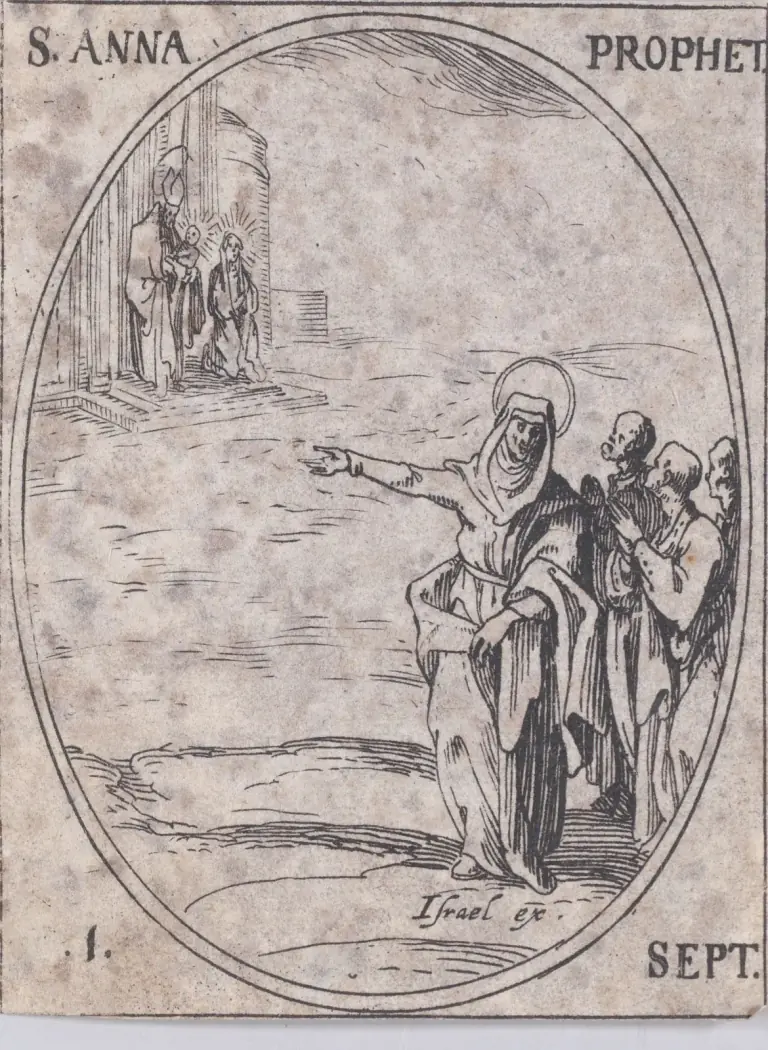
Before that she was kept on September 1. 3 The 1897 English Roman Martyrology entered on that day "blessed Anna, prophetess, whose sanctity is revealed in the Gospel," at Jerusalem, and Callot's etching of 1636 is dated the same day. 5 katolsk.no adds that the Orthodox Church keeps her on February 3 and on August 28. 3
Praying with Saint Anna
Luke gives her one sentence of action. 1 Most of her life, as far as anyone can tell, was spent waiting: decades of fasting and prayer in the same place, for something Luke never says she was promised she would live to see. 13
Ambrose noticed that the waiting began young. The seven years of marriage and the long widowhood are one life to him, and what carried her in old age "began in the aims of her youth." 6
When the child came, she did two things. She gave thanks, and she told other people, "all that looked for the redemption of Israel." 1 Francis described her and Simeon as "full of life" because they were "enlivened by the Holy Spirit." 8
Saint Anna the Prophetess, pray for us.
Sources
- 1.Luke 2:22-40, Douay-Rheims Bible, Challoner revision.
- 2.Edward P. Arbez, "Anna," The Catholic Encyclopedia, Vol. 1 (New York: Robert Appleton Company, 1907).
- 3."Den hellige Anna (Hanna) profetinnen (1. årh.)," Den katolske kirke (katolsk.no), Catholic Diocese of Oslo (in Norwegian).
- 4.Roman Martyrology, entry for February 3, "Santi Simeone e Anna," as printed in "Santo del giorno," Conferenza Episcopale Italiana (in Italian).
- 5.The Roman Martyrology, July 26 and September 1 (Baltimore: John Murphy Company, 1897).
- 6.Ambrose of Milan, Concerning Widows, chapter 4, trans. H. de Romestin, E. de Romestin and H.T.F. Duckworth, Nicene and Post-Nicene Fathers, Second Series, Vol. 10 (1896), at New Advent.
- 7.Jerome, Letter 54, to Furia, trans. W.H. Fremantle, G. Lewis and W.G. Martley, Nicene and Post-Nicene Fathers, Second Series, Vol. 6 (1893), at New Advent.
- 8.Francis, Homily for the Feast of the Presentation of the Lord, February 2, 2014, Libreria Editrice Vaticana.
- 9.Francis, Homily for the Feast of the Presentation of the Lord, February 2, 2017, Libreria Editrice Vaticana.
- 10.Leo XIV, Homily for the Feast of the Presentation of the Lord, February 2, 2026, Libreria Editrice Vaticana.
Saints to turn to next
Others in this collection who are turned to for some of the same things.