Saints Anatolia and Victoria
Died about 250
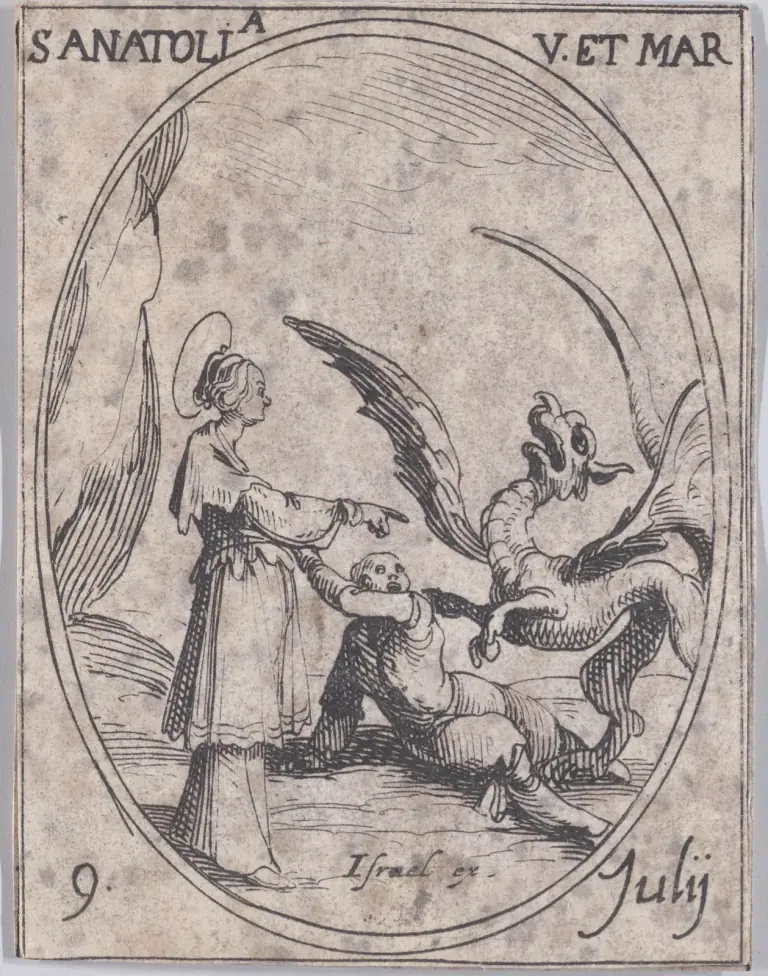
- Patronage
- Victoria is called patron saint for rain by katolsk.no 2
Saints Anatolia and Victoria are two young women of the Sabine country, northeast of Rome, who refused the men they were meant to marry and were put to death as Christians, by most accounts under the emperor Decius around 250. 125 Their cult is old, going back to the sixth or seventh century, but the story told of them is a legend; katolsk.no, the Norwegian bishops' saints database, calls their Passio historically worthless while holding that there is every reason to think they really were martyrs. 25 They are kept together on July 10. 4
The legend
In the story Vatican News summarizes, they were two young noblewomen of Rome who refused marriage because they had consecrated themselves to God; their two suitors had them shut up on their estates in the Sabina, and there they were killed in the persecution of Decius. 5 Thomas Campbell, in the Catholic Encyclopedia, says Anatolia was "living in retirement with her sister when the persecution was raging," and that a young man named Aurelius sought to marry her. 1 Victoria's suitor is named Eugenius in the 1897 English Martyrology, in Butler's Lives and in katolsk.no. 267
An angel enters the story at this point, though the versions disagree about whom it came to. Campbell writes that Anatolia was "on the point of yielding because of the solicitations of her sister Victoria" and "was strengthened by the vision of an angel." 1 The Spanish account on Catholic.net reverses it: Victoria urged her friend to marry, Anatolia answered that her guardian angel had told her virginity was dearer to God, and the angel appeared and won Victoria over. 8
Campbell adds that the Bollandists doubted Anatolia was ever actually betrothed. 1
Anatolia and Audax
Anatolia was banished to Thora and denounced there as a Christian. 1 The 1897 Martyrology places Thora "on lake Velino," and says that before her arrest she had cured many sick people "through the whole province of Picenum" and brought them to believe in Christ. 6 katolsk.no puts the place in the diocese of Rieti, near the village now called Sant'Anatolia after her. 3
The judge, named Faustinian in the 1897 Martyrology, had her tortured. 6 Then, in Campbell's words, "the executioner Audax shut her up in a room with a venomous serpent, but seeing that no harm was done to her he himself professed the faith and died a martyr." 1 Anatolia "was put to death by the sword." 1 The Martyrology says she was run through "whilst her hands were stretched out in prayer," and that Audax, imprisoned, was condemned without delay. 6
Catholic.net tells a different ending, in which her rejected suitor strangled her himself. 8 katolsk.no knows yet another version, in which the creature was a dragon and Anatolia saved Audax from it; it adds that their relics were taken to Subiaco in the tenth century, where a plaque behind the altar of the basilica of Saint Scholastica marks the place. 3
Victoria
Butler's entry for Victoria is short. She "was a young noble Roman lady, who being a Christian, desired to live to her heavenly spouse alone in a state of virginity." 7 Eugenius, refused, accused her to the judge, and "after many fruitless attempts to extort her consent to marry, or to sacrifice to idols, she was stabbed in the breast by an executioner," in 250. 7
The 1897 Martyrology adds that before her death she worked many miracles "by which she gained many virgins to God," and that the executioner struck "at the request of her betrothed." 6 katolsk.no reports a legend in which Eugenius drove the sword into her heart himself, and another in which she was gored to death by a bull in an amphitheater at Rome. 2 Vatican News places both deaths in the Sabina, and Catholic.net between Rome and Rieti. 58
One feast, then two, then one again
katolsk.no traces the cult in some detail. The martyrology attributed to Saint Jerome, from the middle of the fifth century, kept the two together on July 10 and called them sisters, though katolsk.no doubts they were sisters by blood rather than in Christ. 2 Their Passio was known to Saint Aldhelm, who died in 709, and to Saint Bede, whose version passed through the martyrologies of Ado and Usuard into the Roman Martyrology. 2
When Cardinal Cesare Baronius revised the Martyrology at the end of the sixteenth century, he put Anatolia and Audax on July 9 and Victoria on December 23. 2 That is how the 1897 English edition prints them, and why Campbell gives Anatolia's feast as July 9 and Butler gives Victoria's as December 23. 167 The present Martyrology has brought them back to July 10. 24
They appear among the virgin martyrs in the mosaics on the north wall of Sant'Apollinare Nuovo in Ravenna. 2 Victoria's cult spread early in Italy. Relics said to be hers were moved in 827 to save them from Saracen raiders, and are venerated in the parish church of Santa Vittoria in Matenano, between Macerata and Ascoli Piceno. 2
What are Saints Anatolia and Victoria the patron saints of?
Saints Anatolia and Victoria's feast day
The feast day of Saints Anatolia and Victoria is July 10. The current Roman Martyrology, in the text published by the Italian bishops, enters them together on that day as martyrs in the Sabina in Lazio. 4 Vatican News keeps them on July 10, and katolsk.no notes that it is the date of the oldest martyrology. 25
Older calendars divided them. Campbell writes of Anatolia that "her feast is kept 9 July," and the 1897 Martyrology enters Anatolia and Audax on July 9. 16 Victoria's day was December 23, in the same Martyrology and in Butler. 67
Praying with Saints Anatolia and Victoria
What can be known about these two women is very little: their names, their deaths for Christ, and a place in the Sabine hills where they were remembered early. 245 The legend built on that is a story about two friends who argued about marriage and an angel who settled it, and its tellers cannot agree on which of them needed persuading. 18
In every version they hold to their choice against suitors, a judge and an executioner, and the price is their lives. 167 The oldest martyrology kept their two names together long before anyone divided them. 2
The legend also keeps a third person, the executioner Audax, who was set to guard a prisoner and ended by sharing her death. 126
Saints Anatolia and Victoria, pray for us.
Sources
- 1.Thomas Campbell, "St. Anatolia," The Catholic Encyclopedia, vol. 1 (New York: Robert Appleton Company, 1907).
- 2."Den hellige Victoria av Roma," Den katolske kirke (katolsk.no), Catholic Church in Norway, compiled by Per Einar Odden (in Norwegian).
- 3."De hellige Anatolia av Thora og Audax," Den katolske kirke (katolsk.no), Catholic Church in Norway, compiled by Per Einar Odden (in Norwegian).
- 4.Roman Martyrology, entry for July 10, "Sante Anatolia e Vittoria, martiri," Santo del giorno, Conferenza Episcopale Italiana (in Italian).
- 5."Sante Anatolia e Vittoria, martiri," Santo del giorno, 10 luglio, Vatican News (in Italian).
- 6.The Roman Martyrology, July 9 and December 23 (Baltimore: John Murphy Company, 1897), and its index, "Anatolia, St., V., M., July 9" and "Victoria, St., V., M., Dec. 23."
- 7.Alban Butler, "St. Victoria, V. M.," December 23, in The Lives of the Fathers, Martyrs, and Other Principal Saints, vol. 12 (Derby: Richardson and Son, 1842), via the Internet Archive.
- 8.Felipe Santos, "Victoria y Anatolia, Santas," Santoral, Catholic.net (in Spanish).
Saints to turn to next
Others in this collection who are turned to for some of the same things.