Blessed Marie Rose Durocher
October 6, 1811 - October 6, 1849
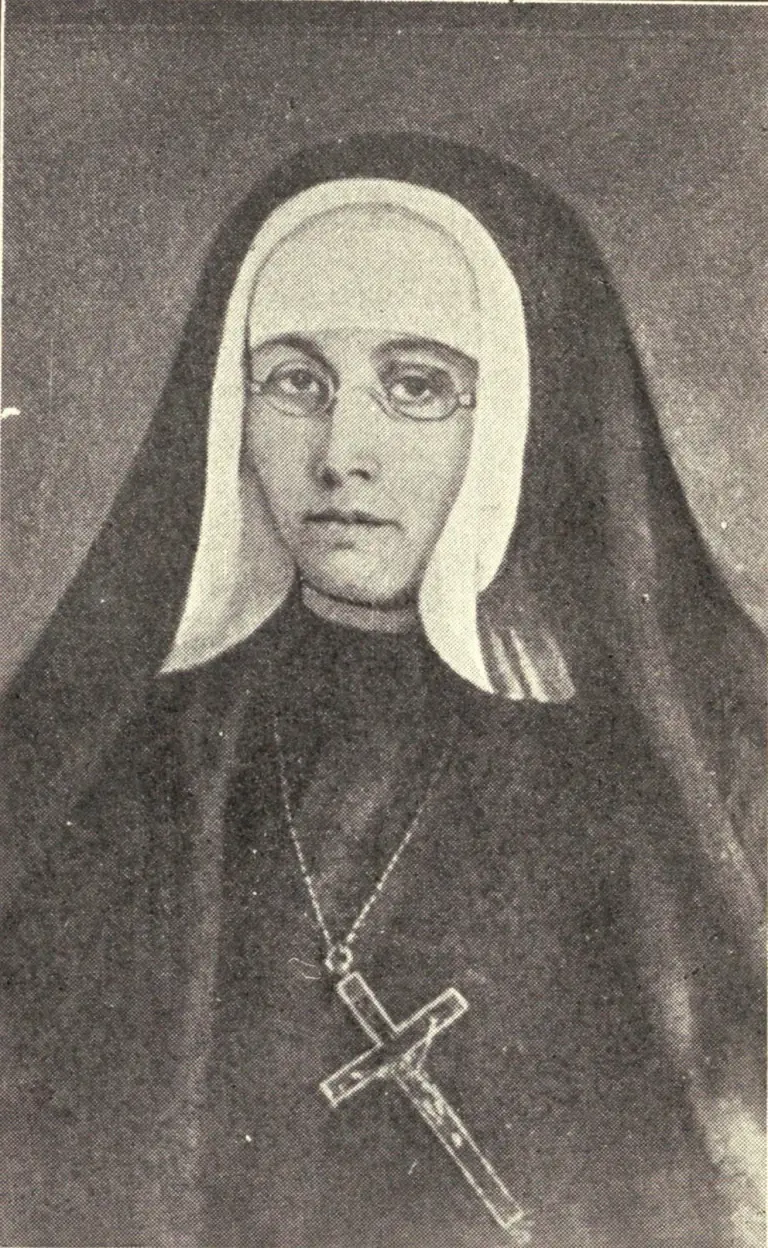
- Died
- October 6, 1849, six years after the founding at Longueuil 1
- Before religious life
- Thirteen years as housekeeper and parish worker in her brother's rectory at Beloeil 12
Blessed Marie Rose Durocher wanted to be a nun at sixteen and was kept out by her health, then spent thirteen years running her brother's rectory. 12 At thirty-two, pressed by her bishop and her spiritual director and against her own reluctance, she founded the Sisters of the Holy Names of Jesus and Mary to teach girls in the poor country parishes around Montreal. 12 She lived six more years. By the time John Paul II beatified her in 1982, the congregation was at work in six countries. 12
A large family near Montreal
Franciscan Media opens her story with the size of the Church she was born into. For the first eight years of her life, Canada was a single diocese from coast to coast, and its half-million Catholics had received civil and religious liberty from the English only forty-four years before. 1
She was born Eulalie Durocher in 1811, in a small village near Montreal, the tenth of eleven children. 13 John Paul II described the household as a large family that gave many of its members to consecrated life. 2 She had a good education, was something of a tomboy, rode a horse named Caesar, and by Franciscan Media's account could have married well. 1
At sixteen she wanted to enter religious life and had to give the idea up because of her weak constitution. 1 The homily is more specific about the closed door. Quebec then had only two congregations of women, and with her poor health she could enter neither of them. 2
Thirteen years at Beloeil
Her mother died when she was eighteen. Her brother, a priest, invited her and their father to join him in his parish at Beloeil, not far from Montreal. 1 She stayed thirteen years, as housekeeper, hostess and parish worker, and became known for her graciousness, courtesy, leadership and tact. People called her "the saint of Beloeil." 1
It was not an easy house. Franciscan Media records two years in which her brother treated her coldly, and wonders whether she was too tactful about it. 1
John Paul II gave those years more weight than a biographer usually gives a housekeeper. Today, he said, she would be called a priest's helper, and the work went well beyond keeping the house in order: she took in sick priests and seminarians, directed the charitable works of the parish, and encouraged the girls of the parish in their devotion to Mary. 2
A founder who did not want to be one
When she was twenty-nine, Ignace Bourget became bishop of Montreal. 1 He had too few priests and sisters and a rural population that had largely gone without schooling, and like the American bishops of the time he went looking in Europe for help. 1 Franciscan Media counts four communities that he founded himself, the Sisters of the Holy Names of Jesus and Mary among them, and calls Marie-Rose its first sister and "reluctant co-foundress." 1
As a young woman she had hoped that one day every parish would have its teaching sisters. She never imagined founding the community herself. 1 Her spiritual director, the Oblate Father Pierre Telmon, guided her thoroughly and severely, and it was he who urged her to do it. Bishop Bourget agreed. She shrank from it: her health was poor, and her father and brother needed her. 1
The homily tells the same events with the weight placed differently. In John Paul II's account she founded the congregation at the request of the bishop of Montreal, with the encouragement of the Oblates of Mary Immaculate and on the model of the Brothers of the Christian Schools, to answer the need for schooling and religious education among girls, above all in the poor countryside around Montreal. 2 He made a point of the order of things. The Church's leaders discerned what she could do and gave her the mission, and genuine apostolic work, he said, is a matter of the Church's call and not only of personal gifts. 2
The 1911 Catholic Encyclopedia supplies the pattern she followed. Three Canadian women, Eulalie Durocher, Henriette Céré and Mélodie Dufresne, were trained under Father J. Allard according to the Institute of the Holy Names of Jesus and Mary that Bishop Eugène de Mazenod had established at Marseilles. 3 The Marseilles community gave the new congregation its name, and its habit and rule with some changes. 3
Longueuil
In the end she agreed. With her two friends she moved into a small house at Longueuil, across the Saint Lawrence from Montreal, where thirteen girls were already gathered for a boarding school. 1 The three took simple vows there on December 8, 1844, and she became Sister Marie-Rose. 3 Bishop Bourget gave the institute diocesan approval and appointed her superior general for life. 3 The congregation was incorporated by act of parliament the following March. 3
Franciscan Media says Longueuil became her Bethlehem, Nazareth and Gethsemane, and lists what filled the six years she had left: poverty, trials, sickness and slander. 1 The qualities formed in the quiet years came into the open, a strong will, intelligence, common sense and great inner courage, together with great deference to those who directed her. 1 Under her the congregation grew quickly, and she laid out a course of study that served English-speaking and French-speaking pupils equally. 3
She was severe with herself and, by present standards, strict with her sisters. 1 John Paul II described the same woman from the other side. She acted with simplicity, prudence, humility and serenity, and neither her health nor the early troubles of the work stopped her. Her secret, he said, was prayer and a forgetfulness of self that her bishop judged to be true holiness. 2
Her death
On her deathbed the prayers most often on her lips were "Jesus, Mary, Joseph! Sweet Jesus, I love you. Jesus, be to me Jesus!" 1 Before she died she smiled and said to the sister beside her, "Your prayers are keeping me here—let me go." 1
She died on October 6, 1849. Franciscan Media gives the same day and month for her birth, which would make it her thirty-eighth birthday. 1
What grew from Longueuil
Pius IX praised the institute by decree in 1863, and its constitutions received final approval in 1901. 3 The sisters reached the United States early. In 1859 Archbishop Blanchet of Oregon City obtained twelve of them for his diocese, and a few years later they were invited to Seattle. 3 A California province was founded at Oakland in 1868, a New York province came to include Florida, and the Ontario province took on parochial schools in Detroit and Chicago. 3 By 1910 the congregation had 1,257 professed sisters and ran ninety-nine schools with more than twenty-four thousand pupils, forty-eight of those schools in the United States. 3
John Paul II beatified her on May 23, 1982, when he proclaimed five new blesseds, among them another Canadian, Brother André Bessette. 2 He introduced her as "une autre figure très apostolique", another deeply apostolic figure, and said that in six short years she had set the work going well enough that it was flourishing in six countries. 2
What is Blessed Marie Rose Durocher the patron saint of?
None of the sources used for this profile names a patronage for her, and this page does not supply one. 1234
What the homily says about the blessed in general is more modest and more exact. By beatifying them, John Paul II explained, the Church declares that they may be invoked and prayed to in the particular Churches, because it is sure they already share in eternal happiness with Christ. 2
Blessed Marie Rose Durocher's feast day
Her feast is October 6, the day she died. 1 In the United States it is an optional memorial on the proper calendar of the American dioceses, listed as "Blessed Marie Rose Durocher, Virgin." 4 It shares the day with Saint Bruno, and the USCCB calendar for 2026 offers both. 4
Franciscan Media places her entry under October 13 in its Saint of the Day series, but states that "her liturgical feast is celebrated on October 6." 1
Praying with Blessed Marie Rose Durocher
Most of her adult life was the waiting. She gave up the convent at sixteen and spent thirteen years in a rectory doing work that was useful and largely unseen, with two of those years spent under a brother who was cold to her. 12 The congregation came at thirty-two, and only after other people had seen in her what she did not see in herself. 12
She did not want it. Her reasons were good ones: she was ill, and her family relied on her. 1 John Paul II drew from that the lesson that real apostolic work is received from the Church as well as chosen. 2 It is a hard thing to say to someone who would rather stay where she is, and the sources do not pretend it was easy for her.
Franciscan Media admits that its readers squirm at the penances of people like her, and does not explain them away; it says that some deliberate self-denial is part of answering the call to turn completely to God. 1 She was severe with herself and strict with her sisters, and her bishop still judged her holy. 12 Both of those are on the record.
At the end she was praying the three names, and then she asked to be let go. 1 It is a strange and gentle last request from a woman who had spent her life being kept by other people's needs.
Blessed Marie Rose Durocher, pray for us.
Sources
- 1."Blessed Marie-Rose Durocher," Saint of the Day, Franciscan Media.
- 2.John Paul II, Homily at the Mass for the beatification of five new Blesseds, May 23, 1982 (the passage on Marie-Rose Durocher in the original French, with an Italian translation). The Holy See.
- 3.Marie Madden, "Sisters of the Holy Names of Jesus and Mary," The Catholic Encyclopedia, Vol. 10 (New York: Robert Appleton Company, 1911).
- 4."Proper Calendar for the Dioceses of the United States of America," in Liturgical Calendar for the Dioceses of the United States of America 2026, United States Conference of Catholic Bishops.
Saints to turn to next
Others in this collection who are turned to for some of the same things.
- Saint Hilda of Whitby614 - November 17, 680Study and teachingDiscernmentSuffering and illness
- Saint Aelred of Rievaulx1109 - January 12, 1166 (or 1167)Suffering and illnessStudy and teaching
- Saint AgathoDied January 10, 681DiscernmentStudy and teaching
- Saint Aldegundc. 630 or c. 639 - 684Suffering and illnessDiscernment