Saint Willibrord
658 - November 739
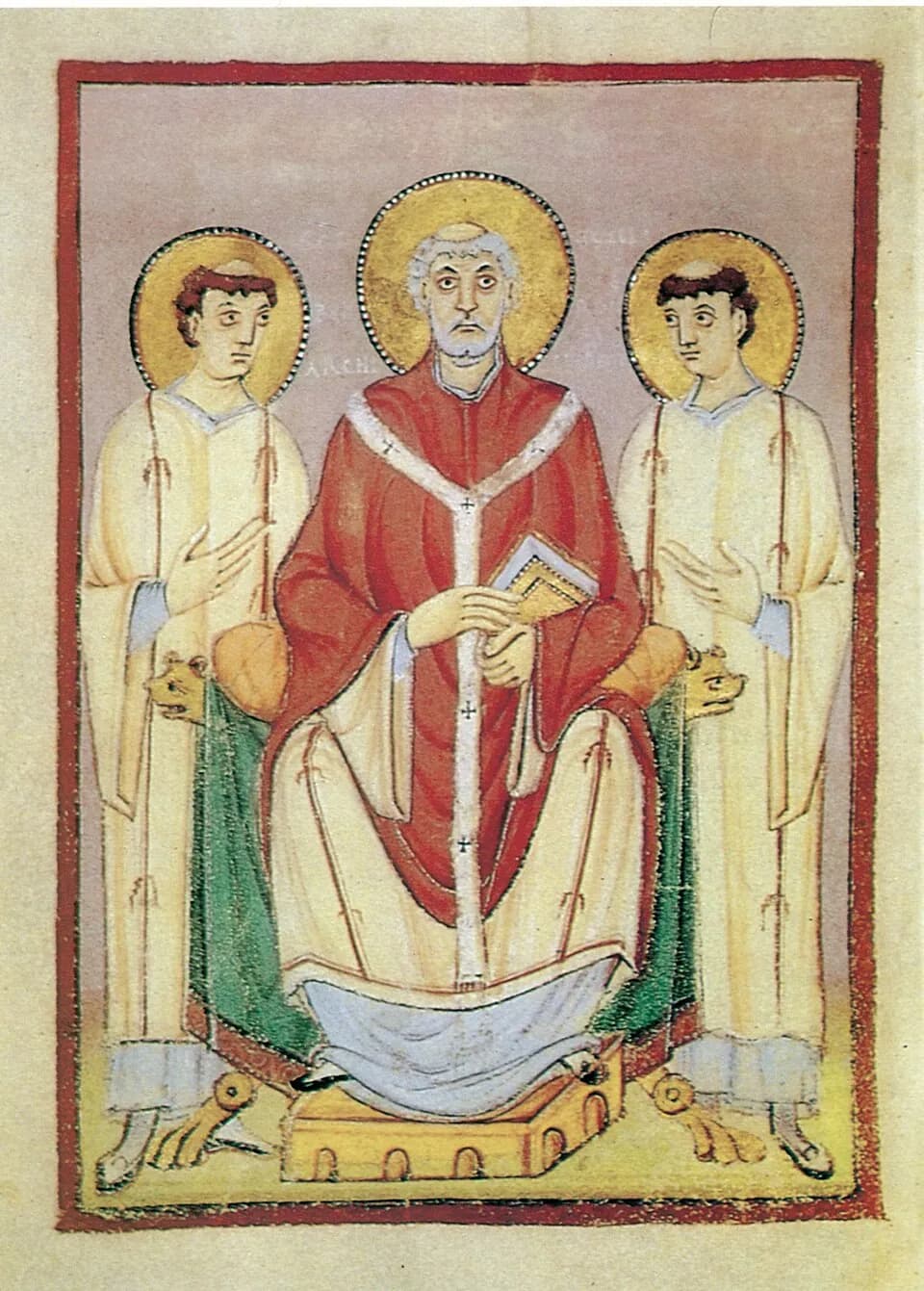
- Feast day
- November 7 156. In England, by order of Leo XIII, November 29, according to the 1912 Catholic Encyclopedia 1
- Consecrated
- In Rome by Pope Sergius, who named him Clement: 21 November 695 per Mershman, 696 per Bede 13
- Founded
- The abbey of Echternach, in present-day Luxembourg, in 698, which he ruled as abbot while bishop 12
- Invoked
- The Echternach dancing procession is made "to avert epilepsy, St. Vitus's dance, convulsions, and all nervous diseases" 2
Saint Willibrord was a Northumbrian monk who crossed to the mouth of the Rhine with eleven companions around 690 and spent the rest of his life preaching to the Frisians. 134 The pope consecrated him bishop and renamed him Clement; he made Utrecht his see, founded the abbey of Echternach, and is still called the Apostle of the Frisians. 136 For centuries the town of Echternach has danced to his tomb on the Tuesday after Pentecost. 2
Ripon, and twelve years in Ireland
He was born in Northumbria in 658. 1 His father, Wilgils, whom Mershman calls Hilgis, gave up "his worldly career" for the monastic life and ended as a hermit on the headlands between the North Sea and the Humber, where the king gave him land for a church. 14 Alcuin, his biographer, later had charge of that church. 4
Alcuin also tells the story of his mother's dream: she saw a new moon grow to the full and fall into her mouth, and a priest told her it was the son she had conceived, who would "disperse the murky darkness of error with the light of truth." 4
As a small child he was given to the monastery at Ripon, where he studied under Saint Wilfrid and made his profession as a monk. 14 At twenty he went to Ireland, drawn, Alcuin says, by its schools and by the hermit-bishop Egbert, and stayed twelve years at the abbey of Rathmelsigi. 14
Twelve men at the mouth of the Rhine
Egbert had meant to preach on the Continent himself and was stopped, Bede says, by a vision and a storm; his companion Wictbert preached in Frisia for two years and "reaped no fruit". 3 So Egbert sent others, "among whom was Wilbrord, a man eminent for his merit and rank in the priesthood." 3 Alcuin puts the decision in Willibrord's thirty-third year: he "considered it of little value to labour at his own sanctification unless he could preach the Gospel to others." 4
They were twelve. 34 They landed at the mouth of the Rhine and went up to Utrecht, found the Frisians and their king, Radbod, still pagan, and turned south to Pepin, duke of the Franks. 14 Pepin, who had just conquered the nearer part of Frisia, sent them there under his protection. 3
Almost at once Willibrord went to Rome, Bede says, to ask the pope's "licence and blessing" and to bring back relics for the churches he meant to build on the sites of the idols. 3 Mershman dates that first journey 692. 1
Clement, bishop of the Frisians
A few years later Pepin sent him back to Rome to be made a bishop. 13 Alcuin says Willibrord refused at first, saying he fell short of what Saint Paul requires of a bishop, and gave way only when his companions sided with the duke. 4
The sources do not agree on the details of what happened there. Mershman says he was consecrated "Bishop of the Frisians" on 21 November 695 in the church of Saint Cecilia, given the name Clement, and given the pallium. 1 Bede makes it archbishop, puts it in 696, also in Saint Cecilia's church "on her feastday", and says he was sent home fourteen days after he arrived. 3 Alcuin also says archbishop, and places the ceremony in "the church of blessed Peter". 4
Pepin gave him the fortress at Utrecht for his see. 3 Mershman adds that he founded a monastery there to train future missionaries and built a church of the Holy Savior as his cathedral. 1 In 698 he founded an abbey at Echternach, on the Sure, on an estate given him by Saint Irmina, daughter of King Dagobert II. 12 Although he was a bishop, he ruled it as abbot until he died. 2
Fositeland
He went past the edge of Frankish power too. Alcuin says Radbod received him kindly and refused to believe, and that among the Danes he found nothing to work with and came home with thirty boys, baptizing them on the voyage in case they died at sea. 4 Mershman: no success in Denmark or Helgoland. 1
Helgoland is Alcuin's Fositeland, an island sacred to a god called Fosite, where no one would touch the cattle and the spring could be drawn from only in silence. 4 Storm-bound there, Willibrord baptized three people in the spring and had cattle slaughtered for his men. 4 Radbod cast lots three times a day for three days to choose who should die for it. The lot fell on one of the company, "who thus won the martyr's crown." 4
Willibrord told the king that what he worshiped "is not a god but a devil". Radbod answered: "It is clear to me that my threats leave you unmoved and that your words are as uncompromising as your deeds." He did not convert, and he sent Willibrord back to Pepin with honor. 4
Losing Frisia, and Boniface
Then Pepin died, and Radbod took all of Frisia: in 716, by Mershman's date, or 715 by Loyola Press's. 16 Willibrord had to leave. Radbod destroyed most of the churches, put up temples to the idols in their place, and killed many of the missionaries. 1
He kept working at the edges, in Brabant and Thuringia. 1 When Radbod died, he went back in 719 and began to repair the damage, helped by a younger Englishman, Winfrid, later called Boniface. 1 The encyclopedia's article on Boniface says he spent three years "under the aged St. Willibrord", and that Willibrord, "feeling the weight of his years", asked him to become his assistant and successor at Utrecht. Boniface refused, "giving as his main reason that the pope had sent him for missionary work." 7
Alcuin adds miracles, among them a spring of fresh water from the sand for his thirsty companions, and an idol-keeper on Walcheren whose sword blow to his head did him no harm. Willibrord stopped his companions from killing the man. 4
Echternach
He retired often to Echternach "to provide more particularly for his own soul", and died there. 1 Alcuin gives the date as the sixth of November. 4 Mershman gives 7 November 739. 1 His own encyclopedia article on Boniface, written five years earlier, says Willibrord died in 744. 7 Bede, writing while he was still alive, describes him as "venerable for old age, having been thirty-six years a bishop." 3
He was buried at Echternach and was honored as a saint almost at once; Alcuin already records healings at the tomb. 14 Only a marginal note in the Echternach calendar can certainly be called his own writing. 1
The dancing procession is the thing Echternach is known for. Alston writes that its origin "cannot be stated with certainty": fifteenth-century documents treat it as an established custom, and before that "there is only tradition." 2 He calls the story of a cattle plague in 1347, cured when the people imitated the animals' trembling while praying to Willibrord, "the legend". 2 The dancers go three steps forward and two back, and dance around the tomb before Benediction. 2 Mershman records 15,085 dancers in 1906. 1 Alston, writing in 1909, called it "curious and even somewhat ludicrous" and added that the people "perform it in all seriousness and as a true act of devotion." 2
What is Saint Willibrord the patron saint of?
None of the sources used here names him patron of anything. He is called the Apostle of the Frisians, because he brought the faith to them and, after Radbod's destruction, brought it back. 16
What the sources do record is an invocation. Alston says the Echternach procession is now made "as an act of expiation and penance on behalf of afflicted relations and especially in order to avert epilepsy, St. Vitus's dance, convulsions, and all nervous diseases." 2
Saint Willibrord's feast day
The feast of Saint Willibrord is November 7. 156 The 1912 Catholic Encyclopedia notes that in England it was kept on November 29, by order of Leo XIII. 1
The day of his death is not settled. Alcuin says he died on the sixth of November; Mershman gives the seventh. 14 The year is unsettled too: 739 in Mershman's article on Willibrord and at Loyola Press, 744 in Mershman's article on Boniface. 167
The Echternach procession is a separate celebration. It falls on Whit Tuesday, the Tuesday after Pentecost, and has done so since 1830. 2
Praying with Saint Willibrord
Most of his life was spent in places that kept being undone. He arrived in Frisia after Wictbert had preached there for two years and "reaped no fruit". 3 Some twenty-five years later Radbod pulled down most of the churches he had built and killed many of the missionaries, and Willibrord, by then nearly sixty, had to leave. 1 He went back when he could and started the repairs. 1 The sources do not say what he felt about it. They record that he went back.
He did not try to do it alone. He came with eleven others, founded a monastery at Utrecht to train the missionaries who would come after him, and wanted Boniface as his successor, though Boniface said no. 147 A bishop with a cathedral also kept an abbey, and, Mershman says, went back to it to look after his own soul. 12
Alcuin's Life is full of miracles, but one scene in it is about restraint. When the keeper of the idol on Walcheren hit him with a sword, his companions went to kill the man, and Willibrord let him go. 4 On Fositeland he told a king who had just had one of his company killed exactly what he thought of the king's god. 4 Both scenes are in the same Life.
And there is Echternach, where for centuries people have danced three steps forward and two back to his tomb on behalf of relatives with epilepsy and other nervous illnesses. 2 Alston thought it ludicrous, and said in the same sentence that the people mean it as a true act of devotion. 2 Joseph II abolished it in 1786, and it was started again in 1802. 2
Saint Willibrord, pray for us.
Sources
- 1.Francis Mershman, "St. Willibrord," The Catholic Encyclopedia, Vol. 15 (New York: Robert Appleton Company, 1912).
- 2.George Cyprian Alston, "Abbey of Echternach," The Catholic Encyclopedia, Vol. 5 (New York: Robert Appleton Company, 1909).
- 3.Bede, The Ecclesiastical History of the English Nation (c. 731), Book V, chapters 10-11, translation attributed to L. C. Jane (London: J. M. Dent, 1910), in the Internet Medieval Sourcebook (Fordham University).
- 4.Alcuin, The Life of Willibrord (c. 796), translated by C. H. Talbot, The Anglo-Saxon Missionaries in Germany (London and New York: Sheed and Ward, 1954), in the Internet Medieval Sourcebook (Fordham University).
- 5."St. Willibrord, Bishop of Northern Europe," Saint of the Day, 7 November, Vatican News.
- 6."Saint Willibrord," Saints Stories for All Ages, Loyola Press, from Bert Ghezzi, Voices of the Saints.
- 7.Francis Mershman, "St. Boniface," The Catholic Encyclopedia, Vol. 2 (New York: Robert Appleton Company, 1907).
Saints to turn to next
Others in this collection who are turned to for some of the same things.
- Saint Andrew Kim TaegonAugust 21, 1821 - September 16, 1846CourageSuffering and illnessWork and vocation
- Saints Cosmas and DamianMartyred c. 287, or in the early fourth centuryWork and vocationSuffering and illnessCourage
- Saint Damien of MolokaiJanuary 3, 1840 - April 15, 1889Suffering and illnessCourageWork and vocation
- Saint Gianna Beretta MollaOctober 4, 1922 - April 28, 1962Work and vocationCourageSuffering and illness