Saint Valentine
Martyred in the third century, or the fourth by one account
- Patron saint of
- Lovers 34, marriages and engaged couples 4; some traditions add beekeepers and people with epilepsy 4
- Who he was
- At least three martyrs named Valentine are recorded under February 14: a priest at Rome, a bishop of Terni, and one in Africa 1
- Died
- Second half of the third century according to the 1912 Catholic Encyclopedia; around 270 for the priest and 346-347 for the bishop according to Vatican News 12
- Buried
- On the Flaminian Way outside Rome 12; the bishop afterward at Terni, according to Vatican News 2
- Liturgical calendar
- Removed from the universal calendar by Paul VI in 1969, according to Catholic Answers 4
- Historical record
- The 1912 Catholic Encyclopedia calls the surviving Acta "of relatively late date and of no historical value" 1
Saint Valentine was a Christian martyr of early Rome, venerated on February 14, and almost nothing else about him can be stated as history. The early martyrologies record at least three martyrs of that name on that day, and the 1912 Catholic Encyclopedia says the accounts of the two best known are "of relatively late date and of no historical value." 1 What is secure is the name, the date, a burial on the Flaminian Way outside Rome, and a devotion old enough to have given its name to a city gate. 14 His link to lovers came much later, from a medieval belief that birds choose their mates in mid-February. 15
One saint, two, or three
Herbert Thurston's article in the 1912 encyclopedia finds "at least three different Saint Valentines, all of them martyrs," in the early martyrologies under February 14. 1 One is described as a priest at Rome. A second was bishop of Interamna, the modern Terni. The third suffered in Africa with a number of companions, and of him "nothing further is known." 1
Thurston places the two Italians in the second half of the third century and says both were buried on the Flaminian Way, "but at different distances from the city." 1 In the time of the chronicler William of Malmesbury, the old Flaminian Gate of Rome, now the Porta del Popolo, was known as the Gate of Saint Valentine, a name that probably came from a small church of his nearby. 1
Today's Roman Martyrology lists two Valentines on February 14, according to Vatican News and Catholic Answers: the Roman priest and the martyr of Terni. 245 Vatican News goes further and argues that the two "are one and the same person," since both stories involve a healing, conversions, and a beheading on the Via Flaminia. 2 Catholic Answers is more cautious, noting that some scholars think the two are one man and others think there was more than one Valentine. 4 This page does not choose between them.
The stories told about him
Thurston says of both Italian Valentines that "some sort of Acta are preserved," but that they are late and historically worthless. 1 Vatican News retells them, and they are worth knowing as the stories the Church has carried, as long as they are read as stories.
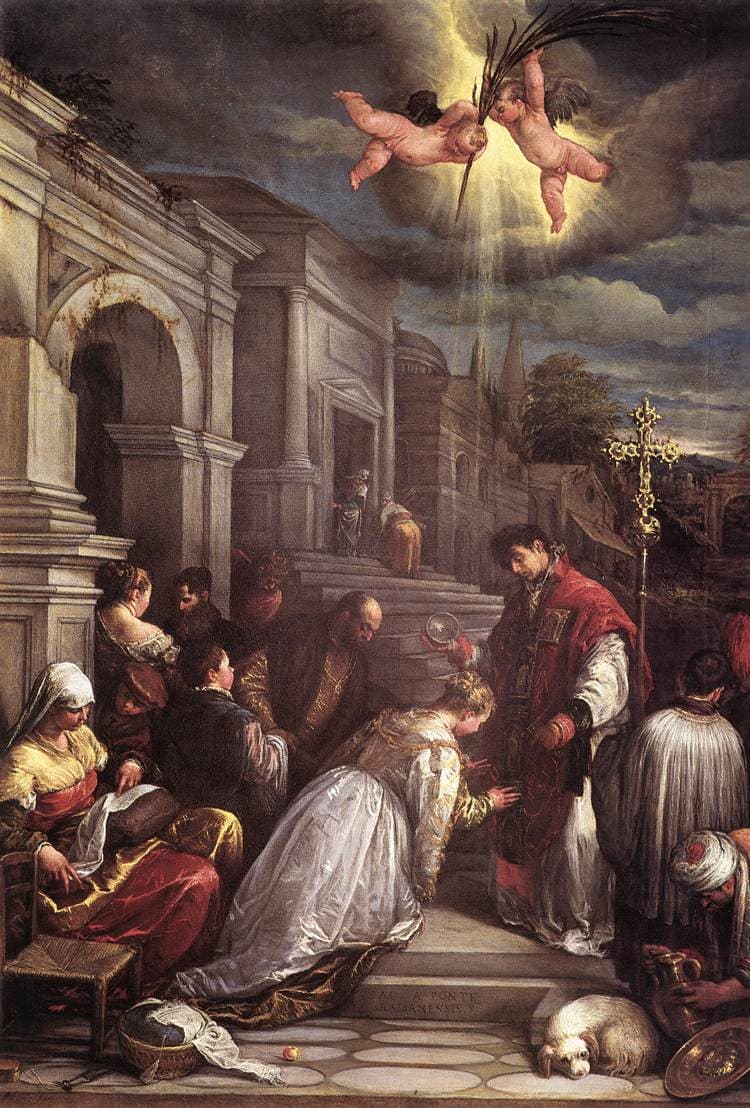
In the first, Valentine is a Roman priest under the emperor Claudius Gothicus, around the year 270. The emperor, curious about his reputation, invites him to the palace and urges him to worship the gods; Valentine refuses. He is handed over to a nobleman, Asterius, to be argued out of his faith. Asterius has a daughter who has been blind since the age of two. Valentine prays over her, she sees, and the whole household is baptized. The emperor has Valentine beheaded on the Via Flaminia, and a church was soon built there in his honor. 2
In the second, Valentine is bishop of Terni, called to Rome by the rhetorician Crato, whose son Chaeremon is so deformed that he must hold his head between his knees. Crato offers half his wealth for a cure. Valentine tells him through a long night that faith in God, not money, will heal the boy, and then prays over him. Crato's family is baptized, and so are several students, among them the son of the prefect Placidus. The prefect has Valentine beheaded at night on the Via Flaminia. Three of the students carry the body home to Terni and are themselves beheaded there. 2 Vatican News dates this martyrdom to 346 or 347, the years Placidus held office, which would put the two Valentines about seventy years apart. 2
Catholic Answers tells a version in which the healed girl is the daughter of Valentine's jailer, and adds two more stories: that he secretly married Christian couples in defiance of a ban by Claudius II on marriage for young men, and that before his death he left the girl a note signed "From your Valentine." 4 It gives his execution as February 14, 269, outside the Flaminian Gate. 4 It also says plainly that "these stories are legendary." 4
How February 14 came to be about love
None of the sources connects Valentine himself with romance. Jimmy Akin of Catholic Answers is direct about it: the association "has nothing to do with the two saints, neither of whom had a clear connection to lovers or courtship." 5
The explanation Thurston gives is a belief common in medieval England and France that birds began to pair on February 14, halfway through the second month. 1 He quotes Chaucer's Parliament of Foules: "For this was sent on Seynt Valentyne's day / Whan every foul cometh ther to choose his mate." 1 From there the day became an occasion for love letters and lovers' tokens, and the people who chose each other seem to have been called each other's Valentines. 1 Thurston cites a fifteenth-century letter from the Paston family in which a young woman addresses her suitor as "my rightwell beloved Valentine." 1 Vatican News agrees on Chaucer and the birds, and adds that the Benedictines, who kept his church at Terni in the Middle Ages, spread the observance through their monasteries in France and England. 2
Franciscan Media gives a different origin, saying the day's roots "lie in the ancient Roman fertility festival Lupercalia," held on February 15, and mentions the birds only as another legend. 6 The Catholic Answers tract holds both: it credits the birds and Chaucer, and also says Pope Gelasius I established the feast in 496 and "reportedly" chose the date partly to turn attention away from the Lupercalia. 4 The encyclopedia does not mention the Lupercalia at all. 1
What is Saint Valentine the patron saint of?
Vatican News calls Saint Valentine "the patron saint of lovers and of the town of Terni." 3 Catholic Answers names him patron of lovers, marriages and engaged couples, and adds that "some traditions" link him with beekeepers and with people who suffer from epilepsy. 4 Both sources describe the patronage of lovers as following from the medieval custom rather than from anything in his life. 25
Saint Valentine's feast day
His feast falls on February 14. 34 That is the date under which the early martyrologies record him, and the date under which the Roman Martyrology lists him today. 12
According to Catholic Answers, Pope Paul VI removed him from the universal liturgical calendar in 1969 because the details of his life are historically uncertain, and the Church now principally celebrates Saints Cyril and Methodius on February 14. 4 The same source says his feast remains one on which a priest may celebrate Mass in his honor, "depending on the local liturgical calendar and a priest's pastoral judgment." 4 Vatican News lists both Cyril and Methodius and Valentine under February 14. 3
Catholic Answers also notes that his name appears in the Depositio Martyrum, a Roman list dating back at least to 354, and takes it as good evidence that the early Christians really did venerate a saint called Valentine. 4 Valentine's Day is not a holy day of obligation. 4
Praying with Saint Valentine
The honest starting point is that we do not know much. There was a martyr, perhaps two or three, and Christians at Rome remembered him on this day. 14 A church of his stood close enough to one of the city gates that the gate came to carry his name. 1 The rest arrived later, and the Church's own historians have said so for over a century. 1
What the stories hold onto, even as stories, is a man who prays over someone else's child. A blind girl in one version, a boy bent double in the other, and in both the conversion of an entire household and a death on the Flaminian Way. 2 Catholic Answers reads them as showing "his courage of faith" and his love for God and neighbor. 4
The love that February 14 now celebrates came from Chaucer and the birds, not from anything recorded of his life. 15 That leaves couples who pray to him in an odd but not unreasonable position. They are asking the help of a man remembered chiefly for dying rather than give up his faith 4, and whose feast happened to fall on the day the birds were thought to pair.
He was taken out of the universal calendar because so little could be said for certain, and yet he is still invoked and Mass may still be said in his honor where the local calendar allows. 4 Nothing on this page has been added to the record in order to make the devotion easier.
Saint Valentine, pray for us.
Sources
- 1.Herbert Thurston, "St. Valentine," The Catholic Encyclopedia, Vol. 15 (New York: Robert Appleton Company, 1912).
- 2."St. Valentin, Martyr on the via Flaminia," Saint of the Day, Vatican News.
- 3."14 February," Saint of the Day, Vatican News.
- 4."Saint Valentine: Catholic Answers Guide to Valentine's Day," Catholic Answers, 2026.
- 5.Jimmy Akin, "Who was Saint Valentine, and how did his feast day of February 14 come to be regarded as a day for romance?" Catholic Answers, 2020.
- 6.Susan Hines-Brigger, "Who Was St. Valentine?" Franciscan Spirit, Franciscan Media, May 14, 2020.
Saints to turn to next
Others in this collection who are turned to for some of the same things.