Saint Theodosius the Cenobiarch
c. 423 - January 11, 529
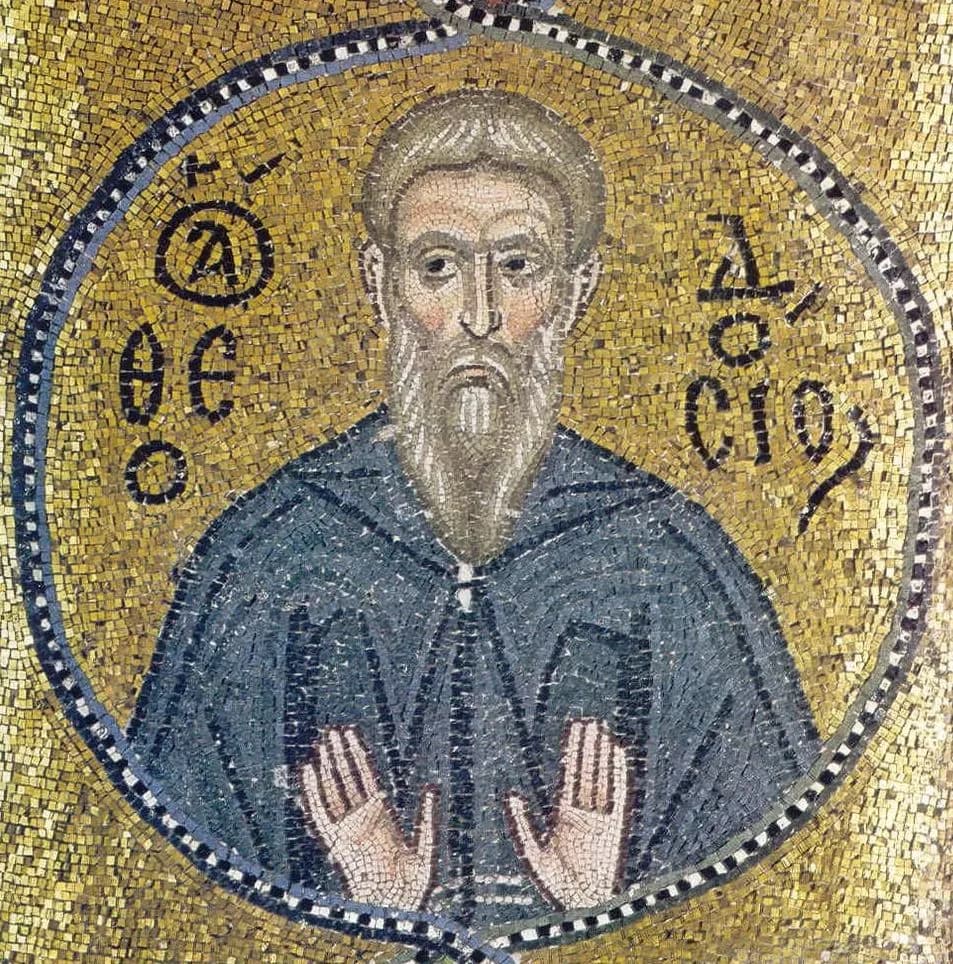
- Office
- From 493, archimandrite over all the cenobites of Palestine 1
- Emblems
- A money box and an hourglass 1
Saint Theodosius the Cenobiarch was a monk from Cappadocia who founded a great monastery in the Judean desert near Bethlehem, and in 493 was made head of all the monks in Palestine who lived in community, as his friend Saint Sabas was made head of the hermits. 123 He fed the poor at his gates, built hospitals beside his churches, and defied an emperor over the Council of Chalcedon. 13 He died in 529 at the age of one hundred and five. 13
From Cappadocia to Jerusalem
Theodosius was born about 423 at Garissus in Cappadocia, to devout Christian parents, according to the Norwegian bishops' saints database (katolsk.no). He was made a lector, and Catholic.net's life says he explained the Scriptures to the people. 13 Moved by the example of Abraham, who left his country and his kin, he set out for Jerusalem at about thirty. 1
On the way he turned aside to see Simeon Stylites on his pillar near Antioch. Catholic.net tells how Simeon greeted him by name before they had met, called him a man of God, had him climb up the column, and told him what lay ahead; katolsk.no says simply that Simeon advised him about the course of his life. 13
After the holy places of Jerusalem he looked for a guide, and put himself in the care of a holy monk named Longinus, who grew very fond of him. 1 A wealthy woman had built a church of Our Lady on the road to Bethlehem and needed someone to lead its community. Longinus thought Theodosius the right man, and it took a direct order to make him accept. 1
The cave and the monastery
He did not stay long. He wanted to live alone, and withdrew to a cave on a nearby mountaintop, where katolsk.no says he wept daily for his sins, lived on date stones and herbs, and ate no bread for thirty years. 1 Disciples came anyway. He tried to keep their number down, but could not bring himself to send anyone away, and in the end took charge of them all. 12
The first rule he gave them was to keep death always in mind. katolsk.no says he had a large tomb set up near the hermitage so that everyone could prepare for their own death, which is why he is shown with an hourglass. 1 When the mountain grew too crowded, he built a large monastery in the Judean desert, at a place called Cathismus near Bethlehem. katolsk.no suggests that as a Cappadocian he knew Saint Basil's teaching on common life and was drawn to it more than to the hermit's life most admired in his day. 1 The Martyrology says that after a long life of solitude he gathered many disciples and practiced the common life in monasteries he built himself. 2
Several hundred monks soon lived there. He divided them by language, Greeks, Armenians and Arabs, with a church for each, where the readings and prayers were in their own tongue, and all came together for the Eucharist in Greek. 1 A fourth church served those doing penance and those recovering from mental illness. 1 He attached three hospitals to the monastery, one for the old, one for the physically sick and one for the mentally ill, and Catholic.net's life says he served the sick himself and kissed their sores. 13
A hundred tables
Nobody was turned away without a meal, however little the monks had. 1 Catholic.net's life tells of a hundred tables laid in a single day, and of a famine in which the brothers in charge of the gate shut it on the hungry; Theodosius ordered it opened and everyone fed, and the bread bins, it says, were full afterward. 3 It adds that his disciples included rich and powerful men, soldiers and scholars, many of whom became bishops and superiors, and that six hundred and ninety-three of them had died before he did. 3
In 493 Sallust, patriarch of Jerusalem, made Sabas archimandrite over the monks of Palestine who lived alone and Theodosius archimandrite over those who lived in community, with the title of cenobiarch. 13 The two represented different traditions and lived in harmony. 1 The Martyrology names him simply as a friend of Saint Sabas. 2
Against the emperor
The emperor Anastasius favored the Monophysites, who rejected the Council of Chalcedon's teaching that Christ has two natures, and he wanted Theodosius on his side. 13 In 513 he removed the patriarch Elias of Jerusalem. katolsk.no says that when Elias's successor John showed signs of giving way, Theodosius and Sabas stood on either side of him and made him publicly condemn the heresy, and the imperial officers thought it wise to withdraw. 1
Anastasius then sent Theodosius a large sum of money, ostensibly for charity. He took it and gave it all to the poor. 13 When the emperor followed it with a heretical confession of faith to sign, Theodosius wrote back that he and his monks would rather die than give up the truth. 13 As persecution resumed, he went through Palestine, old as he was, urging people to hold to the four ecumenical councils; both sources report that he anathematized from the pulpit anyone who did not receive the four councils as they received the four Gospels. 13 The emperor exiled him. 13
The exile was short. katolsk.no says Anastasius died soon after, in 518, and his successor Justin recalled Theodosius, then about ninety-five. 1 Catholic.net's life says the emperor fell dead, struck by lightning. 3 The Martyrology records that he suffered much for the Catholic faith. 2
What is Saint Theodosius the Cenobiarch the patron saint of?
No patronage is recorded for Saint Theodosius the Cenobiarch in the sources consulted here. 123 katolsk.no says he is shown with a money box, because no gift could buy him, and an hourglass, because he kept death before his eyes all his life. 1 It adds that the oldest image of him is an eighth-century icon at Saint Catherine's Monastery on Sinai. 1
Saint Theodosius the Cenobiarch's feast day
Saint Theodosius the Cenobiarch's feast day is January 11, the day of his death. 123 In his last year he suffered a painful illness, which katolsk.no says he bore with great patience; he died on January 11, 529, near Bethlehem, at a hundred and five. 13 The patriarch of Jerusalem came to his funeral. 13 He was buried in his first cell, called the Cave of the Magi because the wise men were said to have camped there. 1 The Roman Martyrology enters him on January 11 as having rested in the peace of Christ at a hundred years old. 2
Praying with Saint Theodosius
He wanted to be alone and spent his life surrounded by people. Each time he withdrew, more came, and he could not make himself send them away. 1 The cave became a community, the community a monastery, and the monastery a small city with churches in three languages, three hospitals and a gate that was not to be shut on the hungry. 13
His first rule was the thought of death, and the hourglass he is painted with is meant seriously. 1 It did not make him gloomy or idle. A man who kept his own grave in view built hospitals for the old, the sick and the mentally ill, and is remembered for feeding a hundred tables in a day. 13
The same steadiness showed when the emperor tried to buy him. He took the money, gave it to the poor, and refused the signature. 13 He was past ninety when he was sent into exile for it, and he went back to his monks when it ended and lived more than ten years among them. 1
Saint Theodosius the Cenobiarch, pray for us.
Sources
- 1."Den hellige Theodosios Cenobiarken (av Betlehem) (423-529)," Den katolske kirke (katolsk.no), Catholic Diocese of Oslo (in Norwegian).
- 2.Roman Martyrology, entry for January 11, "San Teodosio, cenobiarca," as printed in "Santo del giorno," Conferenza Episcopale Italiana (in Italian).
- 3."Teodosio el Cenobita, Santo," Catholic.net, with the Roman Martyrology entry (in Spanish).
Saints to turn to next
Others in this collection who are turned to for some of the same things.
- Saint Aelred of Rievaulx1109 - January 12, 1166 (or 1167)PrayerSuffering and illness
- Saint Alphonsus Rodriguez1532 or 1533 - October 1617PrayerSuffering and illness
- Saint André BessetteAugust 9, 1845 - January 6, 1937PrayerSuffering and illness
- Saint Bernadette SoubirousJanuary 7, 1844 - April 16, 1879PrayerSuffering and illness