Saint Theodore of Tabennisi
c. 314 - April 27, 367 or 368
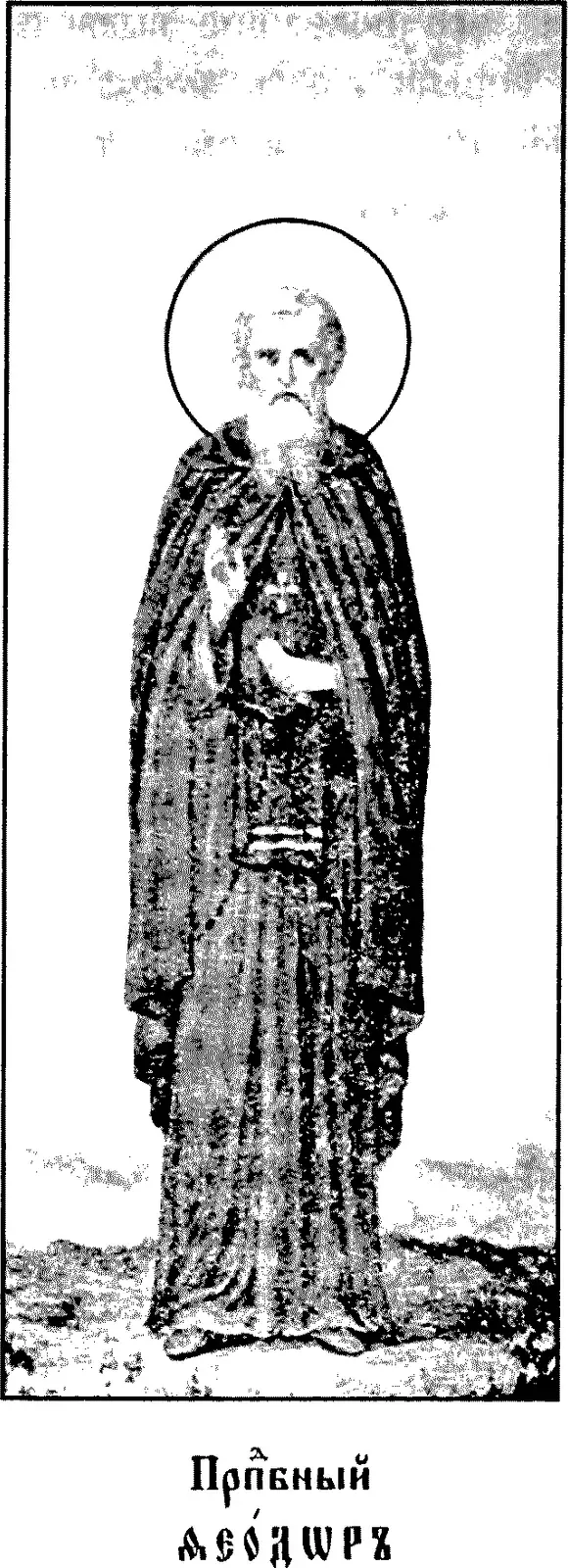
Saint Theodore of Tabennisi was the disciple Pachomius loved best, the young monk he trusted to govern the great monastery of Tabennisi and then removed from office for agreeing too quickly to become his successor. 14 Theodore took the demotion without complaint, spent two years in the lowest place in the community, and years later held the Pachomian monasteries together after the founder's death. 1 He died on April 27, 367 or 368, and his feast in the Roman Martyrology is April 27. 136
A boy from the Thebaid
Butler says he was born in the Upper Thebaid about 314, to illustrious and wealthy parents. 1 katolsk.no names the town as Sne, the modern Esna. 3 When he was eleven or twelve, on the feast of the Epiphany, he gave himself to God with a fervor Butler calls uncommon, and for two years he lived at home with his mother, fasting and praying and going every day to a grammar school. 1
At fourteen his mother let him leave the world. Butler says he finished his education among monks in the diocese of Latopolis; santiebeati, in a text from the monastery of Bose, says he embraced the solitary life very young in a monastery of the diocese of Shne. 14 katolsk.no says simply that at fourteen he became a monk and a disciple of Pachomius at Tabennisi. 3
santiebeati describes him as a radical young man who heard the stories told about Pachomius in monastic circles and set out for Tabennisi to see the father of the first Christian community of monks in Egypt. 4 Butler says that at Tabennisi he was soon among the foremost in that large company. 1
His mother followed him there. Theodore, afraid of being drawn back toward the world, asked Pachomius not to allow the meeting. Butler says she was edified rather than hurt, took the veil in a convent Pachomius had founded nearby, and sometimes had the joy of seeing her son among his fellow monks. 1
The favorite disciple
Pachomius made him his companion on the visitation of his monasteries when Theodore was twenty-five, had him ordained priest at thirty, and gave him the government of the great monastery of Tabennisi while he himself withdrew to the smaller house at Pabau. 1 Every evening Theodore walked to Pabau to hear Pachomius's talk to the monks and then repeated it to the community at Tabennisi. 1 santiebeati says Pachomius used him to recall the brothers to obedience, to explain the Scriptures, and to settle delicate matters. 4
On one journey a philosopher of Panopolis asked to debate with Pachomius. Pachomius sent Theodore instead, who answered all his questions and then told him to leave idle subtleties alone and make the science of salvation his study. 1
He suffered from constant, violent headaches. When some of the brothers asked Pachomius to pray for his healing, Pachomius answered, in Butler's words, "Though abstinence and prayer be of great merit, yet sickness, suffered with patience, is of much greater." 2 Butler repeats the lesson in Theodore's own life. 1
Two years in the last place
Two years before his death Pachomius fell sick at Pabau. The monks of Tabennisi, by pleading and tears, got Theodore to agree that he would take charge of the whole congregation when the founder died. 1 He gave in reluctantly. Pachomius afterward reproved him for it and removed him as superior of Tabennisi. 1
santiebeati puts it more sharply: Theodore "betrayed" Pachomius's trust, and for many years, even after the founder's death, he had to fight the temptation of pride and power that had come with his ascetic zeal from the start. 4 That is why, it says, he was not Pachomius's immediate successor. 4
Butler tells what he did next. Theodore accepted his dismissal "with joy," accused himself of vanity and presumption, and spent two years in the last rank of the community, below all the novices, embracing every humiliation in silence. 1 Butler thought this did him more good than all the great things he had done while he was in charge, and says Pachomius told others so. 1
Holding the koinonia together
Pachomius died in 348 by Butler's reckoning, in 346 by katolsk.no's. 13 katolsk.no says Pachomius told Theodore to bury his body secretly, in a place no one knew, because he did not want a shrine built over it. 3
What followed was not smooth. Butler says Petronius, named by Pachomius as his successor, died thirteen days after him; Orsisius was then chosen, found the burden too heavy and the congregation threatened by factions, and placed Theodore in charge, saying it was the founder's express order, and had to force him to accept. 1 katolsk.no says the monks elected Theodore in 350, and that he carried out the charge to everyone's satisfaction in the difficulties after the founder's death. 3 santiebeati counts him the third successor, governing a community torn by schisms. 4
He gathered the monks, appealed to them to be united, looked into the causes of their quarrels and dealt with them. 1 santiebeati says he learned in those years to carry his brothers' sin as his own and to stand with them in their failure, and that this is why the liturgy calls him "the Sanctified." 4 It quotes the prayer he made at Pachomius's tomb: "We have strayed from the paths of life, from your laws and your precepts, which you had given to our righteous father Pachomius, on whose holy body I now stand." 4
He did nothing without Orsisius. Butler writes that "where there was no pride, there no jealousy could arise," and that the two competed only in humility. 1 Together they visited the monasteries one after another; Theodore corrected faults gently and turned first to prayer and fasting when someone went astray. 1 katolsk.no says he also founded new monasteries in Egypt. 3
Letters, Athanasius, and the end
Butler records a letter Theodore wrote in 353 to the monks of Nitria foretelling the fall of Arian pride, a letter on keeping Easter devoutly, and three letters of instruction to his monks, mentioned by Gennadius, now lost. 1 He tells too of a day on the Nile when Theodore, in a boat with Saint Athanasius, assured him that his persecutor Julian the Apostate had just died. 1 katolsk.no records one of his miracles as an early example of blessed water used as a sacramental. 3
A monk died on Holy Saturday, and Theodore said another death would soon follow. At the end of the Easter octave, when all the monks had gathered at Pabau as was their custom, he preached to them, sent them home, and fell ill. 1 He commended the community to Orsisius and died on April 27: in 367, in his fifty-third year, according to Butler; in 368 according to katolsk.no, santiebeati and the Byzantine Catholic Menaion. 1345 He was buried on the mountain with the monks, and soon afterward laid beside Pachomius; Athanasius wrote to the monks of Tabennisi to console them. 1
What is Saint Theodore the patron saint of?
Saint Theodore's feast day
Saint Theodore's feast day is April 27. The current Roman Martyrology, as the Italian bishops print it, enters him on that day as the abbot at Tabennisi in the Thebaid who was a disciple of Saint Pachomius and father of the monastic community. 6 April 27 is the day of his death in Butler and in katolsk.no; the Bose text dates his death by the Coptic calendar, to the second day of the month of Pashons. 134
The older Roman Martyrology kept him on December 28, as Butler says, and katolsk.no still gives December 28 as his memorial. 13 The current Martyrology's entries for December 28 do not include him. 7 The Greeks keep him on May 16, and the Byzantine Catholic Menaion has his troparion and kontakion on that day. 15 santiebeati lists him on May 10 for the Eastern Churches. 4
Praying with Saint Theodore
The center of his story is a demotion. The man the monks wanted as their next abbot was removed by his own teacher and spent two years below the newest novices. 1 Butler says it was the best thing that happened to him, and santiebeati says the fight with pride did not end there. 14
The headaches did not go away either. Pachomius did not ask for them to be healed, and said why. 2
When the community was breaking apart after the founder's death, Theodore did not govern it as the favorite son returned. The prayer santiebeati quotes is said in the first person plural: "we have strayed." 4 He shared the work with Orsisius, who had been chosen before him. 1
The Greeks named him the Sanctified. 1 The sources agree that it took a long time. 14
Saint Theodore of Tabennisi, pray for us.
Sources
- 1.Alban Butler, "Saint Theodorus, Abbot of Tabenna, C.," December 28, in The Lives of the Fathers, Martyrs, and Other Principal Saints, Vol. XII (Derby: Thomas Richardson and Son, 1842).
- 2.Alban Butler, "St. Pachomius, Abbot," May 14, in The Lives of the Fathers, Martyrs, and Other Principal Saints, Vol. V (Derby: Richardson and Son, 1843).
- 3."Den hellige Theodor av Tabennísi («den hellige») (~314-368)," Den katolske kirke (Catholic Diocese of Oslo) (in Norwegian).
- 4."San Teodoro di Tabennesi," from the Monastery of Bose, Santi, beati e testimoni (santiebeati.it) (in Italian).
- 5."Menaion - May 16," Metropolitan Cantor Institute, Byzantine Catholic Archeparchy of Pittsburgh.
- 6.Roman Martyrology, entries for April 27, Santo del giorno, Conferenza Episcopale Italiana (in Italian).
- 7.Roman Martyrology, entries for December 28, Santo del giorno, Conferenza Episcopale Italiana (in Italian).
Saints to turn to next
Others in this collection who are turned to for some of the same things.
- Saint Carmen RendilesAugust 11, 1903 - May 9, 1977DiscernmentSuffering and illnessWork and vocation
- Saint Giuseppe AllamanoJanuary 21, 1851 - February 16, 1926Work and vocationDiscernmentSuffering and illness
- Saint Godfrey of Amiensd. 1115Work and vocationDiscernmentSuffering and illness
- Saint Guido Maria ConfortiMarch 30, 1865 - November 5, 1931Work and vocationDiscernmentSuffering and illness