Saint Simeon Stylites the Younger
Born between 512 and 521; died between 592 and 597
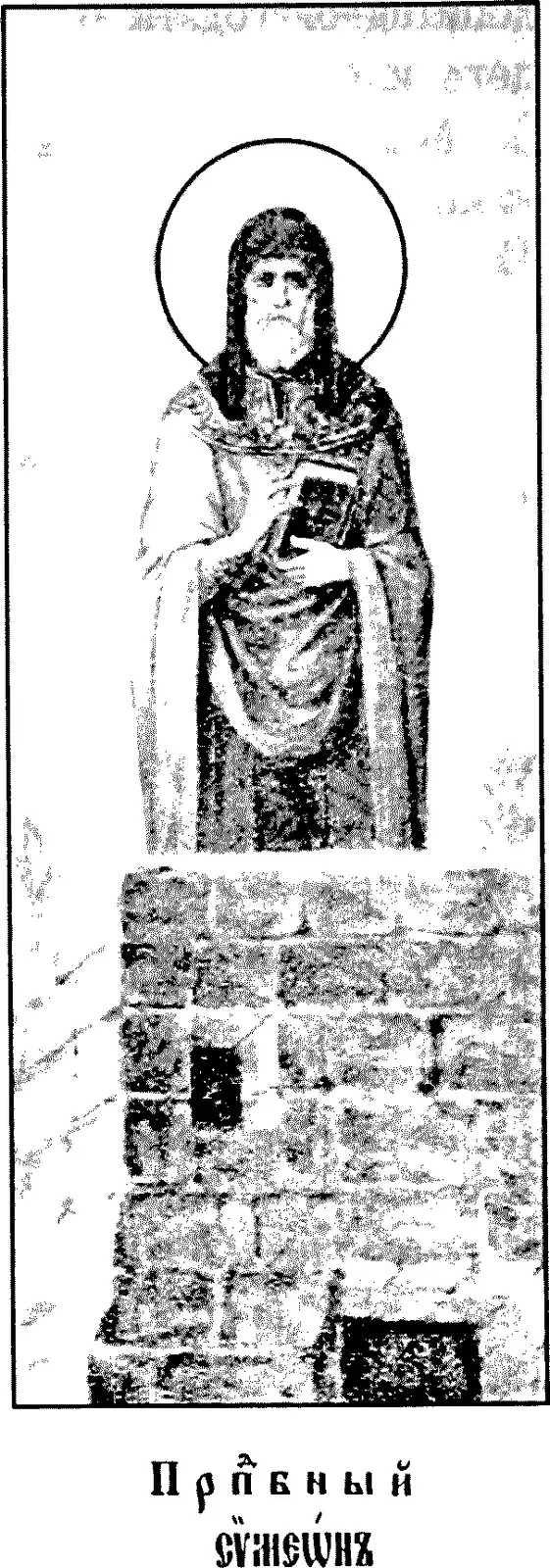
- Also called
- Simeon of the Wondrous Mountain, or of the Admirable Mountain; "Simeon of Mount Thaumastus" 568
- Born
- At Antioch; in 521, says the Catholic Encyclopedia 1; in 512, says Butler 5; about 517, says Catholic.net 7
Saint Simeon Stylites the Younger was a boy from Antioch who was living on top of a pillar before he had lost his first teeth, and who stayed on one pillar or another for sixty-eight years. 14 He ended his days on a mountainside near Antioch called, from his miracles, the Hill of Wonders, a priest by then, whose disciples climbed a ladder to receive Communion from his hands. 1 The Roman Martyrology keeps his memory on May 24. 8
Two Simeons on two pillars
Two saints called Simeon are remembered for living on pillars near Antioch, and they are easily confused. The first, Simeon Stylites the Elder, went up his column in 423 and died in 459. 2 The second was born more than fifty years after the first had died, at Antioch by the Catholic Encyclopedia's account, and he died near the same city. 157 Like his namesake, the encyclopedia says, he seems to have been drawn very young to a life of austerity. 1 The Roman Martyrology keeps the Younger apart by place and by day, remembering him on the Wondrous Mountain in Syria on May 24. 8
A child on a column
His father was a native of Edessa; his mother, Martha, was later venerated as a saint herself, and a life of her survives. 1 Catholic.net adds that his father died in an earthquake when the boy was five. 7 The sources do not agree on when he was born: 521 by the encyclopedia, 512 by Butler, and about 517 by Catholic.net. 157
Still a boy, he attached himself to a community of ascetics gathered around another pillar hermit, John, who acted as their spiritual director. 1 Evagrius, who knew Simeon, tells how it began. 5 The child was out playing on the slopes of the mountain when he met a panther, threw his belt around its neck and led it back to the monastery. His teacher, up on his own column, asked what he had there. He said it was a cat. 4 Judging from this how far the boy would go, John took him up onto the column. 4 Butler tells the same story with a young leopard and a rope, and has the hermit then order the boy to build a pillar of his own. 5
The detail that dates his start comes from Simeon himself. In a letter to Thomas, the guardian of the true cross in Jerusalem, preserved in the life of his mother, he says he was living on a pillar when he lost his first teeth. 1 Evagrius makes the same point in nearly the same words: "he even cast his teeth in that situation." 4 For eight years, until John died, Simeon lived close enough to his master's column for the two to talk, and the older man kept his austerities in check. 1
The Wondrous Mountain
After John's death no one restrained him. 17 Evagrius says he lived on the branches of a shrub that grew on the mountain, "the place of food and drink" being supplied in that way; Catholic.net speaks of fruit and vegetables. 47 He moved to new pillars several times. On the first of these moves, during the short time he spent on the ground, the Patriarch of Antioch and the Bishop of Seleucia ordained him deacon. 1
The place he made famous is named differently in every source. Butler calls it "Thaumistore, or the Admirable Mountain," in the Syrian desert near Antioch. 5 The encyclopedia says that toward the end of his life he occupied a column on a mountainside near Antioch "called from his miracles the 'Hill of Wonders'," and that he died there. 1 Catholic.net tells the move in more detail: he withdrew at about twenty to the top of a rock on a mountain that came to be called the Mount of Wonders, and some ten years later, after a vision, founded a monastery for his disciples and had a new column raised, to which two bishops solemnly led him. 7
He was later ordained priest, at thirty-three according to Catholic.net, which says the bishop climbed up to lay hands on him. 17 From then on he could offer Mass, which the encyclopedia says he did in memory of his mother; his disciples climbed the ladder one after another to receive Communion. 1
What Evagrius saw
Evagrius Scholasticus, a Syrian who lived many years at Antioch and wrote a history of the Church down to 594, is the nearest witness. 5 He wrote that this Simeon "far surpassed all his contemporaries in virtue." 4 He credits him with casting out demons, healing every kind of disease, and the foresight of future things "as if they were present." 4 Visitors came from almost every part of the earth, he says, "not only Romans but barbarians." 4 Butler adds that he was honored by the emperor Maurice. 5
Some of what Evagrius tells is his own experience. Grieving over the loss of his children, he had begun to wonder why such things did not happen to pagans with large families, and he had told no one; Simeon wrote to him telling him to put such thoughts away, as displeasing to God. 4 When the wife of one of Evagrius's secretaries could not nurse her newborn and the child was in danger, Simeon laid his hand on the husband's right hand and told him to place it on his wife, and the milk came at once. 4 A child left behind at night by fellow travelers was carried to the monastery on a lion's back, and Simeon had the servants go out and bring the child in. 4
Evagrius also says Simeon "both said and did many things" that pointed to Maurice becoming emperor. 3 Catholic.net reports two more predictions: that Justin II would succeed Justinian, and that John Scholasticus would become bishop of Constantinople. 7 The encyclopedia notes that in several cases cures were worked through pictures of him. 1
His writings
Several writings go under his name. The encyclopedia lists a number of small spiritual tracts, an "Apocalypse," letters to the emperors Justinian and Justin II, and liturgical hymns. 1 Catholic.net says the homilies and hymns are attributed to him without sufficient reason. 7 The current Martyrology credits him with various treatises on the ascetic life. 8
One letter had a long afterlife. When Samaritans defaced the images in churches, Butler writes, Simeon wrote to the emperor Justin in defense of the respect due to them, and the letter was quoted by Saint John Damascene and by the Second Council of Nicaea. 5 Damascene's collection of testimonies in defense of images includes a passage under the heading "Simeon of Mount Thaumastus on Images": "With the material picture before our eyes we see the invisible God through the visible representation, and glorify Him as if present." 6 The saints are not fictitious, the passage goes on; "They are in being, and are living with God." 6
His last illness
Evagrius reports the end from close by. When Simeon fell gravely ill, Gregory, the patriarch of Antioch, heard of it from Evagrius himself and hurried to greet him a last time, "but was nevertheless disappointed." 4 Simeon had already told Gregory he would not witness his death. 4 Butler and Catholic.net put it more simply: Gregory set out in haste and Simeon died before he arrived. 57
The year is not agreed. Butler heads his life "A.D. 592," and Catholic.net says he fell ill in May 592. 57 The encyclopedia's article on him gives his death at Antioch as May 24, 597, while Thurston's own article on the stylites says 596. 12 The encyclopedia called the long Life by Nicephorus of Antioch "long and dreary," and said more is learned from the life of his mother and from Evagrius. 1 Catholic.net reports Delehaye's view that the Life is an unusual document to be read with good sense, but that its statements can be checked and are not without historical truth. 7
What is Saint Simeon Stylites the Younger the patron saint of?
Saint Simeon Stylites the Younger's feast day
Saint Simeon Stylites the Younger's feast day is May 24. The current Roman Martyrology, as the Italian bishops print it, remembers him that day on the Wondrous Mountain in Syria as a priest and anchorite who lived on a column in conversation with Christ, wrote treatises on the ascetic life and was given great gifts of grace. 8 Catholic.net keeps the same day. 7 The encyclopedia gives May 24 as the day he died. 1
The older Western date was September 3. The 1897 English Martyrology enters "St. Simeon Stylites, the younger" on that day, and Butler, writing his life for September 3, says he "is honoured by the Greeks on the 24th of May, and by the Latins on the 3rd of September." 59
Praying with Saint Simeon Stylites the Younger
Nobody is asked to copy Simeon. Even the old hermit who first took him up kept the boy's austerities in check while he lived, the encyclopedia says. 1 Catholic.net admits that a reader of his Life may be inclined to take him for a figure of fable, and answers with Delehaye that the document is to be read with good sense and is not without historical truth. 7
What the sources keep returning to is the people at the foot of the pillar. A grieving father who had told no one what he was thinking received a letter telling him to let the thought go. 4 A husband afraid for his newborn child was told what to do, and the child was fed. 4 A child left on the road in the dark was brought in. 4 Evagrius records these things because they happened to him and to people he knew. 4
Simeon was a priest on a pillar, and his disciples came up the ladder to receive Communion from him, one at a time. 1 The passage Damascene preserved under his name argues that a picture lets the faithful see "the invisible God through the visible representation," and that the saints honored in such pictures are "living with God." 6 By Evagrius's account, the people who came to him arrived from almost every part of the earth. 4
Saint Simeon Stylites the Younger, pray for us.
Sources
- 1.Herbert Thurston, "St. Simeon Stylites the Younger," The Catholic Encyclopedia, vol. 13 (New York: Robert Appleton Company, 1912).
- 2.Herbert Thurston, "Stylites (Pillar Saints)," The Catholic Encyclopedia, vol. 14 (New York: Robert Appleton Company, 1912).
- 3.Evagrius Scholasticus, Ecclesiastical History, Book V, chapter 21, "Prodigies Foreshewing the Elevation of Maurice to the Empire," translated by E. Walford (London: Samuel Bagster, 1846).
- 4.Evagrius Scholasticus, Ecclesiastical History, Book VI, chapter 23, "Simeon the Stylite the Younger," translated by E. Walford (London: Samuel Bagster, 1846).
- 5.Alban Butler, "St. Simeon Stylites, the Younger," September 3, in The Lives of the Fathers, Martyrs, and Other Principal Saints, Vol. IX (Dublin: James Duffy, 1866), Internet Archive.
- 6.Saint John Damascene, On Holy Images, "Simeon of Mount Thaumastus on Images," translated by Mary H. Allies (London: Thomas Baker, 1898), Internet Medieval Sourcebook, Fordham University.
- 7."Simeón el Estilita el Joven, Santo," Santoral, May 24, Catholic.net (in Spanish).
- 8.Roman Martyrology, entry for May 24, "San Simeone Stilita il Giovane, sacerdote e anacoreta," Santo del giorno, Conferenza Episcopale Italiana (in Italian).
- 9.The Roman Martyrology, September 3 (Baltimore: John Murphy Company, 1897), Internet Archive.
Saints to turn to next
Others in this collection who are turned to for some of the same things.
- Saint Aelred of Rievaulx1109 - January 12, 1166 (or 1167)PrayerSuffering and illness
- Saint Albert of Trapanic. 1240 - August 7, 1307PrayerSuffering and illness
- Saint Aldegundc. 630 or c. 639 - 684Suffering and illnessPrayer
- Saint Alphonsus Rodriguez1532 or 1533 - October 1617PrayerSuffering and illness