Saint Simeon Stylites the Elder
c. 388 - September 2, 459
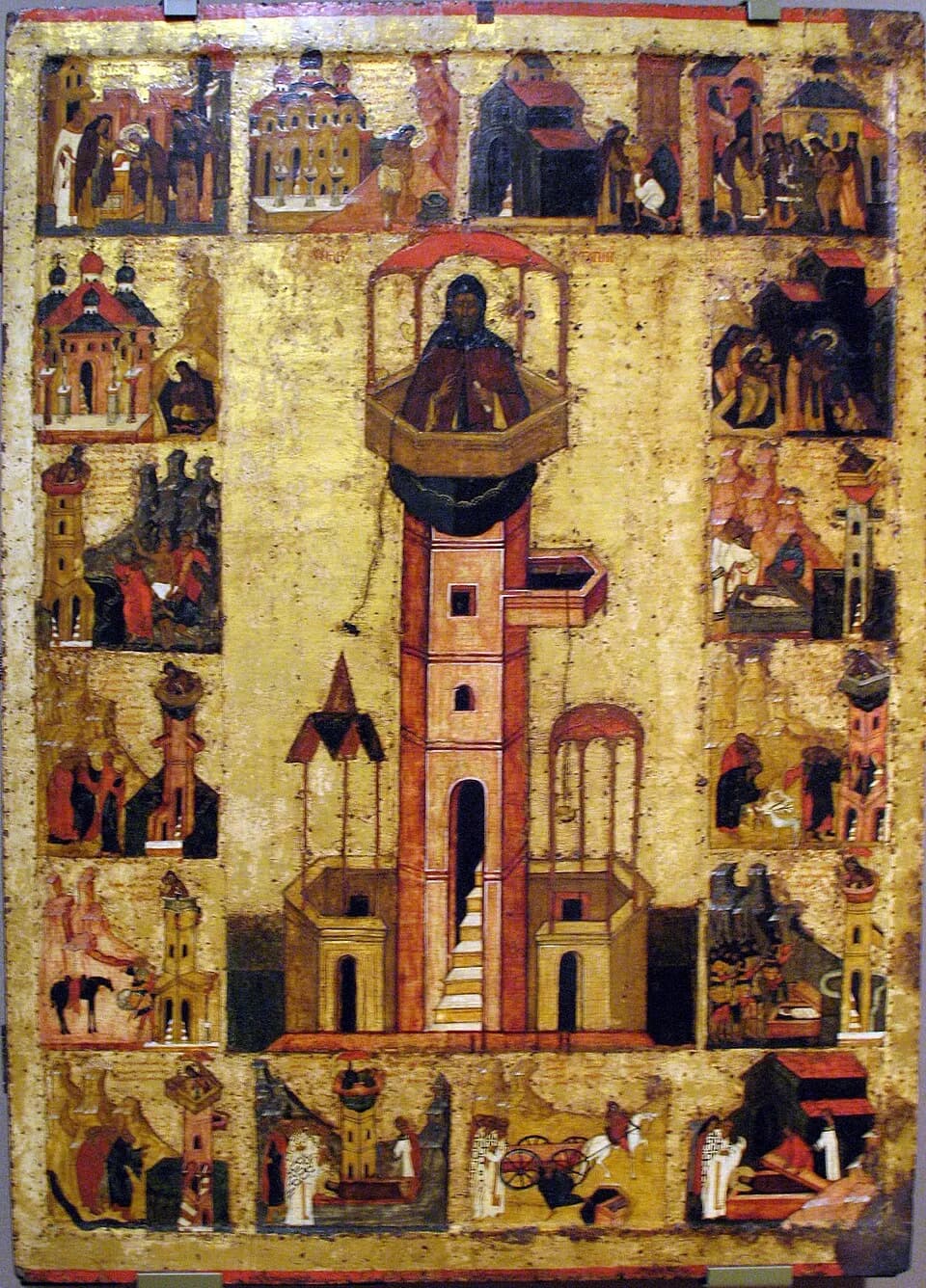
- Born
- About 388, at Sisan, near the northern border of Syria 1
- Died
- Friday, September 2, 459 1
- Shrine
- Qal'at Sim'an, Syria, four basilicas built around the base of his column 1
Saint Simeon Stylites the Elder was a Syrian shepherd who became a monk, then a hermit, and in 423 climbed onto the top of a pillar near Antioch and lived there in the open air until he died in 459. 126 He was the first of the stylites, the pillar hermits of the Christian East, and the Catholic Encyclopedia insists that the evidence for what he did is first-hand and reliable. 1 The Roman Martyrology keeps his memory on July 27. 6
A shepherd who was asked to leave the monastery
Simeon was born about 388 at Sisan, near the northern border of Syria. 1 CNEWA's profile, which places his birth in "Silicia on the Syrian border," says his parents were poor shepherds and that he had no schooling; he spent his boyhood with the flocks and at the Sunday liturgy. 4 It tells one story from those years. He asked an old neighbor to explain the beatitudes, and was told that prayer, fasting and patience in suffering were sure ways of showing love for God, and that a shepherd's lonely life suited them. The boy took to fasting and to long nights of prayer. 4
He entered a monastery young, before he was sixteen by the encyclopedia and at fifteen by CNEWA. 14 It did not go well. From the first, the encyclopedia says, he practiced "an austerity so extreme and to all appearance so extravagant" that his brethren judged him, "perhaps not unwisely," unsuited to any kind of community life, and he was forced to go. 1 CNEWA fills in the picture: the abbot, worried for his health, rebuked him for penances nobody had authorized and which set him apart from everyone else, and as fast as one was forbidden Simeon thought of another, until his body was covered with sores and he was asked to leave. 4
From a hut to a hilltop
He shut himself up for three years in a hut at a place the encyclopedia calls Tell-Neschin. There, for the first time, he passed the whole of Lent without eating or drinking, which became his practice every year afterward, and he added to it the habit of standing upright for as long as his legs would hold him. 1 CNEWA records that one Easter a young priest named Daniel brought him Communion and urged him to keep in touch with the world, where he could do much good. 4
After the hut he moved to "a rocky eminence in the desert" and confined himself to a space "less than twenty yards in diameter." 1 The plan failed in an unexpected way. Pilgrims found him. Crowds came into the desert asking for his advice and his prayers, and left him too little time for his own devotions. 1
The pillar
His answer was to go up. Simeon had a pillar built with a small platform on top and resolved to live on it until he died. 1 The encyclopedia's article on the stylites dates this to 423, and so does CNEWA, which adds that his disciples helped him build. 24 The first pillar was "little more than nine feet high." It was replaced by taller ones, and the last, the encyclopedia says, was "apparently over fifty feet from the ground"; CNEWA makes it eighty feet. 14
The platform probably had some kind of railing, but it was open to the sky, and Simeon never allowed himself a cabin or shelter. 1 CNEWA says he had only a rough woolen monk's habit, with a small sheepskin in winter, that he lived on water and dried beans, and that he prayed for hours at a time with his arms stretched out. 4 In his first years on the column there was a stake he tied himself to, so as to stay upright through the Lenten fast. Later he did without it. 1
The encyclopedia is aware of how this sounds. If the information did not rest on "very reliable first-hand evidence," it writes, one would be inclined to put much of it down to fable, "but no modern critic now ventures to dispute the reality of the feats of endurance attributed to these ascetics." 1 The chief witness is Theodoret, who was his contemporary; there is also a biography by a disciple named Antonius and a Syriac account. 1
Not cut off from anyone
The pillar did not remove him from people. A ladder could be set against the side, and visitors climbed it. He taught disciples, he spoke to the crowds gathered below, and he wrote letters, some of which survive. 1 CNEWA sums up the rest of his life as "blessing and preaching to all who came to him." 4
Those who came included the powerful. The emperor Theodosius and the empress Eudocia revered him and listened to his advice, and the emperor Leo paid respectful attention to a letter Simeon wrote him in support of the Council of Chalcedon. 1 Once, when Simeon was ill, Theodosius sent three bishops to beg him to come down and let doctors treat him. He preferred to leave his cure to God, and before long he recovered. 1
His fame traveled much farther than Syria. The encyclopedia says it spread through Europe and that Rome in particular was remarkable for the number of pictures of him to be seen there. 1 John Paul II, speaking in Damascus in 2001, called him "that matchless saint of your country" and said of him: "His prayer was ceaseless and his charity universal, as he welcomed all who came to him from near and far, the greatest and the least." 3
Death, relics and Qal'at Sim'an
Simeon died on Friday, September 2, 459, after thirty-six years on his pillar by the encyclopedia's count and thirty-seven by CNEWA's. 14 Antioch and Constantinople both wanted his body. Antioch was preferred, and most of his relics stayed there "as a protection to the unwalled city." 1
A vast church complex was raised where he had lived, known as Qal'at Sim'an, which the encyclopedia translates as "the mansion of Simeon." Four basilicas open out from an octagonal court toward the four points of the compass, and in the middle of the court stands the base of his column. 1 The ruins were still standing when the encyclopedia was written in 1912. 1
He also left imitators. Daniel the Stylite, a disciple, set up near Constantinople soon after Simeon died; a second Simeon, called the Younger, lived on a pillar near Antioch and died in 596; and the practice lasted in the East into the twelfth century and in Russia until 1461. 2 Attempts to bring it west, the encyclopedia notes, "met with little favour." 2
What is Saint Simeon Stylites the Elder the patron saint of?
Saint Simeon Stylites the Elder's feast day
The Roman Martyrology lists him on July 27, in an entry that places him near Antioch in Syria and describes a monk who lived for many years on a column and so took the name Stylite. 6 Vatican News presents him on the same day. 5 An older Western date was January 5: CNEWA's 1976 profile ends, "His feast is celebrated January 5th." 4 The day of his death, September 2, is given by the encyclopedia as a date and not as a feast. 1
Praying with Saint Simeon Stylites the Elder
Simeon is not a saint anyone is asked to copy, and the sources do not pretend otherwise. His own monastery sent him away, and the encyclopedia thinks the monks may have been right. 1 CNEWA closes by calling his self-discipline "a puzzle to many and an example to a few." 4
What the sources do offer is a reason. The encyclopedia calls the stylites "the climax of a tendency" toward extreme fasting and restraint in the Eastern churches of that age, and suggests that such lives did, "in an age of terrible corruption and social decadence, impress the need of penance more than anything else could have done." 2 John Paul II quoted the Life written by Simeon's disciples to the same effect: "By the sufferings of his servant, God wished to rouse the world from its deep slumber." 3
The detail that stays with a reader is the ladder. He climbed a pillar because the crowds left him no time to pray, and then he let the crowds climb up after him. 1 He answered letters, settled questions, and wrote to an emperor about a council. 1 The Pope's phrase for him was "a living icon of holiness," and the holiness he described was a matter of ceaseless prayer and of welcoming whoever came. 3
Saint Simeon Stylites the Elder, pray for us.
Sources
- 1.Herbert Thurston, "St. Simeon Stylites the Elder," The Catholic Encyclopedia, vol. 13 (New York: Robert Appleton Company, 1912).
- 2.Herbert Thurston, "Stylites (Pillar Saints)," The Catholic Encyclopedia, vol. 14 (New York: Robert Appleton Company, 1912).
- 3.John Paul II, Address at the meeting with clergy, religious and laity of the Orthodox and Catholic Churches of Syria, Syrian Orthodox Cathedral, Damascus, May 6, 2001.
- 4.Dick Malin, "Saint of the East: St. Simeon Stylites," ONE Magazine, Catholic Near East Welfare Association, Fall 1976.
- 5."St. Simeon Stylites," Saint of the Day, 27 July, Vatican News.
- 6."San Simeone, monaco," Santo del giorno, 27 luglio, from the Roman Martyrology, Conferenza Episcopale Italiana (in Italian).
Saints to turn to next
Others in this collection who are turned to for some of the same things.
- Saint Aelred of Rievaulx1109 - January 12, 1166 (or 1167)PrayerSuffering and illness
- Saint Alphonsus Rodriguez1532 or 1533 - October 1617PrayerSuffering and illness
- Saint André BessetteAugust 9, 1845 - January 6, 1937PrayerSuffering and illness
- Saint Bernadette SoubirousJanuary 7, 1844 - April 16, 1879PrayerSuffering and illness