Saints Protus and Hyacinth
Martyred c. 257-259
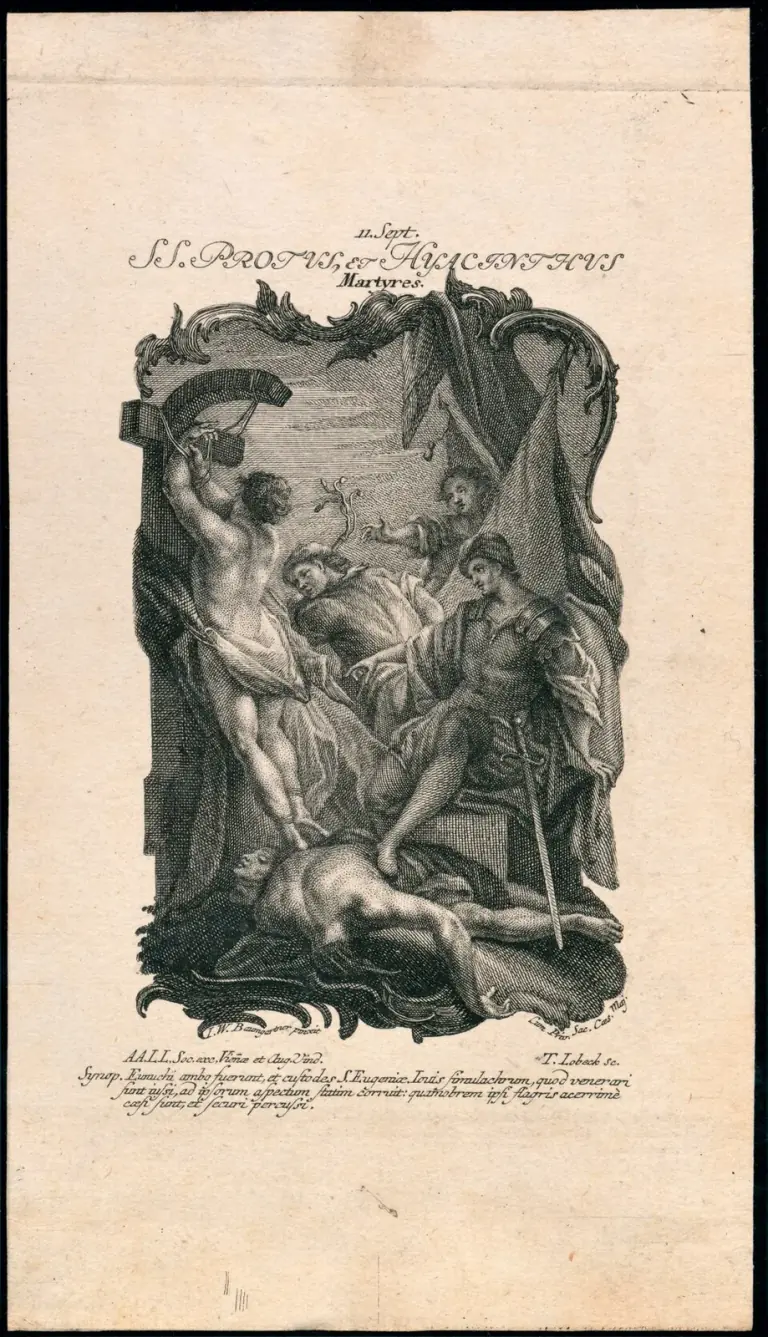
Saints Protus and Hyacinth were martyrs of Rome, buried side by side in the cemetery of Basilla on the old Via Salaria, and their names are on the oldest list of Roman martyrs that survives, the Depositio Martyrum of 354. 1 In 1845 Hyacinth's grave was found sealed and untouched, with ashes and burned bones inside, and a marble slab giving the day of his burial: September 11. 1 That is still their feast. 4
What the oldest records say
Very little is known about the two men, and the sources say so. 13 What is certain is a date and a place. The Depositio Martyrum, part of a Roman almanac compiled in 354, lists the anniversary of Protus and Hyacinth on September 11, and it places their graves in the cemetery of Basilla on the Via Salaria. 1 The early pilgrim itineraries name the same place. 1
Butler adds the liturgical witnesses that follow. They are in the sacramentary of Saint Gregory, in the ancient martyrology published by Fronto, and in the martyrologies of Bede, Usuard and Wandelbert. 2 For katolsk.no, these early and independent witnesses are why their martyrdom itself can be called beyond doubt. 3
When they died is less clear. The Catholic Encyclopedia places them in the persecution of Valerian, between 257 and 259. 1 katolsk.no thinks it more likely they were killed about 305, under Diocletian, and notes that the older date comes from their legend and from the Roman Martyrology. 3
The legend of Eugenia
A later story fills the gap. The Acts of Saint Eugenia, a martyr kept on December 25, make Protus and Hyacinth brothers, eunuchs and servants of Eugenia, the Christian daughter of a prefect of Egypt, who came with her to Rome and died there with her and with a woman named Basilla. 23 Butler reports the story with "They are said," and points out that the Acts put the martyrdom under Valerian in 257 while the Liberian calendar dates Basilla's death to 304, under Diocletian. 2 katolsk.no calls the version in the Golden Legend historically doubtful. 3
The pre-conciliar Roman Martyrology followed the legend: under the emperor Gallienus, it said, the two brothers were found to be Christians, ordered to sacrifice, and when they refused were cruelly beaten and then beheaded. 3
Pope Damasus and the hidden tomb
By the fourth century the tomb had been buried. Pope Damasus, Butler writes, "in 366, removed the earth which hid the tomb of these two martyrs from the view of the faithful," and a priest named Theodorus built a church over it; Pope Symmachus later gave it silver plate and vessels. 2
Damasus also wrote them an epitaph, part of which still exists. 1 It calls them brothers: "Germani fratres animis ingentibus ambo," brothers both, of great spirit, and it adds that one won the palm first and the other the crown. 3 Butler reads it to mean "that Hyacinthus sustained the first conflict, but that Protus obtained his crown before him." 2 katolsk.no suggests that Damasus may have concluded they were brothers simply because they lay so close together. 3
The grave found in 1845
In 1845 the Jesuit Giuseppe Marchi, excavating the cemetery of Basilla, came on a crypt with an undisturbed grave. 13 It was a small square niche closed by a marble slab, and inside lay ashes and pieces of burned bone wrapped in the remains of costly cloth. 1 The slab carried the original inscription: "D P III IDUS SEPTEBR / YACINTHUS / MARTYR," buried on September 11, Hyacinth, martyr. 1
The Catholic Encyclopedia draws the conclusion plainly: "Evidently the saint had been burnt; most probably both martyrs had suffered death by fire." 1 katolsk.no is more cautious: he was probably, though not certainly, burned alive, or his body was burned after he was executed. 3
In the same chamber were fragments of a later architrave reading "SEPULCRUM PROTI M," the grave of the martyr Protus. 1 That grave was empty. 3 So both men had been buried in the same crypt, and only one of them was still there. 1
Where the relics went
The accounts of the relics do not agree. The Catholic Encyclopedia says that when Leo IV (847-855) moved the bones of many martyrs into the churches of Rome, only the grave of Protus could be found, probably because the chamber had been devastated, and his bones went to San Salvatore on the Palatine. 1 katolsk.no places that San Salvatore in Trastevere. 3
Butler and katolsk.no both report that Pope Clement VIII in 1592 moved the relics of the two saints into the city, to San Giovanni dei Fiorentini, and that an eyewitness, Sarazanius, described the translation in his notes on the poems of Damasus. 23 Butler also records that a large part of their relics went in 829 to the Benedictine abbey of Mulinheim, later Seligenstadt, and part about 972 to the church of Saint Vincent at Metz. 2
Hyacinth's remains, recovered in 1845, were placed in 1849 in the chapel of the Propaganda in Rome. 13 The tombs and a stairway built at the end of the fourth century were later found and restored. 1
What are Saints Protus and Hyacinth the patron saints of?
Saints Protus and Hyacinth's feast day
The feast day of Saints Protus and Hyacinth is September 11. It is the day of the Depositio Martyrum of 354 and the day cut into Hyacinth's gravestone. 12 katolsk.no notes that the 1969 revision of the calendar took their feast off the Church's universal calendar and left it to local calendars. 3
They remain in the Roman Martyrology on September 11. Its entry, as the Italian bishops print it, records their burial in the cemetery of Basilla on the old Via Salaria and the verses Pope Damasus wrote for them when he uncovered their tombs; the Latin text adds that some fifteen centuries later Hyacinth's grave was found intact, with his body consumed by fire. 34
Praying with Saints Protus and Hyacinth
Almost nothing is known about these two men except that they died for Christ and that the Church of Rome never forgot the day. 13 Their names were read out at their tomb in the fourth century, and they are read in the Martyrology now. 24
Their story is mostly what other people did for them. A pope dug their tomb out of the earth and wrote them a verse; a priest built a church over it; fifteen centuries later a Jesuit found one of them still lying where he had been laid. 12 Devotion here looks like care for the dead, kept up over a very long time by people who knew no more about them than we do.
The burned bones in the niche are the hardest fact on the page. 1 They are also the one thing the legends never told, and it came to light only when someone went down and looked.
Saints Protus and Hyacinth, pray for us.
Sources
- 1.Johann Peter Kirsch, "Sts. Protus and Hyacinth," The Catholic Encyclopedia, Vol. 12 (New York: Robert Appleton Company, 1911).
- 2.Alban Butler, "SS. Protus and Hyacinthus, Martyrs," September 11, in The Lives of the Fathers, Martyrs, and Other Principal Saints, Vol. IX (Derby: Richardson and Son, 1842).
- 3.Per Einar Odden, "De hellige Protus og Hyacint av Roma," Den katolske kirke (katolsk.no), Oslo Catholic Diocese (in Norwegian).
- 4.Roman Martyrology, entries for September 11, Santo del giorno, Conferenza Episcopale Italiana (in Italian).
Saints to turn to next
Others in this collection who are turned to for some of the same things.