Saints Priscilla and Aquila
First century
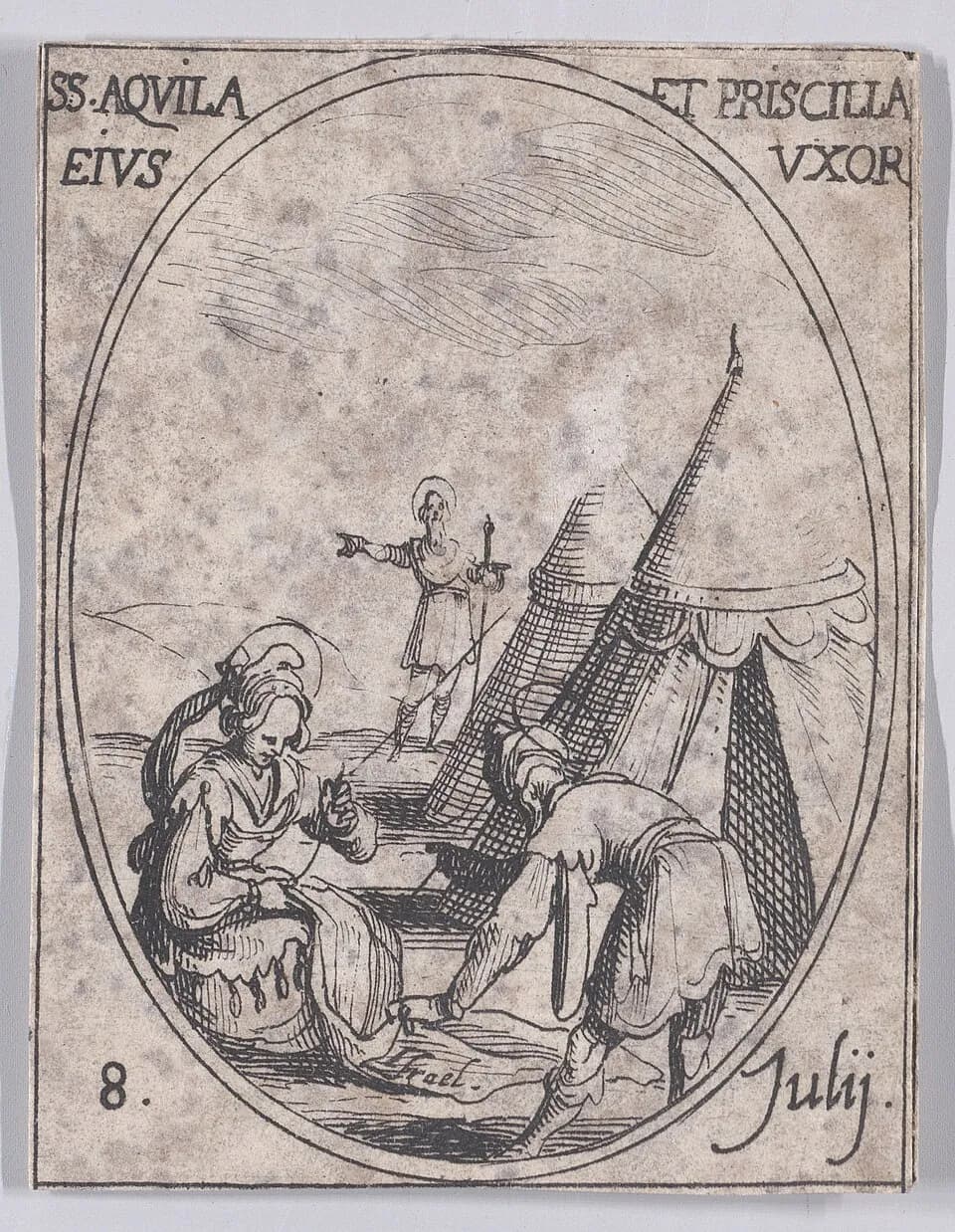
- Origins
- Aquila was a native of Pontus, on the Black Sea; Priscilla was "probably a Jewish woman from Rome" 15
- Died
- "Nothing is known of their deaths" 3
Saints Priscilla and Aquila were a married couple, Jewish tentmakers driven out of Rome by the emperor Claudius, who took Saint Paul into their home and their workshop at Corinth. 25 They followed him to Ephesus, taught the preacher Apollos, kept a church in their house in more than one city, and at some point "risked their necks" for Paul's life. 156 The Roman Martyrology remembers them on July 8. 2
A Jewish couple expelled from Rome
Benedict XVI gave the whole of his general audience of February 7, 2007, to this couple, and began with their names. "The names Aquila and Priscilla are Latin, but the man and woman who bear them were of Hebrew origin." 1 Acts says that Aquila was "a native of Pontus," the region of northern Anatolia that faces the Black Sea. 15 About his wife the text gives no birthplace. Benedict thought she "was probably a Jewish woman from Rome," and the Vatican News account has Aquila emigrate to Rome and meet her there. 13
They left Rome because they had to. Paul, arriving in Corinth, "met a Jew named Aquila, a native of Pontus, who had recently come from Italy with his wife Priscilla because Claudius had ordered all the Jews to leave Rome." 5 The 1907 Catholic Encyclopedia dates the expulsion to 49 or 50, and Vatican News to 49. 23 Benedict quoted the Roman historian Suetonius on the reason: the Jews of the city "were rioting due to someone named Chrestus." 1 The historian, the pope remarked, had the name wrong and only a confused idea of what had happened, but behind it lay arguments within the Jewish community over whether Jesus was the Christ. 1
Were they already Christians when they reached Corinth? The encyclopedia will not say: "The time of their conversion to the Faith is not known." 2 Benedict reasoned from the expulsion that they "had already embraced the Christian faith in the 40s," and the note to Acts in the New American Bible agrees that both "may already have been Christians at the time of their arrival in Corinth." 15 Vatican News says they converted together in Rome. 3 Catholic Culture's short summary for the day leans the other way and suggests Paul "was probably instrumental in their conversion." 4
Tentmakers at Corinth
Luke explains the friendship in one practical sentence. Paul went to see them "and, because he practiced the same trade, stayed with them and worked, for they were tentmakers by trade." 5 Benedict glossed the craft as "making tents or large draperies for domestic use" and placed the meeting at the beginning of the 50s. 1
So the first thing the New Testament records about them is a shared bench and a spare room. Paul settled in Corinth for a year and a half, arguing in the synagogue every sabbath and then turning to the Gentiles. 5 When he finally sailed for Syria he did not go alone: he left "together with Priscilla and Aquila." 5
Ephesus, and the teaching of Apollos
The ship put in at Ephesus, and there Paul "left them" while he went on. 5 In his absence a visitor arrived, a Jew named Apollos from Alexandria, "an eloquent speaker" and "an authority on the scriptures," who taught accurately about Jesus "although he knew only the baptism of John." 5 He began to speak boldly in the synagogue, "but when Priscilla and Aquila heard him, they took him aside and explained to him the Way (of God) more accurately." 5
It is a striking scene. Two craftspeople correct a learned and gifted preacher, and they do it privately. Benedict said they had "a decisive role in completing the Christian formation" of Apollos, and Vatican News adds a remark of its own: "Their catechetical instruction was made credible by their love for one another." 13 Apollos went on to Achaia, where Acts says he "gave great assistance" to the believers. 5
Paul came back to Ephesus on his next journey. The encyclopedia says the couple "entertained the Apostle Paul at Ephesus for three years," while Vatican News says he lived there for two. 23
The church in their house
From Ephesus Paul wrote his First Letter to the Corinthians, and with his own greeting, Benedict notes, he sent those of "Aquila and Prisca, together with the church in their house." 1 For the pope this was the most important thing the couple did: they opened their home to the local Christians "when they gathered to listen to the Word of God and to celebrate the Eucharist." 1 There were no church buildings yet. In houses like theirs, he said, "we can see the very birth of the reality of the Church in the homes of believers." 1
They did the same in Rome once they were able to return. Writing to the Romans, Paul asks his readers to greet the couple and then to "greet also the church at their house." 6 The New American Bible's note observes that such house assemblies "might consist of only one or two dozen Christians each." 6 Vatican News calls their home "a domestic church," a point of reference for the communities of Corinth, Ephesus and Rome. 3
They risked their necks
The greeting in Romans is the fullest thing Paul ever wrote about them. "Greet Prisca and Aquila, my co-workers in Christ Jesus, who risked their necks for my life, to whom not only I am grateful but also all the churches of the Gentiles." 6 Benedict's response was unguarded: "What extraordinary praise for these two married persons in these words!" 1
Paul does not say what they did or when. Benedict thought the danger was "probably linked to interventions in his favour during some prison stay, perhaps in the same Ephesus." 1 He allowed that the thanks of "all the churches of the Gentiles" might be a little hyperbolic, and still took it as a measure of how far their influence reached. 1
Prisca is simply the shorter form of her name; the encyclopedia heads its article "Aquila and Priscilla" and adds "(Or Prisca.)" 2 She is named before her husband in the greeting in Romans, in the last greeting of the Second Letter to Timothy, and twice in Acts. 567 The encyclopedia says plainly that "it is not known why Scripture several times names Priscilla before Aquila." 2
What became of them
The sources trace their later movements differently. According to the encyclopedia they left Ephesus for Rome "probably after the riot stirred up by the silversmith Demetrius," then "soon left that city, probably on account of the persecution of Nero, and settled again at Ephesus." 2 Its evidence for the last move is a single line near the end of 2 Timothy: "Greet Prisca and Aquila and the family of Onesiphorus." 27 Vatican News says only that they went back to Rome "after the expulsion order against the Jews was lifted," and it ends there: "Nothing is known of their deaths." 3
In Rome the name is remembered on the Aventine, where a church is dedicated to Saint Prisca, and in the Catacombs of Priscilla on the Via Salaria. 1 Benedict mentioned both with care. "Later hagiographic tradition has given a very singular importance to Priscilla, even if the problem of identifying her with the martyr Priscilla remains." 1
What are Saints Priscilla and Aquila the patron saints of?
None of the sources consulted for this page names Priscilla and Aquila as patrons of anything. The Catholic Encyclopedia, Benedict XVI, Vatican News and Catholic Culture all describe their lives and none states a patronage, so this page does not supply one. 1234
What the Church does say is close to it without being the same thing. Benedict ended his catechesis by honoring them "as models of conjugal life responsibly committed to the service of the entire Christian community," and Vatican News heads the last part of its account "Witnesses to conjugal love rooted in the Gospel." 13
Saints Priscilla and Aquila's feast day
The feast of Saints Priscilla and Aquila is July 8. "The Roman Martyrology commemorates them on 8 July," says the 1907 Catholic Encyclopedia, and Vatican News lists "Sts. Aquila and Priscilla, disciples of st. Paul" on the same day. 23
They are not on the general calendar that every parish follows. Catholic Culture's page for July 8 shows an ordinary weekday and lists "Sts. Priscilla & Aquila (RM)" among the other commemorations, the letters standing for the Roman Martyrology. 4 The etching on this page, made by Jacques Callot for a book of the saints of the year, carries the same date under the picture.
Praying with Saints Priscilla and Aquila
Scripture never shows one of them without the other. Six times they are named and six times as a pair, working, traveling, teaching and hosting together. 1567 Benedict drew the plainest lesson from that: when Christian spouses are sustained by faith, "their courageous commitment for the Church and in the Church becomes natural." 1
Their holiness also had an address. They were not apostles and nobody ordained them to anything that the texts record; they had a trade, a table and a house where the church could meet. 56 "Every home can transform itself in a little church," Benedict said, meaning that the whole of a family's life "is called to revolve around the singular lordship of Jesus Christ." 1
The pope was direct about what the Church owes to people like them. Christianity, he said, "has reached our generation" thanks to "the faith and apostolic commitment of the lay faithful, of families, of spouses like Priscilla and Aquila." 1 The apostles announced the Gospel. Households gave it somewhere to take root.
Then there is the part nobody can fill in. They risked their lives for a friend, and Paul thought it enough to say so in a line without telling the story. 6 Nothing is known of how they died. 3 What remains is a pair of names in a list of greetings, and the thanks Paul recorded from all the churches of the Gentiles. 6
Saints Priscilla and Aquila, pray for us.
Sources
- 1.Benedict XVI, General Audience, "Priscilla and Aquila," 7 February 2007 (Libreria Editrice Vaticana).
- 2.Anthony Maas, "Aquila and Priscilla," The Catholic Encyclopedia, Vol. 1 (New York: Robert Appleton Company, 1907).
- 3."Sts. Aquila and Priscilla, disciples of st. Paul," Saint of the Day, 08 July, Vatican News (Dicastery for Communication).
- 4.Liturgical Year calendar, July 8, 2026, "Other Commemorations: Bl. Peter Vigne, Priest (RM); Sts. Priscilla & Aquila (RM)," Catholic Culture (Trinity Communications).
- 5.Acts of the Apostles, chapter 18, with notes, New American Bible, Revised Edition (United States Conference of Catholic Bishops).
- 6.Letter to the Romans, chapter 16, with notes, New American Bible, Revised Edition (United States Conference of Catholic Bishops).
- 7.Second Letter to Timothy, chapter 4, with notes, New American Bible, Revised Edition (United States Conference of Catholic Bishops).
Saints to turn to next
Others in this collection who are turned to for some of the same things.
- Saint Adelaide931 - December 16, 999Marriage and familyCourageWork and vocation
- Saint Gianna Beretta MollaOctober 4, 1922 - April 28, 1962Marriage and familyWork and vocationCourage
- Saint Andrew Kim TaegonAugust 21, 1821 - September 16, 1846CourageWork and vocation
- Saint Ansgar801 - February 865CourageWork and vocation