Saint Peter Regalado
1390 - March 30, 1456
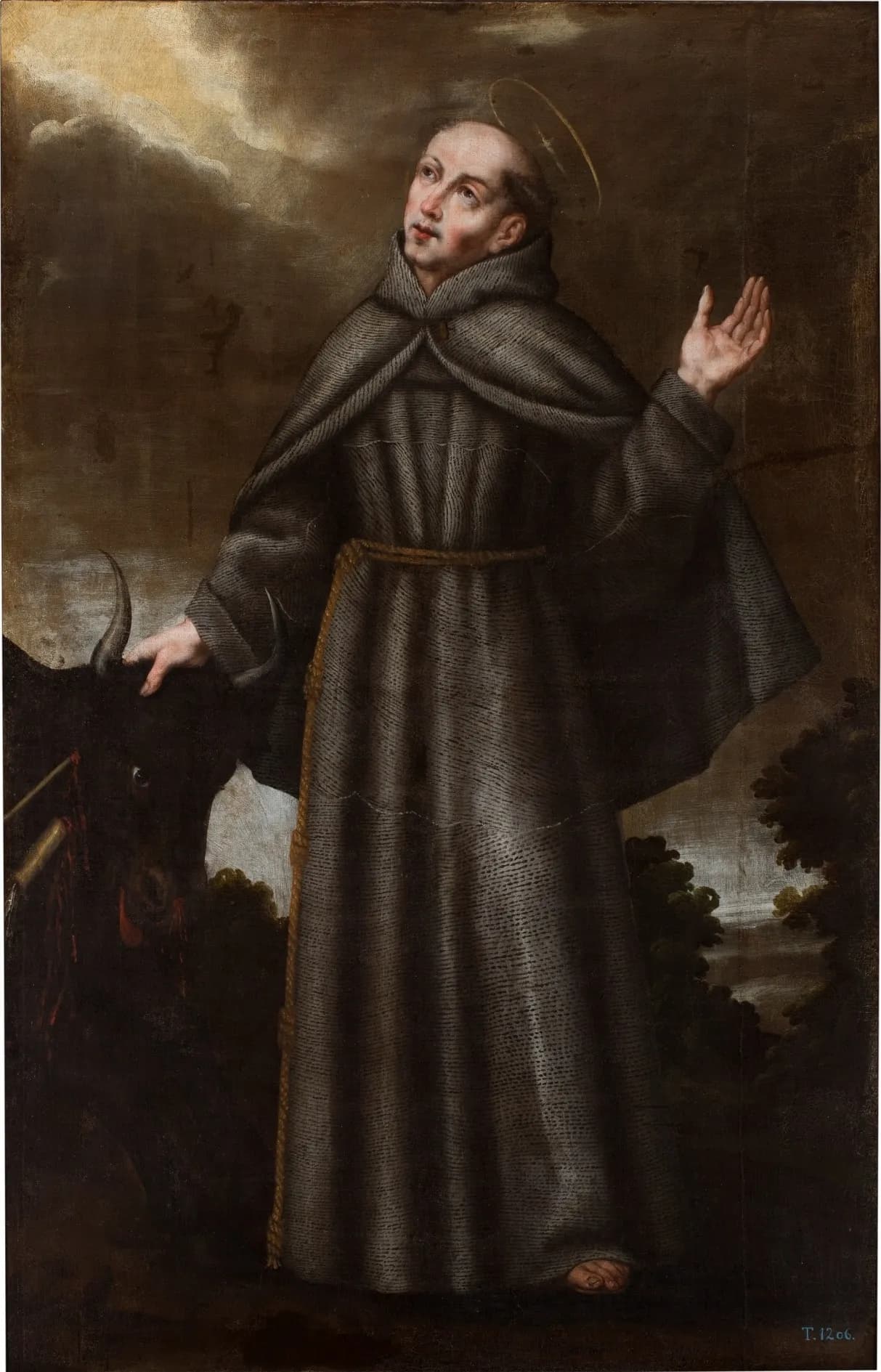
Saint Peter Regalado was a Franciscan friar from Valladolid who spent most of his life in two tiny, remote friaries in Castile, where the brothers prayed for twelve hours a day and were forbidden to keep provisions. 13 He died at La Aguilera in 1456, Isabella the Catholic came to stand at his tomb, and in 1746 he was canonized. 13 Valladolid, the city of his birth, keeps him as its patron. 5
A boy at the friary door
He was born at Valladolid in 1390, to parents the Catholic Encyclopedia describes as noble, wealthy and virtuous. 1 His father died when he was young and his mother raised him. 1 At the age of ten, Heckmann writes, he begged to be admitted to the Franciscans, and three years later the friars of his native town took him in. 1 Catholic.net and Franciscan Media both have him entering at thirteen, and Franciscan Media specifies that it was the Conventual branch of the order. 34 Valladolid was then the seat of the royal court. 3
It was a poor moment for religious life. Catholic.net describes communities weakened by the Great Western Schism and by the Black Death, which had left monasteries filling their empty places with numbers rather than vocations. 3 Franciscan Media adds the Hundred Years' War and, near the end of his life, the fall of Constantinople. 4
The reform of Villacreces
In 1404 he became one of the first followers of Pedro de Villacreces, who in 1397 had brought the Observant reform of the Franciscans into Spain. 1 Catholic.net describes Villacreces as an old, spare man, a former teacher at Salamanca, who had obtained the bishop of Osma's permission to found a house in the hill country of Burgos, at La Aguilera. 3 At fifteen Peter became his inseparable companion. 3 In the new house he found what the encyclopedia calls "the life of solitude, prayer, and eminent poverty, which had always been the greatest object of his desire." 1
The rule of the reformed houses was severe. Catholic.net lists twelve hours of prayer a day, spread across the day and the night; work in the fields to help the farmers and earn alms; an absolute ban on storing provisions; bare cells; near-continuous silence; and no money taken for Masses. 3 The Martyrology remembers him for building two small houses in which only twelve friars at a time could live in solitude. 2 Catholic.net says the reform spread through further foundations, which became known as "the seven of renown." 3
Within the house he did everything. Over eleven years, Catholic.net says, he passed through all the jobs a poor friary has: almoner, sacristan, cook, and the brother who gave alms to the poor at the door. 3 When Villacreces founded a second house at El Abrojo, near Valladolid, Peter became its novice master, and he preached in the villages around with a simplicity that brought many conversions. 3
Superior and reformer
The sources date his leadership differently. In the encyclopedia he became superior of La Aguilera in 1415 and, when Villacreces died in 1422, of El Abrojo as well. 1 Catholic.net says that in 1422 the friars of both houses elected him their vicar. 3 Franciscan Media says that in 1442 he was appointed head of all the Spanish Franciscans of his reform group. 4
Franciscan Media describes a superior who led by example, with "a special love of the poor and the sick," and passes on accounts that the bread he gave to the hungry never ran out. 4 It also notes that he did not rage at the failings of his brothers. He helped those who were struggling to return to the life they had vowed instead. 4
Penance, prayer and a flight by night
His penances were famous. The encyclopedia says he kept nine Lents, fasting on bread and water, and Franciscan Media that he lived on bread and water all his life. 14 Catholic.net names three loves at the center of his prayer: the Eucharist, the Virgin Mary and the Passion. 3 It is told, Catholic.net says, that on more than one night he could be seen on a hill near La Aguilera walking the Way of the Cross with a rope around his neck, a heavy wooden cross on his shoulders and a crown of thorns on his head. 3
One story was recorded in the canonization process and gave painters his image. Early on the morning of the Annunciation, March 25, he was singing Matins at El Abrojo and longing to honor Mary at La Aguilera, a house he had dedicated to her. Angels, the story goes, carried him through the air the eighty kilometers between the two friaries and brought him back again. 3 The encyclopedia records that he was credited with the gifts of miracles and prophecy, and that artists show him "with flames bursting from his heart." 1
Death and the tomb at La Aguilera
He died at La Aguilera on March 30, 1456. 12 Franciscan Media says his tomb became a place of pilgrimage. 4 Catholic.net tells of Isabella the Catholic visiting the friary in the summer of 1493 and saying to the ladies with her, in its words translated here, "Tread softly, for beneath these stones rest the bones of a saint." 3 Cardinal Cisneros, it adds, had been there before her, toward the end of the saint's life, and the emperor Charles V, Don Juan of Austria and Philip II came after. 3
The encyclopedia says his body was exhumed thirty-six years after his death at Isabella's request, found incorrupt, and placed in a richer tomb. 1 Innocent XI beatified him on March 11, 1684, and Benedict XIV canonized him on June 29, 1746. 1
What is Saint Peter Regalado the patron saint of?
Saint Peter Regalado's feast day
Saint Peter Regalado's feast day is March 30, the day he died. The current Roman Martyrology enters him on that date, and Franciscan Media and Catholic.net's calendar keep him on it. 234 Valladolid keeps a second date. In 1911 the Catholic Encyclopedia gave his feast as May 13, "the day of the translation of his body," and the city still celebrates its patron then: a diocesan bulletin published by the archdiocese in 2025 lists May 13 as the feast of the patron of Valladolid. 15
Praying with Saint Peter Regalado
Most of what is remembered about him is small. He spent eleven years as almoner, sacristan, cook and doorkeeper before anyone put him in charge of anything. 3 The houses he helped build were made deliberately too small to grow, so that twelve men could live there in solitude. 2 Even the flight with the angels is a story about a friar who wanted to keep a feast of Mary in the other house. 3
The severity is real and it would be dishonest to soften it. Bread and water, nine Lents, the rope and the crown of thorns on the hill at night. 13 What the sources put beside it is the bread that did not run out for the hungry and a superior who corrected his brothers without anger. 4 The rule kept nothing in store, and the brothers worked in the fields alongside the farmers. 3
He was born in a city that was then the seat of the royal court, and he spent his life in two small friaries that were forbidden to store provisions. 3 Valladolid still keeps him as its patron and still celebrates him every May, which means that each year a city honors the man who left it for a cell. 5
Saint Peter Regalado, pray for us.
Sources
- 1.Ferdinand Heckmann, "St. Peter de Regalado," The Catholic Encyclopedia, Vol. 11 (New York: Robert Appleton Company, 1911).
- 2.Roman Martyrology, entry for March 30, "San Pietro Regalado da Valladolid, sacerdote," as printed in "Santo del giorno," Conferenza Episcopale Italiana (in Italian).
- 3."Pedro Regalado, Santo," Catholic.net, credited to the Archdiocese of Madrid (in Spanish).
- 4."Saint Peter Regalado," Saint of the Day, Franciscan Media.
- 5.Comisión Diocesana de Valladolid, Boletín Informativo no. 66, May 2025, published by the Archdiocese of Valladolid (in Spanish).
Saints to turn to next
Others in this collection who are turned to for some of the same things.
- Saint Agnes of Bohemiac. 1200-1205 - March 1281 or 1282Poverty and simplicityPrayer
- Saint Aidan of Lindisfarnec. 590 - August 31, 651Poverty and simplicityPrayer
- Saint Alexius of RomeFifth century, by traditionPoverty and simplicityPrayer
- Saint André BessetteAugust 9, 1845 - January 6, 1937PrayerPoverty and simplicity