Saint Paul of the Cross
January 3, 1694 - October 18, 1775
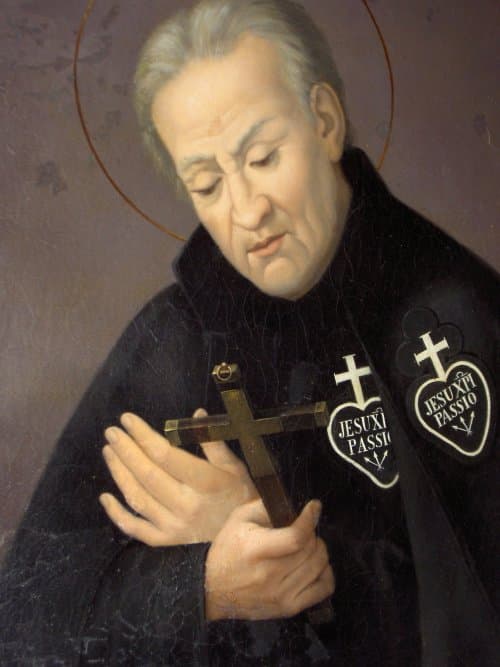
- Feast day
- October 20 in the United States, October 19 on the General Roman Calendar 1
- Born
- Paul Francis Danei, at Ovada near Genoa, January 3, 1694 1
- Founded
- The Passionists, who take a fourth vow to keep the memory of the Passion 2
- Kept
- Of a whole inheritance from his priest uncle, only the breviary 1
- Prayed
- For fifty years for the conversion of England, and left the devotion to his order 1
- Died
- Rome, October 18, 1775, "worn out as much by his austerities as by old age" 1
Saint Paul of the Cross was offered a good marriage and a priest uncle's estate, and took neither - "He kept for himself only the priest's Breviary." 1 He spent his life on a single idea: that the Passion of Christ is not primarily a horror to be contemplated but, as Franciscan Media puts it, "a demonstration of God's love for all people." 2 The order he founded takes a fourth vow to keep that memory alive. 2 He was elected its superior general against his wishes and held the office until he died. 1
What he turned down
Devine begins with a formation rather than an event: "From his earliest years the crucifix was his book, and the Crucified his model." 1 He was taught by a priest who kept a school for boys at Cremolino, went to daily Mass, and spent his free time reading and in church. 1 He left school at fifteen and went home, "and from this time his life was full of trials." 1
Franciscan Media supplies a detail Devine leaves out entirely: "After a brief time as a soldier, he turned to solitary prayer." 2
Then the refusals. "In early manhood he renounced the offer of an honourable marriage; also a good inheritance left him by an uncle who was a priest. He kept for himself only the priest's Breviary." 1 Out of a whole estate he took the one thing he would use every day for the rest of his life.
The founding began with an act of vesting rather than an institution. The Bishop of Alessandria, his director, put him in a black tunic bearing the emblem of the Passion, and "barefooted, and bareheaded, he retired to a narrow cell where he drew up the Rules of the new congregation according to the plan made known to him in a vision, which he relates in the introduction to the original copy of the Rules." 1 Devine points to the document rather than vouching for the vision - the account is Paul's own, written into the Rules he was drafting.
A fourth vow
Franciscan Media explains what the order was for, and why the emphasis was needed then. Paul "lived at a time when many regarded Jesus as a great moral teacher but no more." 2 Against that, he put the Passion - not as an argument, but as evidence of love.
The consequence was practical. "In 1720, Paul founded the Congregation of the Passion, whose members combined devotion to Christ's passion with preaching to the poor, and rigorous penances. Known as the Passionists, they add a fourth vow to the traditional three of poverty, chastity, and obedience, to spread the memory of Christ's passion among the faithful." 2 Most orders take three vows. His take a fourth, and it is a vow to remember something and make sure other people do.
Franciscan Media also records what that produced in him, which was not severity toward others: "In turn that devotion nurtured his compassion and supported a preaching ministry that touched the hearts of many listeners. He was known as one of the most popular preachers of his day, both for his words and for his generous acts of mercy." 2
Superior general, against his wishes
The first general chapter met on Mount Argentaro on April 10, 1747. "At this chapter, St. Paul, against his wishes, was unanimously elected first superior general, which office he held until the day of his death." 1 Franciscan Media: he spent "the remainder of his life in Rome." 2
Devine quotes Pius IX's brief for the beatification on what that office did not stop him doing: "Although continually occupied with the cares of governing his religious society, and of founding everywhere new houses for it, yet he never left off preaching the word of God, burning as he did with a wondrous desire for the salvation of souls." 1
He kept the austerities to the end, and the article is blunt about the arithmetic: he "never, even to his last hour, remitted anything of his austere manner of life, finally succumbing to a severe illness, worn out as much by his austerities as by old age." 1 The penances helped kill him, and his own encyclopedia says so.
He did not do it alone. Chief among his companions was "John Baptist, his younger brother and constant companion from childhood, who shared all his labours and sufferings and equaled him in the practice of virtue." 1
And one long private intention: "For fifty years he prayed for the conversion of England, and left the devotion as a legacy to his sons." 1 Fifty years on a thing that did not happen in his lifetime, bequeathed to the people who came after him.
What is Saint Paul of the Cross the patron saint of?
Neither source cited here gives him a patronage. 12 Devine ends with the spread of devotion to him wherever Passionists are established, and Franciscan Media with his letters; neither names a cause he is invoked for, and this page does not supply one.
What survives of him in his own words is substantial. "Over 2,000 of his letters and several of his short writings have survived." 2
Saint Paul of the Cross's feast day
The feast of Saint Paul of the Cross is October 20 in the United States, and October 19 on the General Roman Calendar. Both are current; they differ because October 19 in the American dioceses is the memorial of the North American Martyrs, John de Brébeuf and Isaac Jogues and their companions, and he moves to the day after.
The 1911 encyclopedia gives a third date, and then corrects itself. The article says "His feast occurs on 28 April", and a note added by New Advent's editors follows: "It was later transferred to 19 October." 1 April 28 was his day before the reform.
He died on October 18. 1 None of the three feast dates is the day of his death, and neither source explains why.
Praying with Saint Paul of the Cross
He is the saint for a devotion that has gone cold or grim. The Passion can be preached as an accusation - look what you did - and Franciscan Media is careful to say that is not what he saw in it. He "saw in the Lord's passion a demonstration of God's love for all people", and the result in him was compassion and a reputation for mercy rather than severity toward anyone but himself. 2
The severity toward himself is real and his own encyclopedia does not present it as a model. He died "worn out as much by his austerities as by old age", having refused to relax anything even in his last hour. 1 That is stated as a fact about him rather than as a recommendation, and it is worth reading that way.
The detail to keep is the breviary. He was left an estate by a priest uncle and took one book out of it. 1 Not a gesture made in front of anybody - just the quiet arithmetic of a man who had worked out what he was going to need.
And fifty years of praying for England. 1 It did not happen while he was alive, he knew it would not, and he handed the intention on. Most of what anybody prays for is like that, and he is a good saint for it.
Saint Paul of the Cross, pray for us.
Sources
Saints to turn to next
Others in this collection who are turned to for some of the same things.
- Saint Charles de FoucauldSeptember 15, 1858 - December 1, 1916PrayerPoverty and simplicitySuffering and illness
- Saint Louis de MontfortJanuary 31, 1673 - April 28, 1716PrayerPoverty and simplicitySuffering and illness
- Saint Teresa of CalcuttaAugust 26, 1910 - September 5, 1997Poverty and simplicitySuffering and illnessPrayer
- Saint Alphonsus Rodriguez1532 or 1533 - October 1617PrayerSuffering and illness